Viguerie Alex, Lorenzo Guillermo, Auricchio Ferdinando, Baroli Davide, Hughes Thomas J R, Patton Alessia, Reali Alessandro, Yankeelov Thomas E, Veneziani Alessandro
Dipartimento di Ingegneria Civile ed Architettura, Università di Pavia, Via Ferrata 3, Pavia, PV 27100, Italy.
Oden Institute for Computational Engineering and Sciences, The University of Texas at Austin, 201 E. 24th Street, Austin, TX 78712-1229, USA.
Appl Math Lett. 2021 Jan;111:106617. doi: 10.1016/j.aml.2020.106617. Epub 2020 Jul 15.
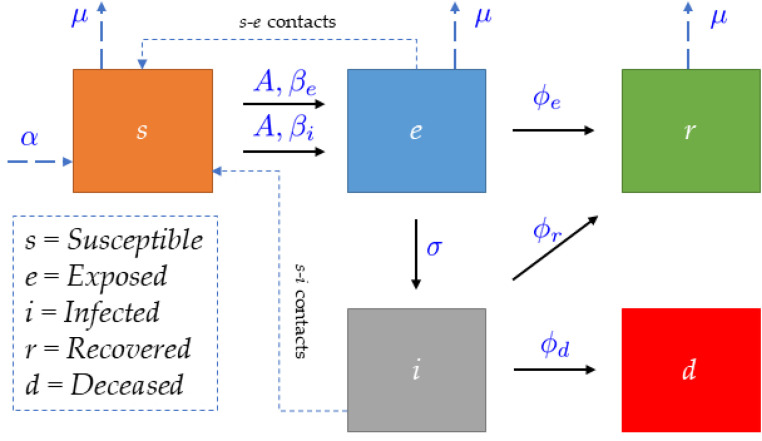
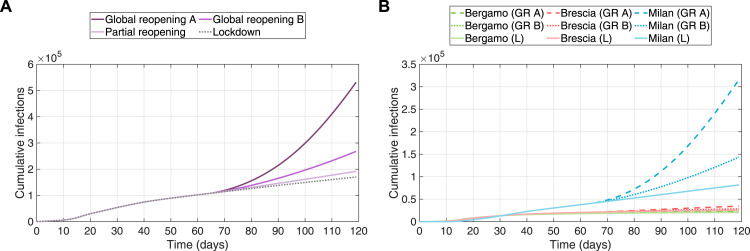
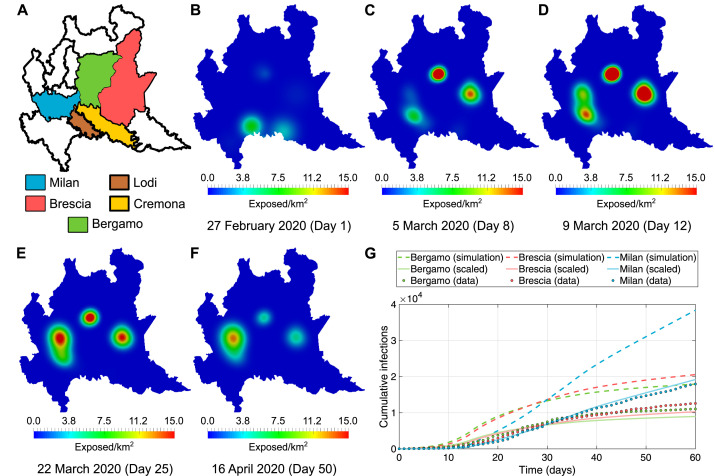
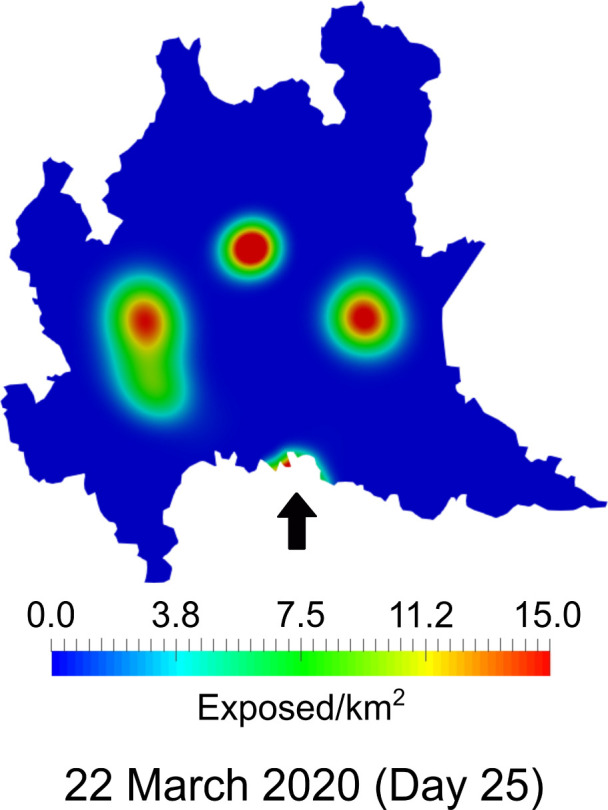
We present an early version of a Susceptible-Exposed-Infected-Recovered-Deceased (SEIRD) mathematical model based on partial differential equations coupled with a heterogeneous diffusion model. The model describes the spatio-temporal spread of the COVID-19 pandemic, and aims to capture dynamics also based on human habits and geographical features. To test the model, we compare the outputs generated by a finite-element solver with measured data over the Italian region of Lombardy, which has been heavily impacted by this crisis between February and April 2020. Our results show a strong qualitative agreement between the simulated forecast of the spatio-temporal COVID-19 spread in Lombardy and epidemiological data collected at the municipality level. Additional simulations exploring alternative scenarios for the relaxation of lockdown restrictions suggest that reopening strategies should account for local population densities and the specific dynamics of the contagion. Thus, we argue that data-driven simulations of our model could ultimately inform health authorities to design effective pandemic-arresting measures and anticipate the geographical allocation of crucial medical resources.
我们展示了一个基于偏微分方程并结合异质扩散模型的易感-暴露-感染-康复-死亡(SEIRD)数学模型的早期版本。该模型描述了新冠疫情的时空传播,旨在基于人类习惯和地理特征捕捉动态变化。为了测试该模型,我们将有限元求解器生成的输出与伦巴第大区(意大利)的实测数据进行了比较,该地区在2020年2月至4月期间受到了这场危机的严重影响。我们的结果表明,伦巴第大区新冠疫情时空传播的模拟预测与市级层面收集的流行病学数据之间存在很强的定性一致性。探索放松封锁限制替代方案的额外模拟表明,重新开放策略应考虑当地人口密度和传染的具体动态。因此,我们认为我们模型的数据驱动模拟最终可为卫生当局提供信息,以设计有效的疫情防控措施,并预测关键医疗资源的地理分配。