San Francisco Department of Public Health, San Francisco, California.
Department of Medicine, University of California, San Francisco.
JAMA Netw Open. 2021 Mar 1;4(3):e210490. doi: 10.1001/jamanetworkopen.2021.0490.
Several jurisdictions in the United States have secured hotels to temporarily house people experiencing homelessness who require isolation or quarantine for confirmed or suspected coronavirus disease 2019 (COVID-19). To our knowledge, little is known about how these programs serve this vulnerable population outside the hospital setting.
To assess the safety of a hotel-based isolation and quarantine (I/Q) care system and its association with inpatient hospital capacity.
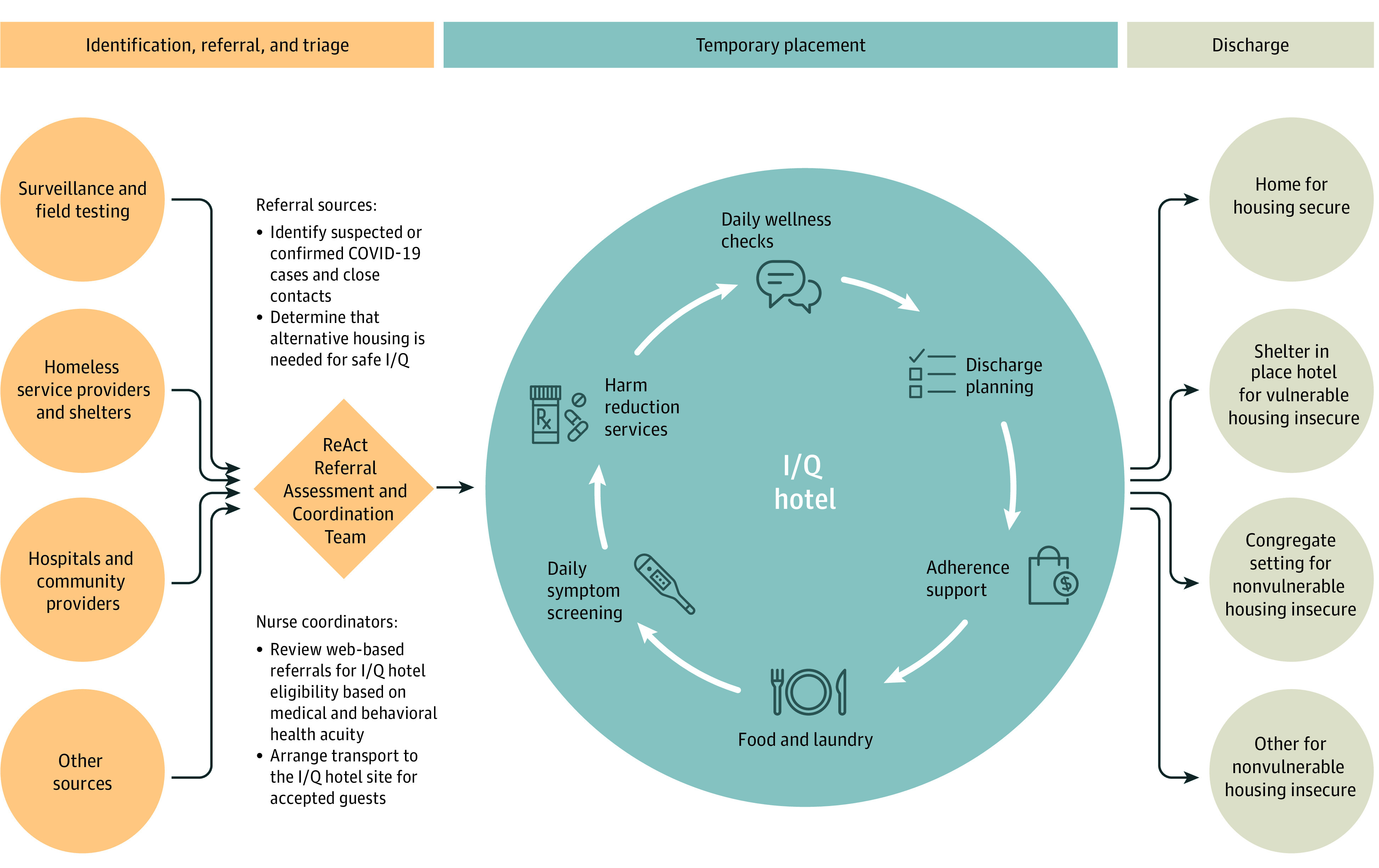
DESIGN, SETTING, AND PARTICIPANTS: This retrospective cohort study of a hotel-based I/Q care system for homeless and unstably housed individuals in San Francisco, California, was conducted from March 19 to May 31, 2020. Individuals unable to safely isolate or quarantine at home with mild to moderate COVID-19, persons under investigation, or close contacts were referred from hospitals, outpatient settings, and public health surveillance to 5 I/Q hotels. Of 1009 I/Q hotel guests, 346 were transferred from a large county public hospital serving patients experiencing homelessness.
A physician-supervised team of nurses and health workers provided around-the-clock support, including symptom monitoring, wellness checks, meals, harm-reduction services, and medications for opioid use disorder.
Characteristics of I/Q hotel guests, program retention, county hospital readmissions, and mean length of stay.
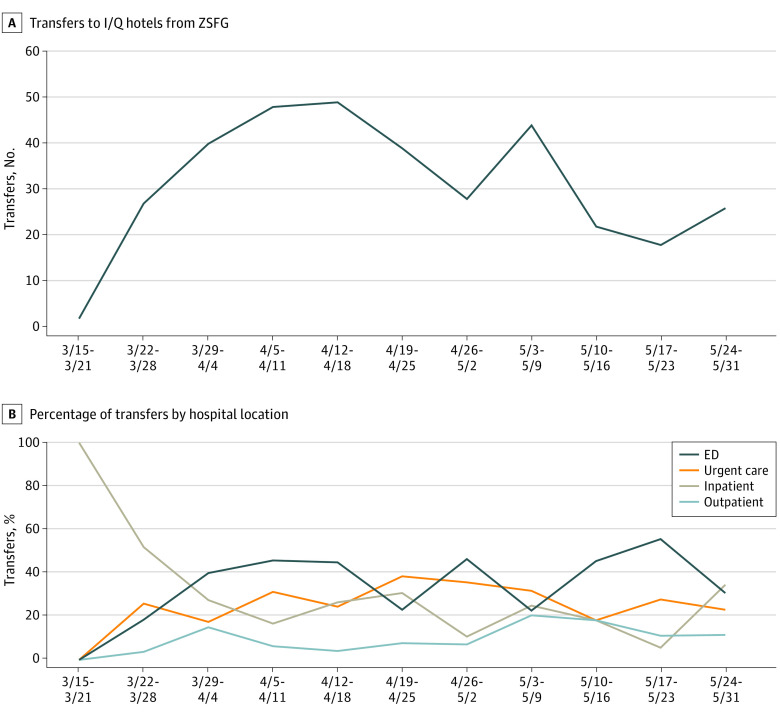
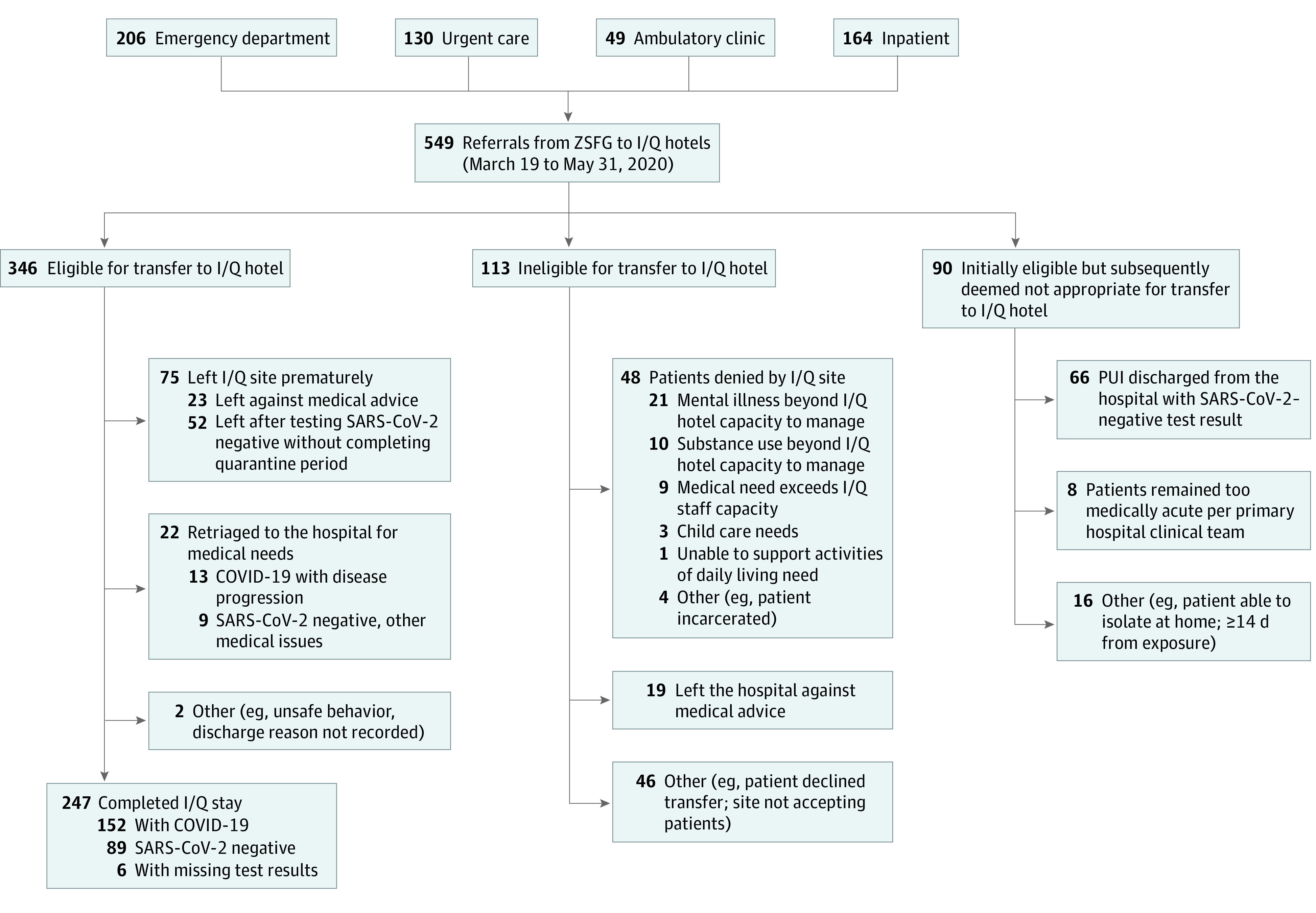
Overall, the 1009 I/Q hotel guests had a median age of 44 years (interquartile range, 33-55 years), 756 (75%) were men, 454 (45%) were Latinx, and 501 (50%) were persons experiencing sheltered (n = 295) or unsheltered (n = 206) homelessness. Overall, 463 (46%) received a diagnosis of COVID-19; 303 of 907 (33%) had comorbid medical disorders, 225 of 907 (25%) had comorbid mental health disorders, and 236 of 907 (26%) had comorbid substance use disorders. A total of 776 of 955 guests (81%) completed their I/Q hotel stay; factors most strongly associated with premature discontinuation were unsheltered homelessness (adjusted odds ratio, 4.5; 95% CI, 2.3-8.6; P < .001) and quarantine status (adjusted odds ratio, 2.6; 95% CI, 1.5-4.6; P = .001). In total, 346 of 549 patients (63%) were transferred from the county hospital; of 113 ineligible referrals, 48 patients (42%) had behavioral health needs exceeding I/Q hotel capabilities. Thirteen of the 346 patients transferred from the county hospital (4%) were readmitted for worsening COVID-19. Overall, direct transfers to I/Q hotels from emergency and outpatient departments were associated with averting many hospital admissions. There was a nonsignificant decrease in the mean hospital length of stay for inpatients with confirmed or suspected COVID-19 from 5.5 to 2.7 days from March to May 2020 (P = .11).
To support persons experiencing homelessness during the COVID-19 pandemic, San Francisco rapidly and safely scaled a hotel-based model of I/Q that was associated with reduced strain on inpatient capacity. Strategies to improve guest retention and address behavioral health needs not met in hotel settings are intervention priorities.
美国的几个司法管辖区已经确保了酒店,以暂时安置那些需要对确诊或疑似 2019 年冠状病毒病(COVID-19)进行隔离或检疫的无家可归者。据我们所知,对于这些在医院环境之外为弱势群体服务的项目,人们知之甚少。
评估基于酒店的隔离和检疫(I/Q)护理系统的安全性及其与住院医院容量的关系。
设计、地点和参与者:这是一项回顾性队列研究,研究了加利福尼亚州旧金山的一个基于酒店的 I/Q 护理系统,该系统针对无家可归和不稳定住房的个人,于 2020 年 3 月 19 日至 5 月 31 日进行。无法在家中安全隔离或检疫的轻度至中度 COVID-19 患者、调查对象或密切接触者,均从医院、门诊和公共卫生监测机构转介至 5 家 I/Q 酒店。在 1009 名 I/Q 酒店客人中,有 346 人从一家为无家可归者服务的大型县公立医院转来。
一个由医生监督的护士和卫生工作者团队提供 24 小时支持,包括症状监测、健康检查、膳食、减少伤害服务和治疗阿片类药物使用障碍的药物。
I/Q 酒店客人的特征、计划保留率、县医院再次入院率和平均住院时间。
总体而言,1009 名 I/Q 酒店客人的中位年龄为 44 岁(四分位距,33-55 岁),756 人(75%)为男性,454 人(45%)为拉丁裔,501 人(50%)为有庇护(n = 295)或无庇护(n = 206)的无家可归者。总体而言,463 人(46%)被诊断患有 COVID-19;907 人中有 303 人(33%)有合并的医疗疾病,907 人中有 225 人(25%)有合并的心理健康障碍,907 人中有 236 人(26%)有合并的物质使用障碍。共有 955 名客人中的 776 人(81%)完成了他们的 I/Q 酒店住宿;与过早中断最相关的因素是无庇护的无家可归(调整后的优势比,4.5;95%置信区间,2.3-8.6;P < .001)和检疫状态(调整后的优势比,2.6;95%置信区间,1.5-4.6;P = .001)。共有 549 名患者中的 346 人(63%)从县医院转来;在 113 名不符合条件的转介患者中,有 48 名患者(42%)的心理健康需求超出了 I/Q 酒店的能力。从县医院转来的 346 名患者中有 13 人(4%)因 COVID-19恶化而再次入院。总体而言,从急诊和门诊直接转至 I/Q 酒店可避免许多住院。从 3 月到 5 月,确诊或疑似 COVID-19 的住院患者的平均住院时间从 5.5 天缩短至 2.7 天(P = .11)。
为了在 COVID-19 大流行期间支持无家可归者,旧金山迅速安全地扩大了基于酒店的 I/Q 模式,这与住院容量的压力减轻有关。提高客人保留率和解决酒店环境中无法满足的行为健康需求是干预的优先事项。