Mohi-Ud-Din Mohammed, Siddiqui Md Nurealam, Rohman Md Motiar, Jagadish S V Krishna, Ahmed Jalal Uddin, Hassan Mohamed M, Hossain Akbar, Islam Tofazzal
Department of Crop Botany, Bangabandhu Sheikh Mujibur Rahman Agricultural University, Gazipur-1706, Bangladesh.
Department of Biochemistry and Molecular Biology, Bangabandhu Sheikh Mujibur Rahman Agricultural University, Gazipur-1706, Bangladesh.
Antioxidants (Basel). 2021 Feb 26;10(3):351. doi: 10.3390/antiox10030351.
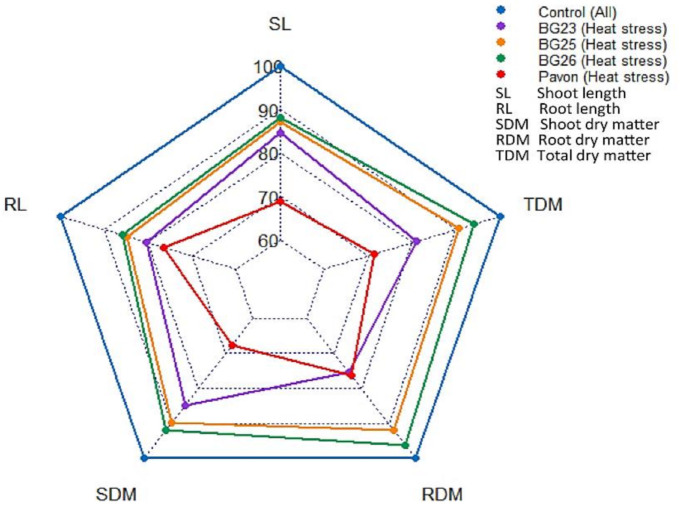
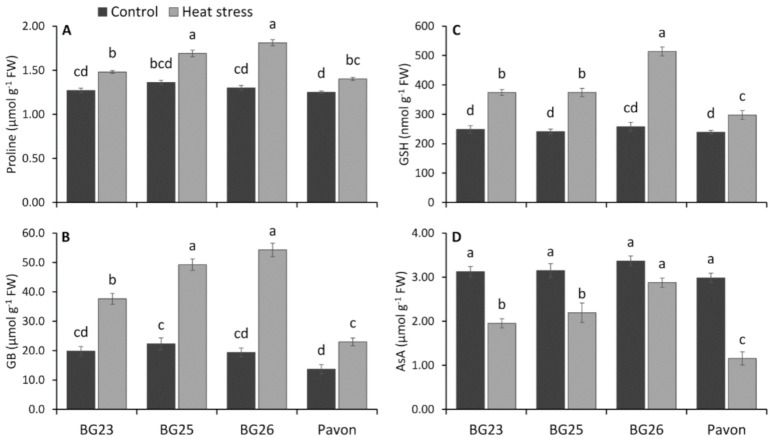
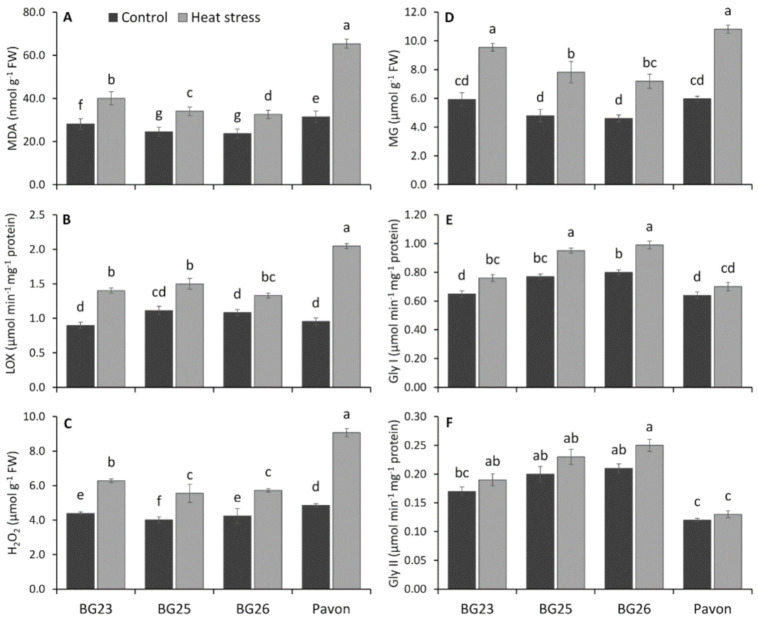
Heat stress alters photosynthetic components and the antioxidant scavenging system, negatively affecting plant growth and development. Plants overcome heat stress damage through an integrated network involving enzymatic and non-enzymatic antioxidants. This study aimed to assess physiological and biochemical responses in contrasting thermo-tolerant wheat varieties exposed to 25 °C (control) and 35 °C (heat stress), during the seedling stage. Our results revealed a substantial decrease in the photosynthetic pigments, carotenoids, anthocyanin content, and increased membrane injury index, malondialdehyde, methylglyoxal (MG), HO contents and lipoxygenase activity compared to non-stress wheat seedlings. The heat-tolerant variety BARI Gom 26 ("BG26") maintained higher cellular homeostasis compared to the heat susceptible variety Pavon 76 ("Pavon"), perpetuated by higher accumulation of proline, glycine betaine, ascorbate-glutathione cycle associated enzymes, reduced glutathione and ascorbate concentration in plant cells. Significantly lower levels of MG detoxification and antioxidant activities and ascorbate-glutathione cycle-related enzymatic activities lead to increased susceptibility in variety "Pavon". Hierarchical clustering and principal component analysis revealed that variety "BG26" possess a combination of biochemical responses tailoring antioxidant activities that induced a higher level of tolerance. Taken together, our results provide a pipeline for establishing a trade-off between antioxidant capacity and heat tolerance to facilitate functional genomics and translational research to unravel underlying mechanisms to better adapt wheat to heat stress.
热胁迫会改变光合组分和抗氧化清除系统,对植物生长发育产生负面影响。植物通过一个涉及酶促和非酶促抗氧化剂的综合网络来克服热胁迫损伤。本研究旨在评估在苗期暴露于25℃(对照)和35℃(热胁迫)下的耐热性不同的小麦品种的生理生化反应。我们的结果显示,与未受胁迫的小麦幼苗相比,光合色素、类胡萝卜素、花青素含量大幅下降,膜损伤指数、丙二醛、甲基乙二醛(MG)、过氧化氢含量以及脂氧合酶活性增加。与热敏感品种Pavon 76(“Pavon”)相比,耐热品种BARI Gom 26(“BG26”)维持了更高的细胞稳态,这是由于脯氨酸、甘氨酸甜菜碱、抗坏血酸 - 谷胱甘肽循环相关酶、还原型谷胱甘肽和抗坏血酸在植物细胞中的积累更高。“Pavon”品种中MG解毒和抗氧化活性以及抗坏血酸 - 谷胱甘肽循环相关酶活性显著较低,导致其易感性增加。层次聚类和主成分分析表明,“BG26”品种具有一系列生化反应,这些反应调节抗氧化活性,从而诱导更高水平的耐受性。综上所述,我们的结果为在抗氧化能力和耐热性之间建立权衡关系提供了一条途径,以促进功能基因组学和转化研究,从而揭示潜在机制,使小麦更好地适应热胁迫。