Institute of Physical Chemistry, Polish Academy of Sciences, 00Kasprzaka 44/52, 01-224 Warsaw, Poland.
Department of Environmental Sciences and Engineering, Gillings School of Global Public Health, University of North Carolina at Chapel Hill, Chapel Hill, North Carolina 27599, United States.
Chem Res Toxicol. 2021 Mar 15;34(3):817-832. doi: 10.1021/acs.chemrestox.0c00409. Epub 2021 Mar 2.
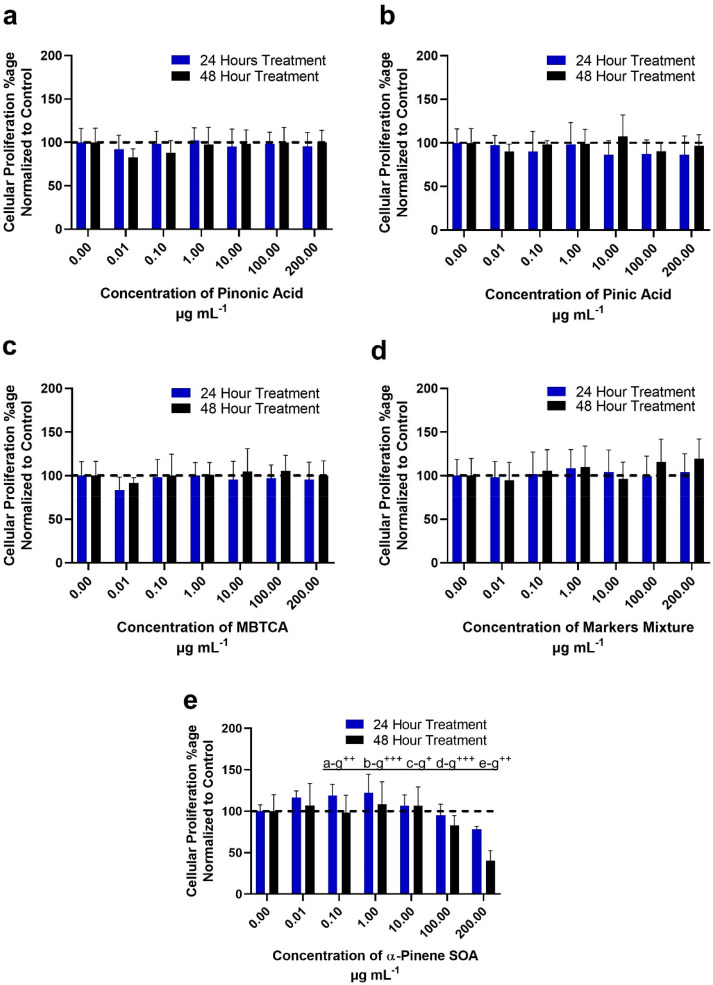
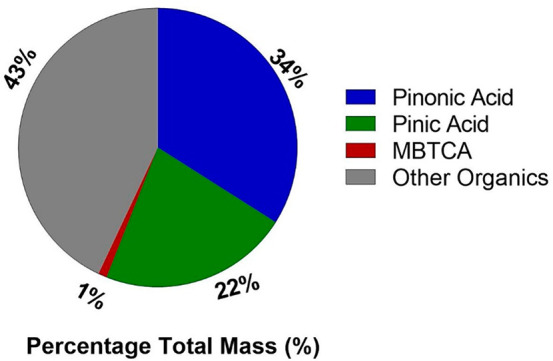
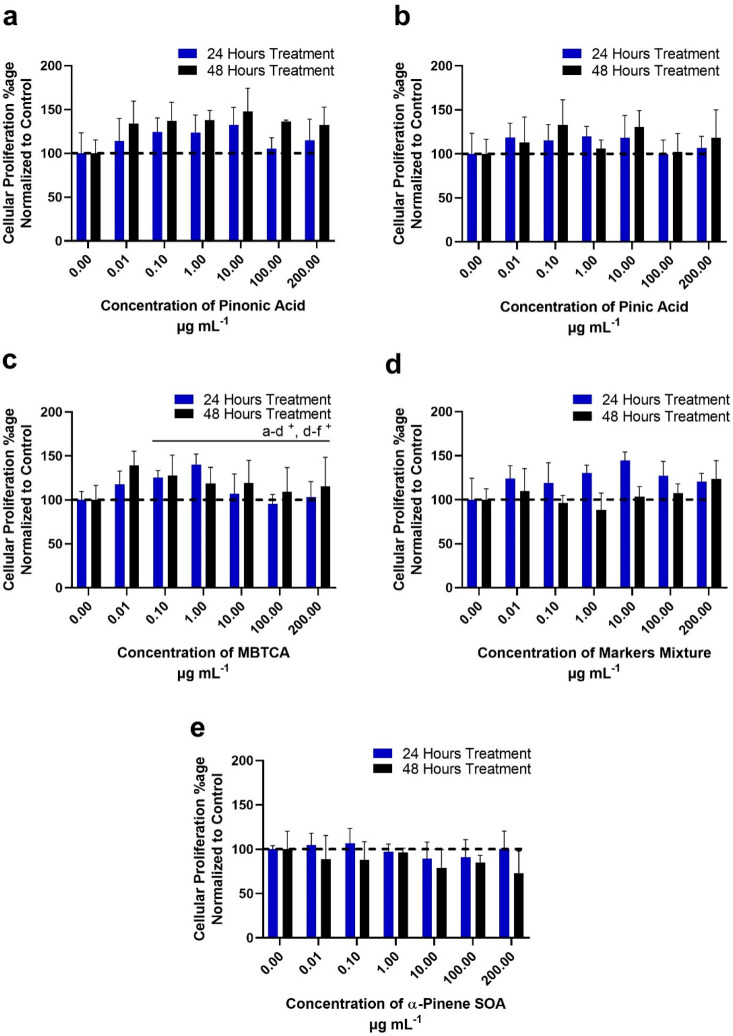
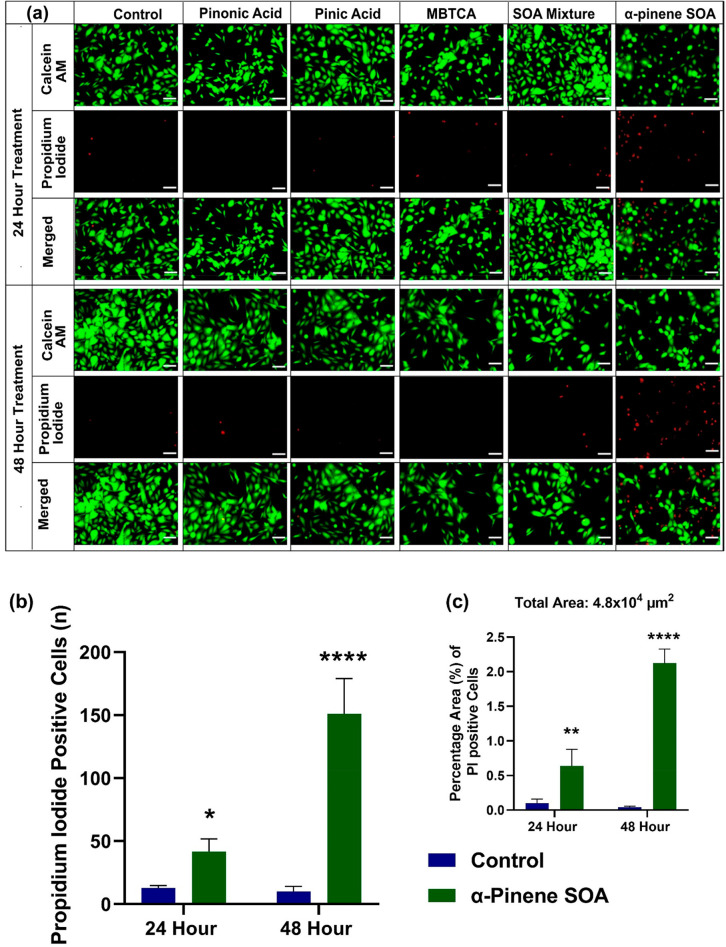
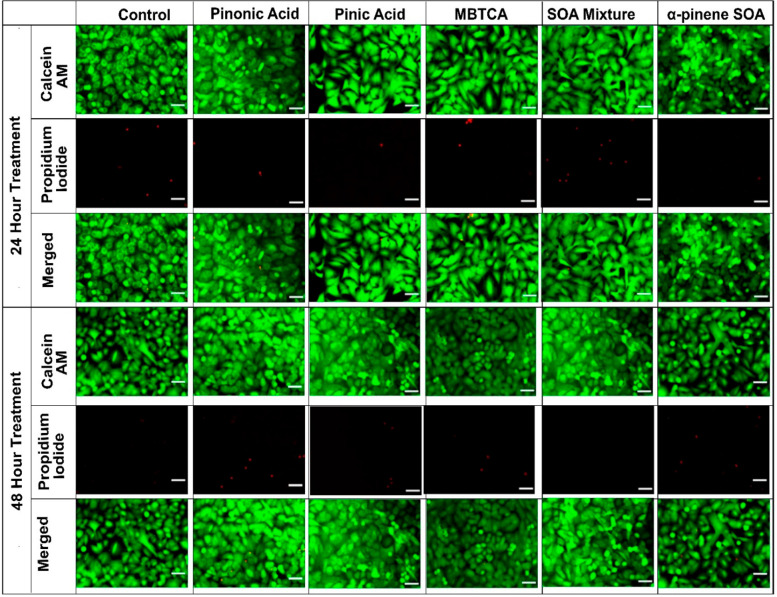
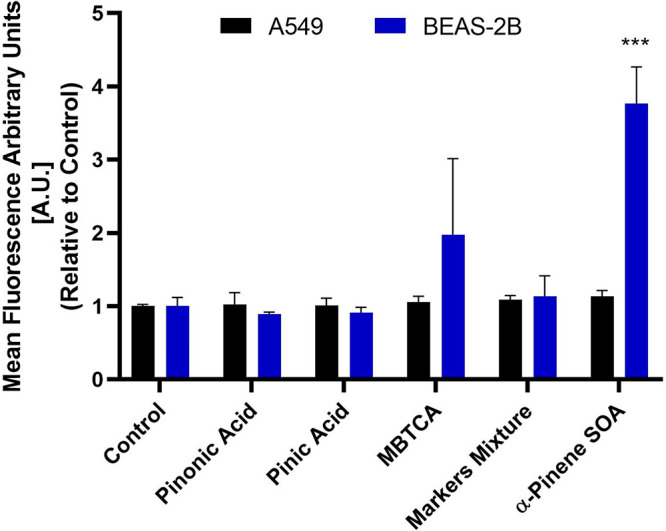
Secondary organic aerosol (SOA) is a major component of airborne fine particulate matter (PM) that contributes to adverse human health effects upon inhalation. Atmospheric ozonolysis of α-pinene, an abundantly emitted monoterpene from terrestrial vegetation, leads to significant global SOA formation; however, its impact on pulmonary pathophysiology remains uncertain. In this study, we quantified an increasing concentration response of three well-established α-pinene SOA tracers (pinic, pinonic, and 3-methyl-1,2,3-butanetricarboxylic acids) and a full mixture of α-pinene SOA in A549 (alveolar epithelial carcinoma) and BEAS-2B (bronchial epithelial normal) lung cell lines. The three aforementioned tracers contributed ∼57% of the α-pinene SOA mass under our experimental conditions. Cellular proliferation, cell viability, and oxidative stress were assessed as toxicological end points. The three α-pinene SOA molecular tracers had insignificant responses in both cell types when compared with the α-pinene SOA (up to 200 μg mL). BEAS-2B cells exposed to 200 μg mL of α-pinene SOA decreased cellular proliferation to ∼70% and 44% at 24- and 48-h post exposure, respectively; no changes in A549 cells were observed. The inhibitory concentration-50 (IC) in BEAS-2B cells was found to be 912 and 230 μg mL at 24 and 48 h, respectively. An approximate 4-fold increase in cellular oxidative stress was observed in BEAS-2B cells when compared with untreated cells, suggesting that reactive oxygen species (ROS) buildup resulted in the downstream cytotoxicity following 24 h of exposure to α-pinene SOA. Organic hydroperoxides that were identified in the α-pinene SOA samples likely contributed to the ROS and cytotoxicity. This study identifies the potential components of α-pinene SOA that likely modulate the oxidative stress response within lung cells and highlights the need to carry out chronic exposure studies on α-pinene SOA to elucidate its long-term inhalation exposure effects.
二次有机气溶胶 (SOA) 是空气中细颗粒物 (PM) 的主要成分之一,吸入后会对人体健康产生不利影响。大气中 α-蒎烯的臭氧分解是一种从陆地植被中大量排放的单萜烯,导致了大量的全球 SOA 形成;然而,其对肺病理生理学的影响仍不确定。在这项研究中,我们量化了三种成熟的 α-蒎烯 SOA 示踪剂(松油、松油烯和 3-甲基-1,2,3-丁烷三羧酸)和 α-蒎烯 SOA 全混合物在 A549(肺泡上皮癌)和 BEAS-2B(支气管上皮正常)肺细胞系中的浓度增加反应。在我们的实验条件下,上述三种示踪剂对 α-蒎烯 SOA 质量的贡献约为 57%。细胞增殖、细胞活力和氧化应激被评估为毒理学终点。与 α-蒎烯 SOA(高达 200 μg mL)相比,这三种 α-蒎烯 SOA 分子示踪剂在两种细胞类型中均无明显反应。暴露于 200 μg mL α-蒎烯 SOA 的 BEAS-2B 细胞的细胞增殖在暴露后 24-48 小时分别降至约 70%和 44%;A549 细胞无变化。在 BEAS-2B 细胞中,IC 在 24 小时和 48 小时时分别为 912 和 230 μg mL。与未处理细胞相比,BEAS-2B 细胞中的细胞氧化应激增加了约 4 倍,这表明在暴露于 α-蒎烯 SOA 24 小时后,活性氧 (ROS) 的积累导致了下游细胞毒性。在 α-蒎烯 SOA 样品中鉴定出的有机过氧化物可能导致了 ROS 和细胞毒性。这项研究确定了 α-蒎烯 SOA 中可能调节肺细胞内氧化应激反应的潜在成分,并强调需要对 α-蒎烯 SOA 进行慢性暴露研究,以阐明其长期吸入暴露的影响。