Department of Psychiatry, Health and Behavior Research Center, Washington University School of Medicine, St. Louis (Xu, Presnall, Mintz, Hartz, Bierut, Grucza); Department of Biomedical Data Science, Center for Technology and Behavioral Health, Geisel School of Medicine, Dartmouth, Hanover, N.H. (Borodovsky); Alvin J. Siteman Cancer Center, Barnes Jewish Hospital and Washington University School of Medicine, St. Louis (Bierut); and Departments of Family and Community Medicine and Health and Outcomes Research, St. Louis University, St. Louis (Grucza).
Am J Psychiatry. 2021 Jul;178(7):651-659. doi: 10.1176/appi.ajp.2020.20081174. Epub 2021 Mar 3.
Persons with opioid use disorder who take benzodiazepines are at high risk for overdose. The objective of this study was to evaluate the association of benzodiazepine and Z-drug use with drug-related poisonings among patients receiving buprenorphine maintenance treatment.
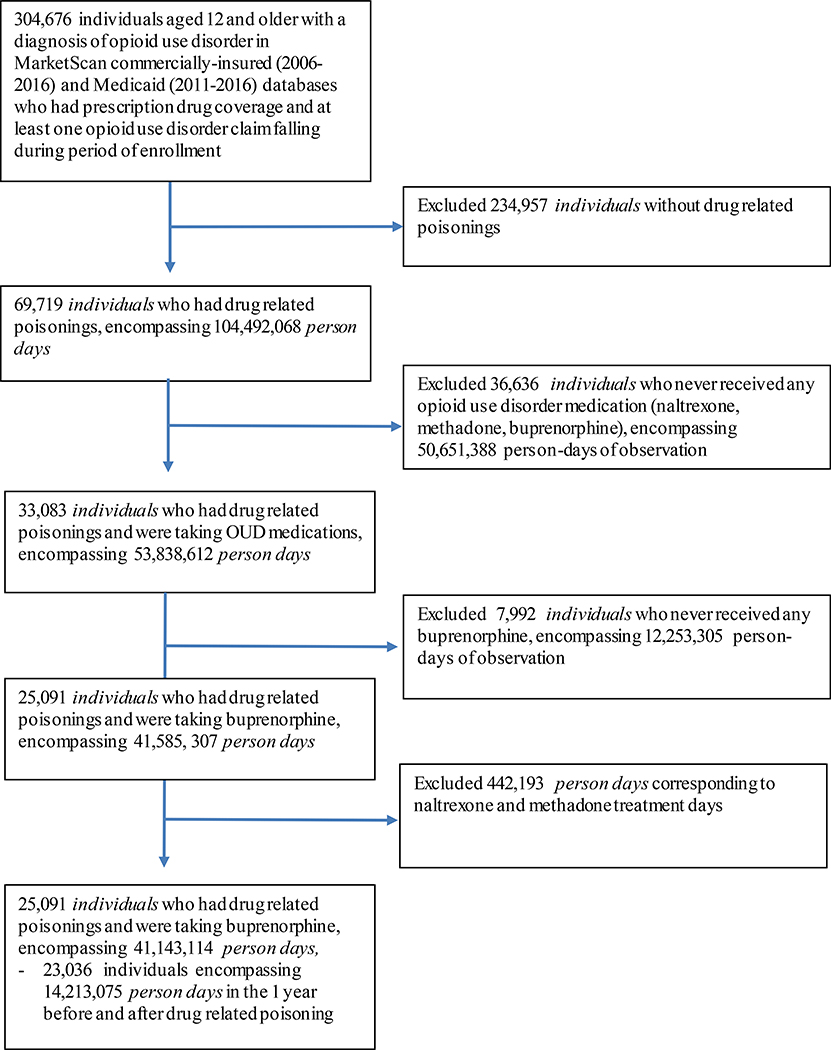
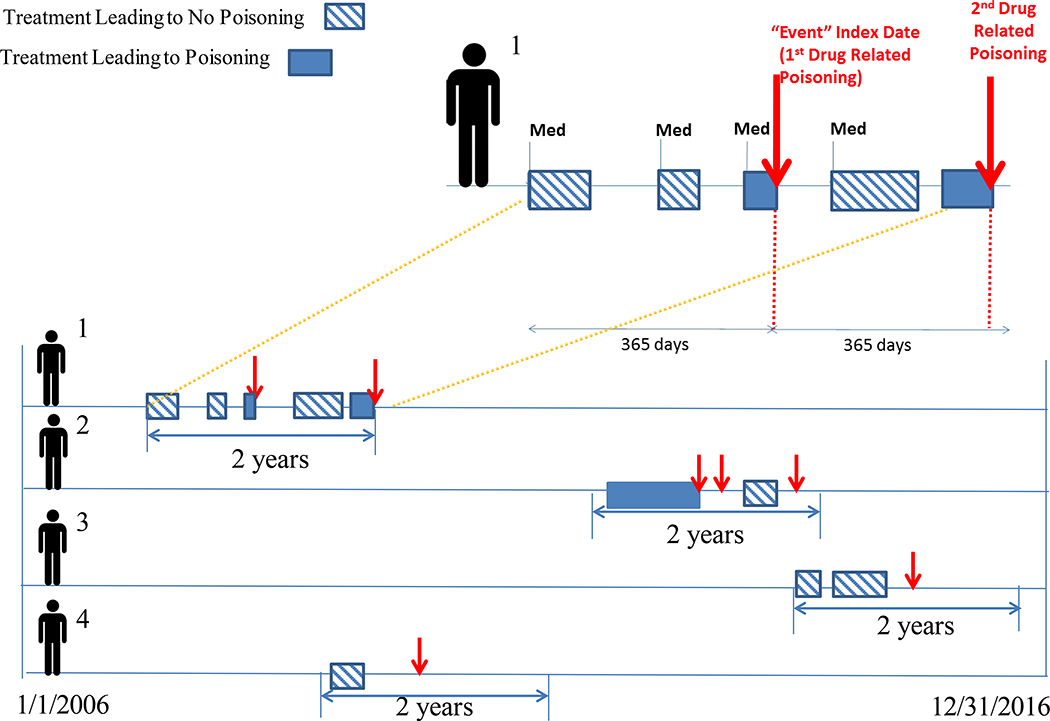
A case-crossover study design was used to analyze prescription claims among persons ages 12-64 with opioid use disorder who had buprenorphine prescriptions and had claims data in the IBM MarketScan databases (2006-2016), encompassing 14,213,075 person-days of observation time for 23,036 individuals who experienced drug-related poisoning. The exposures were buprenorphine prescriptions and benzodiazepine or Z-drug prescriptions, standardized as daily diazepam-equivalent milligram doses and separated by pharmacologic properties (short-acting or long-acting benzodiazepines, Z-drugs). The outcome of interest was nonfatal drug-related poisoning. Conditional logistic regression was used to evaluate variation in benzodiazepine or Z-drug and buprenorphine use between poisoning and nonpoisoning days.
Buprenorphine treatment days were associated with a nearly 40% reduction in the risk of poisoning events (odds ratio=0.63, 95% CI=0.60, 0.66) compared with nontreatment days, whereas benzodiazepine or Z-drug treatment days were associated with an 88% increase in the risk of such events (95% CI=1.78, 1.98). In stratified analyses by dose, we observed a 78% (95% CI=1.67, 1.88) and 122% (95% CI=2.03, 2.43) increase in poisonings associated with low-dose and high-dose benzodiazepine or Z-drug treatment days, respectively. High-dose, but not low-dose, benzodiazepine or Z-drug treatment was associated with increased poisonings in combination with buprenorphine cotreatment (odds ratio=1.64, 95% CI=1.39, 1.93), but this was lower than the odds risk associated with benzodiazepine or Z-drug treatment in the absence of buprenorphine (low-dose: odds ratio=1.69, 95% CI=1.60, 1.79; high-dose: odds ratio=2.23, 95% CI=2.04, 2.45).
Increased risk of nonfatal drug-related poisoning is associated with benzodiazepine or Z-drug treatment in patients with opioid use disorder, but this risk is partially mitigated by buprenorphine treatment. Dose reduction of benzodiazepines or Z-drugs while maintaining buprenorphine treatment may provide the advantage of lowering drug-related poisoning risk.
使用阿片类药物的患者同时使用苯二氮䓬类药物和 Z 类药物会有更高的药物过量风险。本研究的目的是评估丁丙诺啡维持治疗患者中苯二氮䓬类药物和 Z 类药物的使用与药物相关中毒之间的关联。
采用病例交叉研究设计,分析了 IBM MarketScan 数据库(2006-2016 年)中年龄在 12-64 岁、使用丁丙诺啡且有药物使用数据的阿片类药物使用障碍患者的处方数据,共涵盖了 23036 名发生药物相关中毒患者的 14213075 人天观察时间。暴露因素为丁丙诺啡处方和苯二氮䓬类药物或 Z 类药物处方,标准化为每日等效的地西泮毫克剂量,并按药理学特性(短效或长效苯二氮䓬类药物、Z 类药物)进行区分。感兴趣的结局是非致命性药物相关中毒。条件逻辑回归用于评估中毒日和非中毒日之间苯二氮䓬类药物或 Z 类药物和丁丙诺啡使用的变化。
与非治疗日相比,丁丙诺啡治疗日与中毒事件风险降低近 40%相关(比值比=0.63,95%CI=0.60,0.66),而苯二氮䓬类药物或 Z 类药物治疗日与中毒事件风险增加 88%相关(95%CI=1.78,1.98)。按剂量分层分析,我们观察到低剂量和高剂量苯二氮䓬类药物或 Z 类药物治疗日分别与中毒风险增加 78%(95%CI=1.67,1.88)和 122%(95%CI=2.03,2.43)相关。高剂量(而非低剂量)苯二氮䓬类药物或 Z 类药物治疗与丁丙诺啡联合治疗时与中毒风险增加相关(比值比=1.64,95%CI=1.39,1.93),但这低于无丁丙诺啡治疗时苯二氮䓬类药物或 Z 类药物治疗的风险比(低剂量:比值比=1.69,95%CI=1.60,1.79;高剂量:比值比=2.23,95%CI=2.04,2.45)。
阿片类药物使用障碍患者中苯二氮䓬类药物或 Z 类药物治疗与非致命性药物相关中毒风险增加相关,但丁丙诺啡治疗部分减轻了这种风险。在维持丁丙诺啡治疗的同时减少苯二氮䓬类药物或 Z 类药物的剂量可能会降低药物相关中毒风险。