Department of Psychiatry, Washington University School of Medicine, St Louis, Missouri.
Department of Social Work, Washington University in St Louis, St Louis, Missouri.
JAMA Netw Open. 2022 May 2;5(5):e2211634. doi: 10.1001/jamanetworkopen.2022.11634.
Stimulant medication use is common among individuals receiving buprenorphine for opioid use disorder (OUD). Associations between prescription stimulant use and treatment outcomes in this population have been understudied.
To investigate whether use of prescription stimulants was associated with (1) drug-related poisoning and (2) buprenorphine treatment retention.
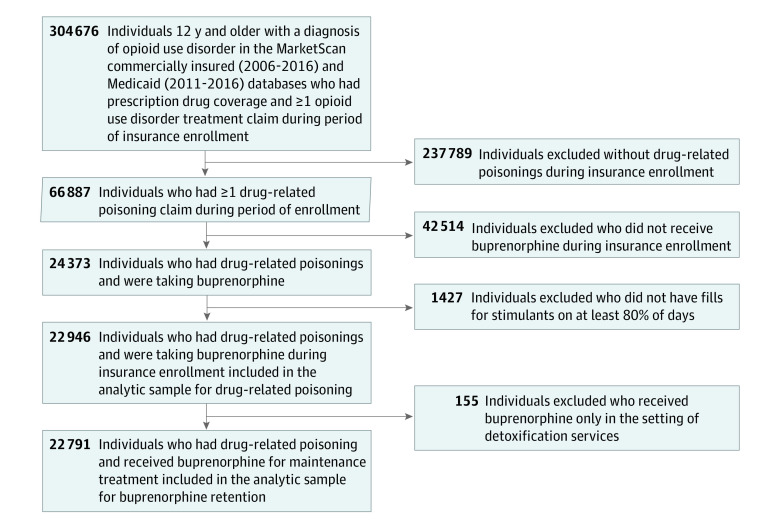
DESIGN, SETTING, AND PARTICIPANTS: This retrospective, recurrent-event cohort study with a case-crossover design used a secondary analysis of administrative claims data from IBM MarketScan Commercial and Multi-State Medicaid databases from January 1, 2006, to December 31, 2016. Primary analyses were conducted from March 1 through August 31, 2021. Individuals aged 12 to 64 years with an OUD diagnosis and prescribed buprenorphine who experienced at least 1 drug-related poisoning were included in the analysis. Unit of observation was the person-day.
Days of active stimulant prescriptions.
Primary outcomes were drug-related poisoning and buprenorphine treatment retention. Drug-related poisonings were defined using International Classification of Diseases, Ninth Revision, and International Statistical Classification of Diseases and Related Health Problems, Tenth Revision, codes; treatment retention was defined by continuous treatment claims until a 45-day gap was observed.
There were 13 778 567 person-days of observation time among 22 946 individuals (mean [SD] age, 32.8 [11.8] years; 50.3% men) who experienced a drug-related poisoning. Stimulant treatment days were associated with 19% increased odds of drug-related poisoning (odds ratio [OR], 1.19 [95% CI, 1.06-1.34]) compared with nontreatment days; buprenorphine treatment days were associated with 38% decreased odds of poisoning (OR, 0.62 [95% CI, 0.59-0.65]). There were no significant interaction effects between use of stimulants and buprenorphine. Stimulant treatment days were associated with decreased odds of attrition from buprenorphine treatment (OR, 0.64 [95% CI, 0.59-0.70]), indicating that stimulants were associated with 36% longer mean exposure to buprenorphine and its concomitant protection.
Among persons with OUD, use of prescription stimulants was associated with a modest increase in per-day risk of drug-related poisoning, but this risk was offset by the association between stimulant use and improved retention to buprenorphine treatment, which is associated with protection against overdose.
在接受丁丙诺啡治疗阿片类药物使用障碍(OUD)的人群中,兴奋剂药物的使用很常见。在该人群中,处方兴奋剂的使用与治疗结果之间的关系研究较少。
调查处方兴奋剂的使用是否与(1)与药物相关的中毒,和(2)丁丙诺啡治疗保留有关。
设计、设置和参与者:这是一项使用 IBM MarketScan 商业和多州医疗补助数据库的回顾性、复发性事件队列研究,采用病例交叉设计。主要分析于 2021 年 3 月 1 日至 8 月 31 日进行。纳入了患有 OUD 诊断并开有丁丙诺啡处方且至少经历过 1 次与药物相关的中毒的年龄在 12 岁至 64 岁之间的个体。观察单位为人天。
活性兴奋剂处方天数。
主要结局是与药物相关的中毒和丁丙诺啡治疗保留。使用国际疾病分类第 9 版和国际疾病分类和相关健康问题统计分类第 10 版代码定义与药物相关的中毒;治疗保留定义为连续的治疗索赔,直到观察到 45 天的差距。
在 22946 名(平均[SD]年龄,32.8[11.8]岁;50.3%为男性)经历过与药物相关的中毒的个体中,观察时间有 13778567 人天。与非治疗日相比,兴奋剂治疗日与 19%的药物相关中毒风险增加相关(比值比[OR],1.19[95%CI,1.06-1.34]);丁丙诺啡治疗日与中毒风险降低 38%相关(OR,0.62[95%CI,0.59-0.65])。兴奋剂使用和丁丙诺啡之间没有显著的交互作用。兴奋剂治疗日与丁丙诺啡治疗脱落的风险降低相关(OR,0.64[95%CI,0.59-0.70]),表明兴奋剂的使用与丁丙诺啡及其伴随保护的平均暴露时间延长 36%相关。
在患有 OUD 的人群中,处方兴奋剂的使用与每日与药物相关的中毒风险略有增加有关,但这种风险被兴奋剂的使用与丁丙诺啡治疗保留增加的关联所抵消,而丁丙诺啡治疗保留增加与防止过量有关。