Université de Lomé, Faculté des Sciences de la Santé, BP 1515, Lomé, Togo.
Programme National d'Elimination de la Filariose Lymphatique, Ministère de la Santé et de l'Hygiène Publique, BP 336, Lomé, Togo.
Parasit Vectors. 2021 Mar 2;14(1):134. doi: 10.1186/s13071-021-04644-2.
In March 2017, Togo was declared the first country in sub-Saharan Africa to eliminate lymphatic filariasis as a public health problem, but post-validation surveillance has been lacking. In some areas of the country, migrant groups from neighboring countries that are still endemic for LF pose a risk of reintroduction of LF to Togo. The objective of this study was to identify the risk posed by migrant groups by measuring their prevalence of LF infection and investigating any positive case using Togo's case investigation algorithm to prevent resurgence of LF and sustain Togo's elimination success.
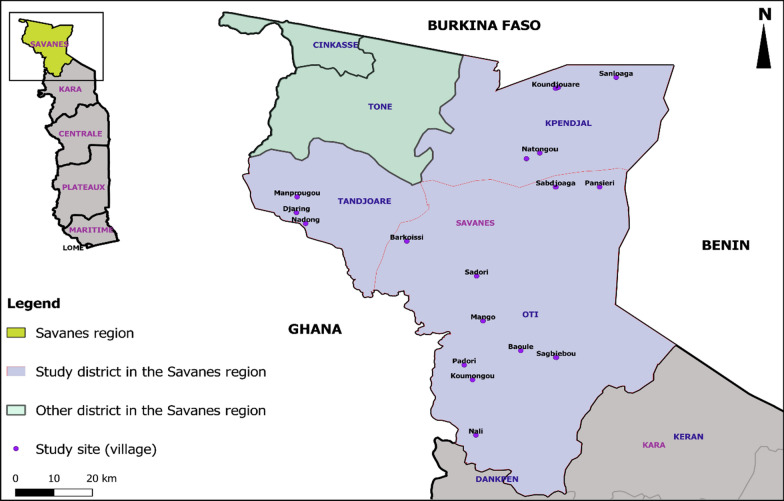
A cross-sectional study was conducted in 2018 in the northernmost region of the country. Three migrant populations were identified: (i) nomadic Peuhls, (ii) Togolese members of local communities who migrate annually to neighboring countries for seasonal labor, and (iii) refugees from Ghana who came to Togo because of a communal conflict in Ghana. A questionnaire was designed to collect data on demographics and history of LF and MDA; all participants were tested for circulating filariasis antigen (CFA) using the filariasis test strip (FTS). Any CFA-positive case was confirmed with nocturnal microfilaremia.
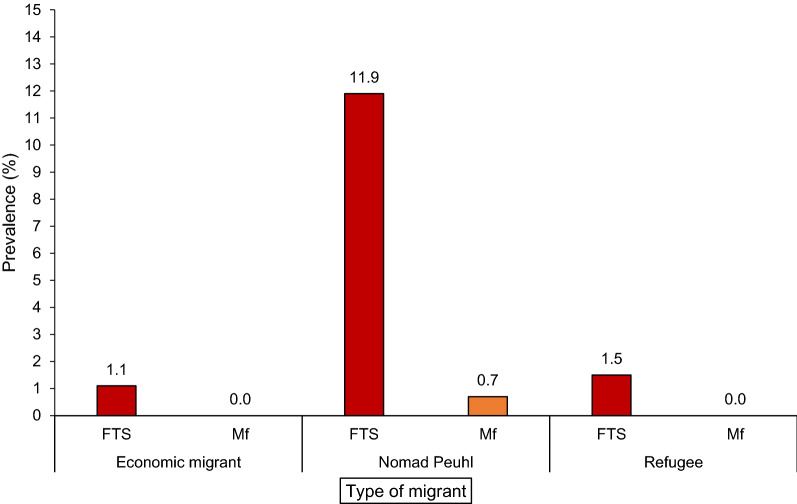
Refugees, seasonal economic migrants and nomadic Peuhls represented 42.1%, 31.4% and 26.5% of the study participants, respectively. The overall prevalence of CFA was 4.2% (58/1391) with the highest prevalence in the nomadic Peuhl group (11.9%), but only one of them (0.07%) was confirmed positive with nocturnal microfilaremia. Using the case investigation algorithm, no other positive case was identified in the positive case's surroundings.
This study demonstrates that nomadic Peuhls, with a CFA prevalence of 11.9%, pose a potential risk for reintroduction of LF into Togo while Ghanaian refugees and seasonal economic migrants do not appear to pose a significant risk. Periodic monitoring of migrants, especially the nomadic Peuhl population, is a potential post-validation surveillance approach that could be used to promptly detect any LF cluster that may arise.
2017 年 3 月,多哥被宣布成为撒哈拉以南非洲首个消除淋巴丝虫病这一公共卫生问题的国家,但后续验证监测工作却一直缺乏。在该国的一些地区,来自邻国的移徙群体仍然流行淋巴丝虫病,这给多哥带来了淋巴丝虫病再次传入的风险。本研究的目的是通过测量移徙群体的淋巴丝虫病感染率并使用多哥的病例调查算法对任何阳性病例进行调查,以确定移徙群体所带来的风险,从而防止淋巴丝虫病的死灰复燃,并维持多哥的消除成果。
2018 年在该国最北部地区进行了一项横断面研究。确定了三个移徙群体:(i)游牧的 Peuhl 人,(ii)每年迁移到邻国从事季节性劳动的多哥当地社区成员,以及(iii)因加纳社区冲突而来到多哥的加纳难民。设计了一份问卷,以收集人口统计学和淋巴丝虫病病史以及 MDA 数据;所有参与者均使用丝虫病检测条(FTS)检测循环性丝虫抗原(CFA)。任何 CFA 阳性病例均通过夜间微丝蚴血症进行确认。
难民、季节性经济移徙者和游牧的 Peuhl 人分别占研究参与者的 42.1%、31.4%和 26.5%。CFA 的总体流行率为 4.2%(58/1391),游牧的 Peuhl 群体的流行率最高(11.9%),但其中只有一例(0.07%)经夜间微丝蚴血症确认为阳性。使用病例调查算法,在阳性病例的周围环境中未发现其他阳性病例。
本研究表明,CFA 流行率为 11.9%的游牧的 Peuhl 人可能会将淋巴丝虫病重新引入多哥,而加纳难民和季节性经济移徙者似乎不会带来重大风险。定期监测移徙者,尤其是游牧的 Peuhl 人群,可能是一种潜在的后续验证监测方法,可用于及时发现任何可能出现的淋巴丝虫病聚集。