Karthikeyan Smruthi, Ronquillo Nancy, Belda-Ferre Pedro, Alvarado Destiny, Javidi Tara, Longhurst Christopher A, Knight Rob
Department of Pediatrics, University of California, San Diego, La Jolla, California, USA.
Department of Electrical and Computer Engineering, University of California, San Diego, La Jolla, California, USA.
mSystems. 2021 Mar 2;6(2):e00045-21. doi: 10.1128/mSystems.00045-21.
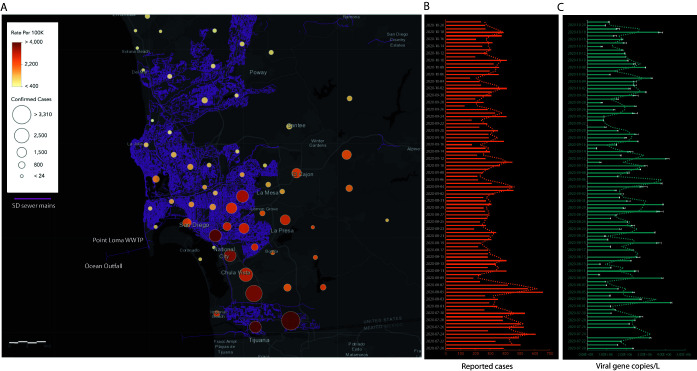
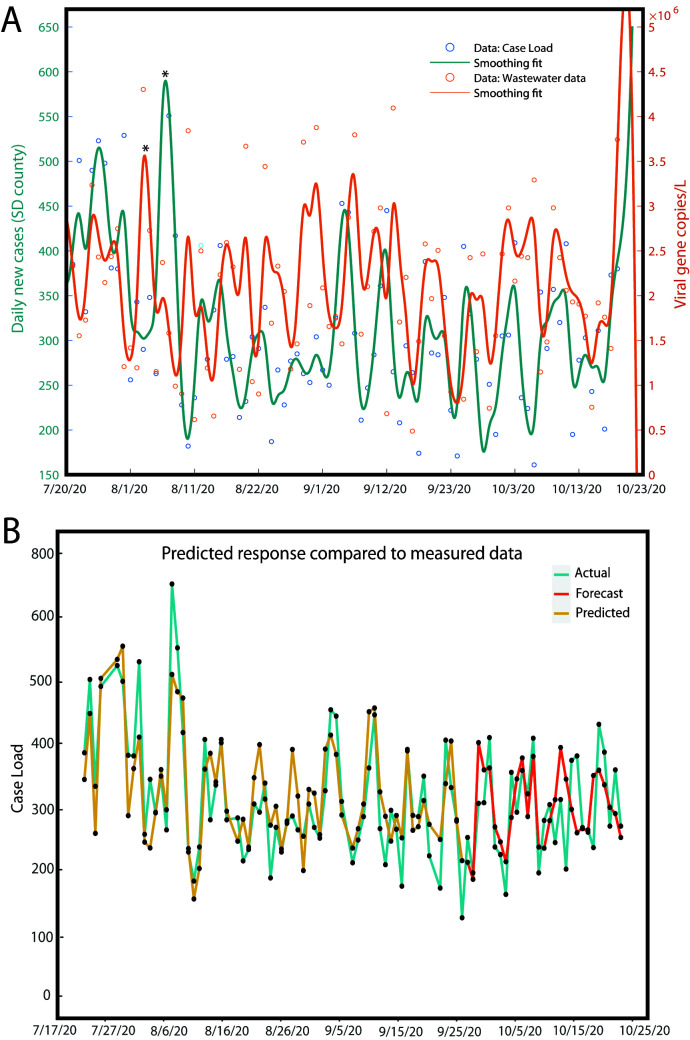
Large-scale wastewater surveillance has the ability to greatly augment the tracking of infection dynamics especially in communities where the prevalence rates far exceed the testing capacity. However, current methods for viral detection in wastewater are severely lacking in terms of scaling up for high throughput. In the present study, we employed an automated magnetic-bead-based concentration approach for viral detection in sewage that can effectively be scaled up for processing 24 samples in a single 40-min run. The method compared favorably to conventionally used methods for viral wastewater concentrations with higher recovery efficiencies from input sample volumes as low as 10 ml and can enable the processing of over 100 wastewater samples in a day. The sensitivity of the high-throughput protocol was shown to detect 1 asymptomatic individual in a building of 415 residents. Using the high-throughput pipeline, samples from the influent stream of the primary wastewater treatment plant of San Diego County (serving 2.3 million residents) were processed for a period of 13 weeks. Wastewater estimates of severe acute respiratory syndrome coronavirus 2 (SARS-CoV-2) viral genome copies in raw untreated wastewater correlated strongly with clinically reported cases by the county, and when used alongside past reported case numbers and temporal information in an autoregressive integrated moving average (ARIMA) model enabled prediction of new reported cases up to 3 weeks in advance. Taken together, the results show that the high-throughput surveillance could greatly ameliorate comprehensive community prevalence assessments by providing robust, rapid estimates. Wastewater monitoring has a lot of potential for revealing coronavirus disease 2019 (COVID-19) outbreaks before they happen because the virus is found in the wastewater before people have clinical symptoms. However, application of wastewater-based surveillance has been limited by long processing times specifically at the concentration step. Here we introduce a much faster method of processing the samples and show its robustness by demonstrating direct comparisons with existing methods and showing that we can predict cases in San Diego by a week with excellent accuracy, and 3 weeks with fair accuracy, using city sewage. The automated viral concentration method will greatly alleviate the major bottleneck in wastewater processing by reducing the turnaround time during epidemics.
大规模废水监测有能力极大地加强对感染动态的追踪,尤其是在患病率远远超过检测能力的社区。然而,目前用于废水中病毒检测的方法在扩大规模以实现高通量方面严重不足。在本研究中,我们采用了一种基于磁珠的自动化浓缩方法用于污水中的病毒检测,该方法能够有效地扩大规模,在单次40分钟的运行中处理24个样本。该方法与传统用于病毒废水浓缩的方法相比具有优势,对于低至10毫升的输入样本体积具有更高的回收效率,并且一天能够处理超过100个废水样本。高通量方案的灵敏度显示能够在一栋有415名居民的大楼中检测出1名无症状感染者。使用高通量流程,对圣地亚哥县(服务230万居民)初级污水处理厂进水的样本进行了为期13周的处理。未经处理的原废水中严重急性呼吸综合征冠状病毒2(SARS-CoV-2)病毒基因组拷贝数的废水估计值与该县临床报告病例密切相关,并且当与过去报告的病例数和时间信息一起用于自回归积分移动平均(ARIMA)模型时,能够提前3周预测新报告病例。综合来看,结果表明高通量监测通过提供可靠、快速的估计,能够极大地改善全面的社区患病率评估。废水监测在揭示2019冠状病毒病(COVID-19)疫情爆发方面具有很大潜力,因为在人们出现临床症状之前病毒就已在废水中被发现。然而,基于废水的监测应用一直受到处理时间长的限制,特别是在浓缩步骤。在这里,我们介绍了一种更快的样本处理方法,并通过与现有方法进行直接比较展示了其稳健性,还表明使用城市污水我们能够以极高的准确性提前一周预测圣地亚哥的病例,以尚可的准确性提前三周预测。这种自动化病毒浓缩方法将通过减少疫情期间的周转时间极大地缓解废水处理中的主要瓶颈。