Xia Shujie, Zhong Zhangfeng, Gao Bizhen, Vong Chi Teng, Lin Xuejuan, Cai Jin, Gao Hanlu, Chan Ging, Li Candong
Research Base of Traditional Chinese Medicine Syndrome, Fujian University of Traditional Chinese Medicine, No.1 Qiuyang Road, Minhou District, 350122, Fuzhou, China.
State Key Laboratory of Quality Research in Chinese Medicine, Institute of Chinese Medical Sciences, University of Macau, 999078, Macao, China.
Chin Med. 2021 Mar 3;16(1):25. doi: 10.1186/s13020-021-00427-0.
Coronavirus Disease 2019 (COVID-19) is an unprecedented disaster for people around the world. Many studies have shown that traditional Chinese medicine (TCM) are effective in treating COVID-19. However, it is difficult to find the most effective combination herbal pair among numerous herbs, as well as identifying its potential mechanisms. Herbal pair is the main form of a combination of TCM herbs, which is widely used for the treatment of diseases. It can also help us to better understand the compatibility of TCM prescriptions, thus improving the curative effects. The purpose of this article is to explore the compatibility of TCM prescriptions and identify the most important herbal pair for the treatment of COVID-19, and then analyze the active components and potential mechanisms of this herbal pair.
We first systematically sorted the TCM prescriptions recommended by the leading experts for treating COVID-19, and the specific herbs contained in these prescriptions across different stages of the disease. Next, the association rule approach was employed to examine the distribution and compatibility among these TCM prescriptions, and then identify the most important herbal pair. On this basis, we further investigated the active ingredients and potential targets in the selected herbal pair by a network pharmacology approach, and analyzed the potential mechanisms against COVID-19. Finally, the main active compounds in the herbal pair were selected for molecular docking with severe acute respiratory syndrome coronavirus 2 (SARS-COV-2) 3CLpro and angiotensin converting enzyme II (ACE2) for further verification.
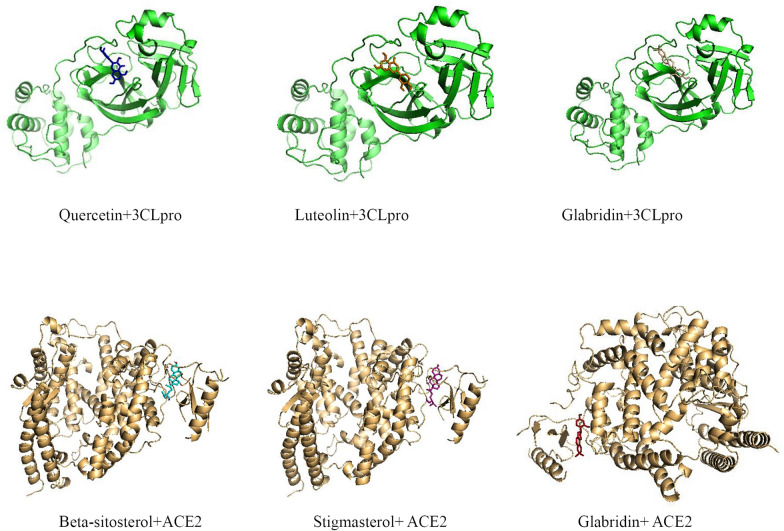
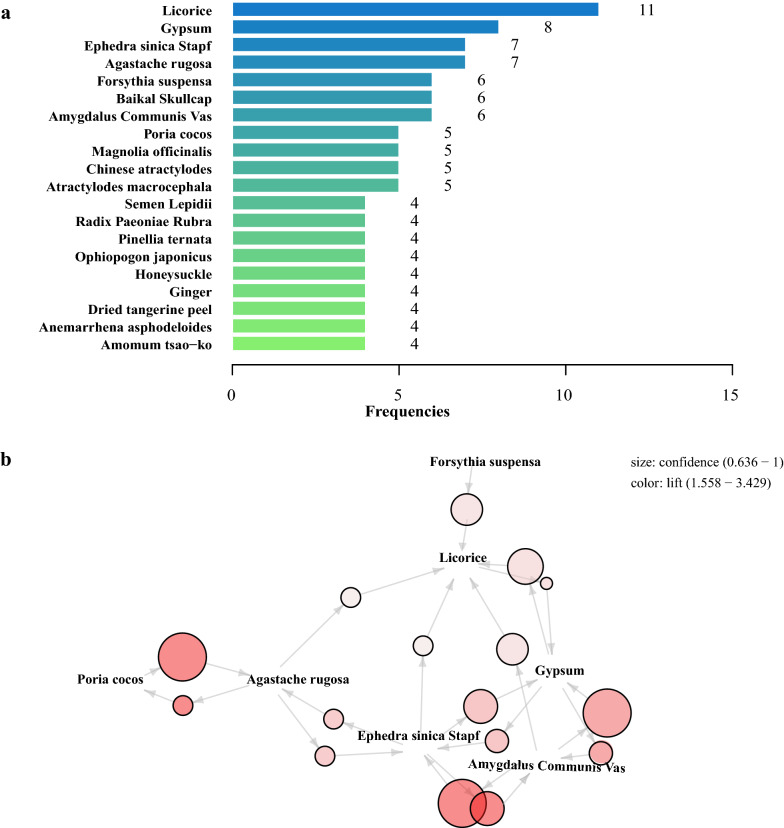
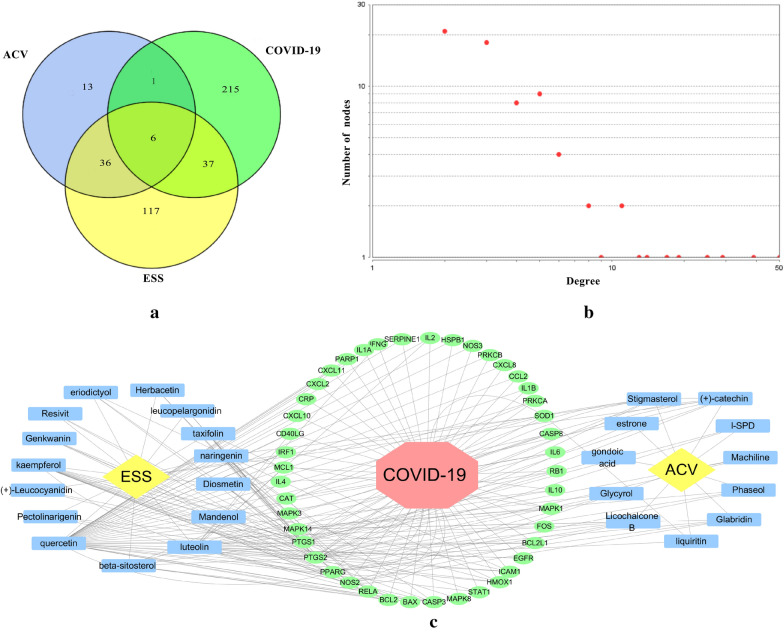
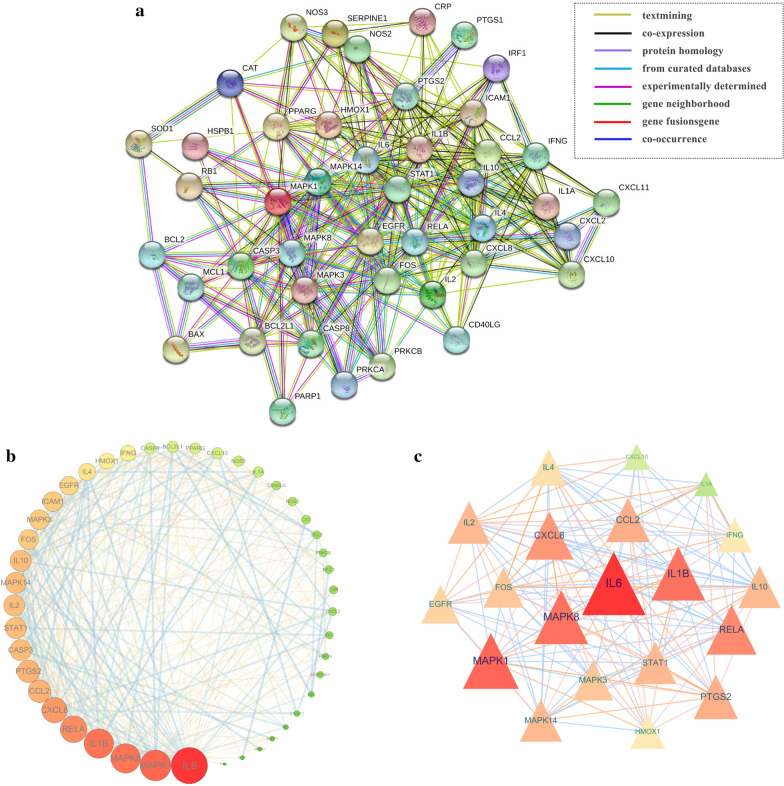
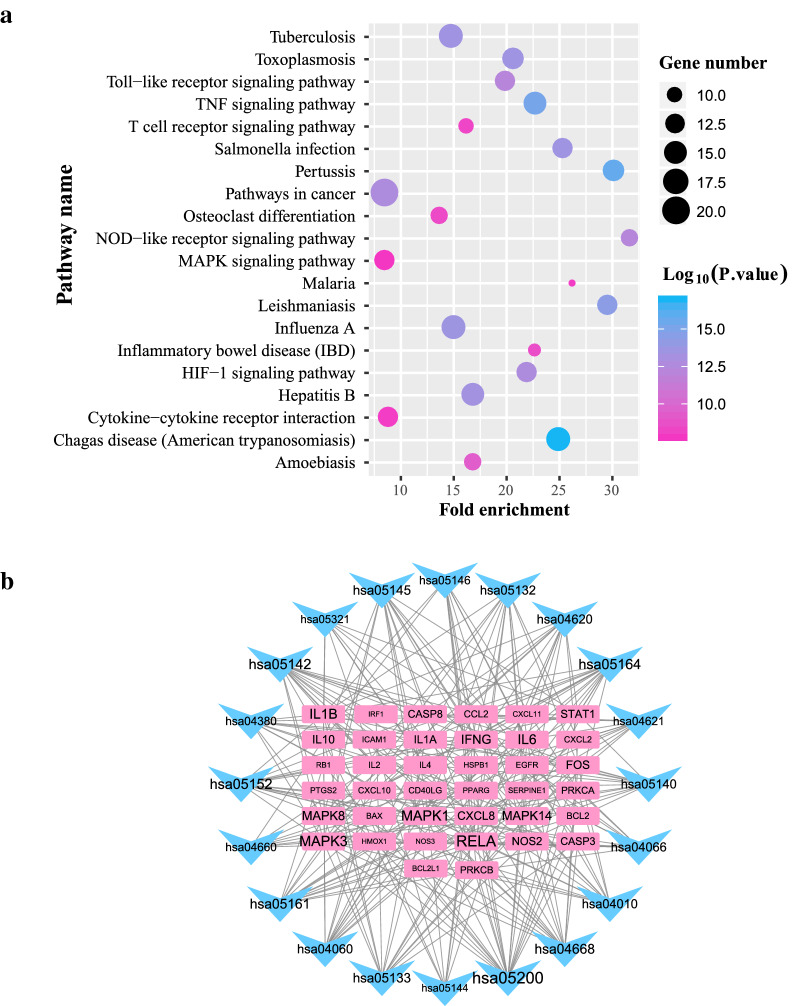
We obtained 32 association rules for the herbal combinations in the selection of TCM treatment for COVID-19. The results showed that the combination of Amygdalus Communis Vas (ACV) and Ephedra sinica Stapf (ESS) had the highest confidence degree and lift value, as well as high support degree, which can be used in almost all the stages of COVID-19, so ACV and ESS (AE) were selected as the most important herbal pair. There were 26 active ingredients and 44 potential targets, which might be related to the herbal pair of AE against COVID-19. The main active ingredients of AE against COVID-19 were quercetin, kaempferol, luteolin, while the potential targets were Interleukin 6 (IL-6), Mitogen-activated Protein Kinase 1 (MAPK)1, MAPK8, Interleukin-1β (IL-1β), and Nuclear factor kappa-light-chain-enhancer of activated B cells (NF-kB) p65 subunit (RELA). The protein-protein interaction (PPI) cluster demonstrated that IL-6 was the seed in the cluster, which plays an important role in connecting other nodes in the PPI network. The potential pathways mainly involved tumor necrosis factor (TNF), Toll-like receptor (TLR), hypoxia-inducible factor-1 (HIF-1), and nucleotide-binding oligomerization domain (NOD)-like receptor (NLRs). The molecular docking results showed that the main active ingredients of AE have good affinity with SARS-COV-2 3CLpro and ACE2, which are consistent with the above analysis.
There were 32 association rules in the TCM prescriptions recommended by experts for COVID-19. The combination of ACV and EAS was the most important herbal pair for the treatment of COVID-19. AE might have therapeutic effects against COVID-19 by affecting the inflammatory and immune responses, cell apoptosis, hypoxia damage and other pathological processes through multiple components, targets and pathways.
2019冠状病毒病(COVID-19)对全球人民来说是一场前所未有的灾难。许多研究表明,中药在治疗COVID-19方面有效。然而,在众多草药中难以找到最有效的药对组合,也难以确定其潜在机制。药对是中药配伍的主要形式,广泛应用于疾病治疗。它还能帮助我们更好地理解中药方剂的配伍规律,从而提高疗效。本文旨在探讨中药方剂的配伍规律,确定治疗COVID-19最重要的药对,进而分析该药对的活性成分和潜在机制。
我们首先系统梳理了权威专家推荐的用于治疗COVID-19的中药方剂,以及这些方剂在疾病不同阶段所含的具体草药。接下来,采用关联规则方法研究这些中药方剂之间的分布和配伍情况,进而确定最重要的药对。在此基础上,通过网络药理学方法进一步研究所选药对中的活性成分和潜在靶点,并分析其抗COVID-19的潜在机制。最后,选择药对中的主要活性化合物与严重急性呼吸综合征冠状病毒2(SARS-COV-2)3CL蛋白酶和血管紧张素转换酶II(ACE2)进行分子对接,以进一步验证。
我们获得了32条关于治疗COVID-19的中药方剂中药物组合的关联规则。结果显示,苦杏仁(ACV)与麻黄(ESS)的组合具有最高的置信度和提升值,以及较高的支持度,可用于COVID-19的几乎所有阶段,因此苦杏仁与麻黄(AE)被选为最重要的药对。有26种活性成分和44个潜在靶点,可能与AE药对抗COVID-19有关。AE抗COVID-19的主要活性成分是槲皮素、山奈酚、木犀草素,而潜在靶点是白细胞介素6(IL-6)、丝裂原活化蛋白激酶1(MAPK)1、MAPK8、白细胞介素-1β(IL-1β)和活化B细胞核因子κB(NF-κB)p65亚基(RELA)。蛋白质-蛋白质相互作用(PPI)聚类表明,IL-6是聚类中的种子节点,在连接PPI网络中的其他节点方面发挥重要作用。潜在通路主要涉及肿瘤坏死因子(TNF)、Toll样受体(TLR)、缺氧诱导因子-1(HIF-1)和核苷酸结合寡聚化结构域(NOD)样受体(NLRs)。分子对接结果表明,AE的主要活性成分与SARS-COV-2 3CL蛋白酶和ACE2具有良好的亲和力,与上述分析一致。
专家推荐的治疗COVID-19的中药方剂中有32条关联规则。苦杏仁与麻黄的组合是治疗COVID-19最重要的药对。AE可能通过多种成分、靶点和途径影响炎症和免疫反应、细胞凋亡、缺氧损伤等病理过程,从而对COVID-19产生治疗作用。