Ayobola Ehwarieme Daniel, Oscar Whiliki Onoriadjeren, Ejovwokoghene Ejukonemu Francis
Department of Microbiology, Faculty of Science, Delta State University, Abraka, Nigeria.
Department of Science Laboratory Technology, Delta State Polytechnic, Otefe-Oghara, Nigeria.
AIMS Microbiol. 2021 Feb 3;7(1):75-95. doi: 10.3934/microbiol.2021006. eCollection 2021.
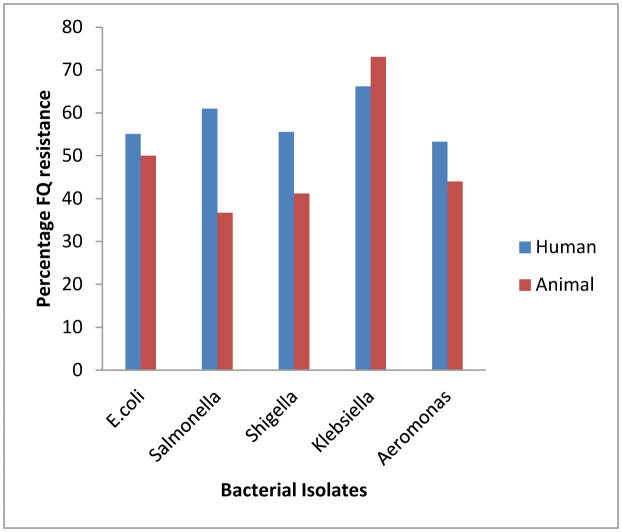
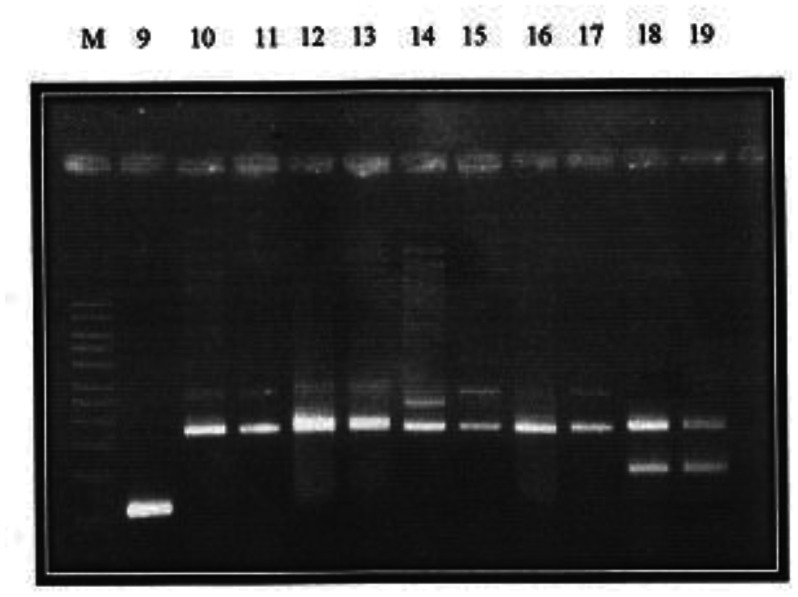
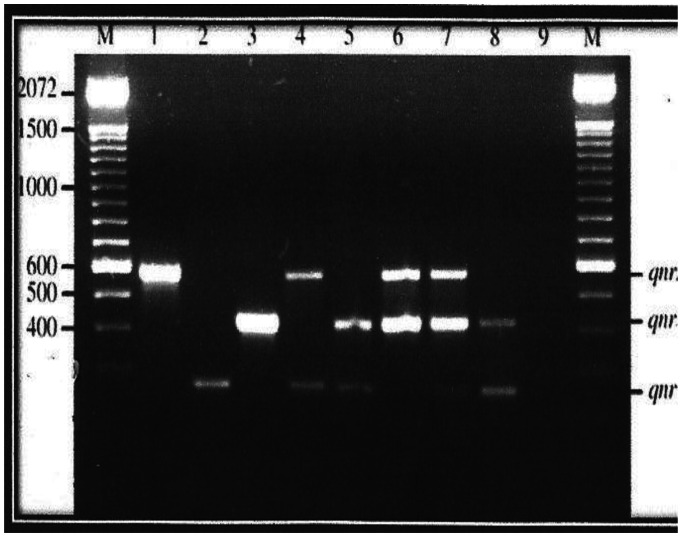
Plasmid mediated quinolone resistance (PMQR) is a public health challenge arising among other things, from indiscriminate use of the floroquinolones (FQr) prophylactically in animal husbandry. This study examines the occurrence of PMQR genes amongst enteric bacteria isolated from human and animal sources. A total of 720 (360 stool and 360 fish pond water/poultry litter) samples were examined for fluoroquinolone resistant (FQr) bacteria. Percentage FQr was generally higher among human isolates than isolates from animals. Proportion of PMQR amongst FQr isolates were (1.05 and 4.32) % for . from human and animal sources. For spp., spp., spp. and spp., percentages PMQR were 0.00 & 6.93, 0.00 & 6.38, 4.26 & 5.26 and 0.00 &3.03 for human and animal sources respectively, for the isolates. The PMQR genes: A, B, S and A were 11, 15, 7 and 1 amongst a total of 1018 FQr and 29 PMQR isolates respectively. The aac (6')-Ib-cr gene was not detected in this study. Approximate Plasmid bands of PCR amplicon for A, B, S and A respectively were established. The proportion of PMQR genes especially among isolates from animal sources is of public health concern due to the higher possibility of a horizontal FQ resistance transfer to humans.
质粒介导的喹诺酮耐药性(PMQR)是一个公共卫生挑战,部分原因是在畜牧业中预防性地滥用氟喹诺酮类药物(FQr)。本研究调查了从人和动物源分离的肠道细菌中PMQR基因的出现情况。共检测了720份样本(360份粪便样本以及360份鱼塘水/家禽粪便样本)中的耐氟喹诺酮细菌。人类分离株中的耐氟喹诺酮细菌百分比通常高于动物分离株。人和动物源的耐氟喹诺酮分离株中PMQR的比例分别为1.05%和4.32%。对于大肠杆菌属、克雷伯菌属、肠杆菌属和沙门氏菌属,人和动物源分离株的PMQR百分比分别为0.00%和6.93%、0.00%和6.38%、4.26%和5.26%、0.00%和3.03%。在总共1018株耐氟喹诺酮分离株和29株PMQR分离株中,PMQR基因qnrA、qnrB、qnrS和qepA分别有11个、15个、7个和1个。本研究未检测到aac(6')-Ib-cr基因。分别确定了qnrA、qnrB、qnrS和qepA的PCR扩增子的近似质粒条带。由于氟喹诺酮耐药性水平转移至人类的可能性较高,PMQR基因的比例,尤其是动物源分离株中的比例,引起了公共卫生方面的关注。