Movement Analysis Laboratory, IRCCS Istituto Ortopedico Rizzoli, Bologna, Italy.
DIBINEM - University of Bologna, via di Barbiano, Bologna, Italy.
Radiol Med. 2021 Jun;126(6):869-877. doi: 10.1007/s11547-021-01339-7. Epub 2021 Mar 3.
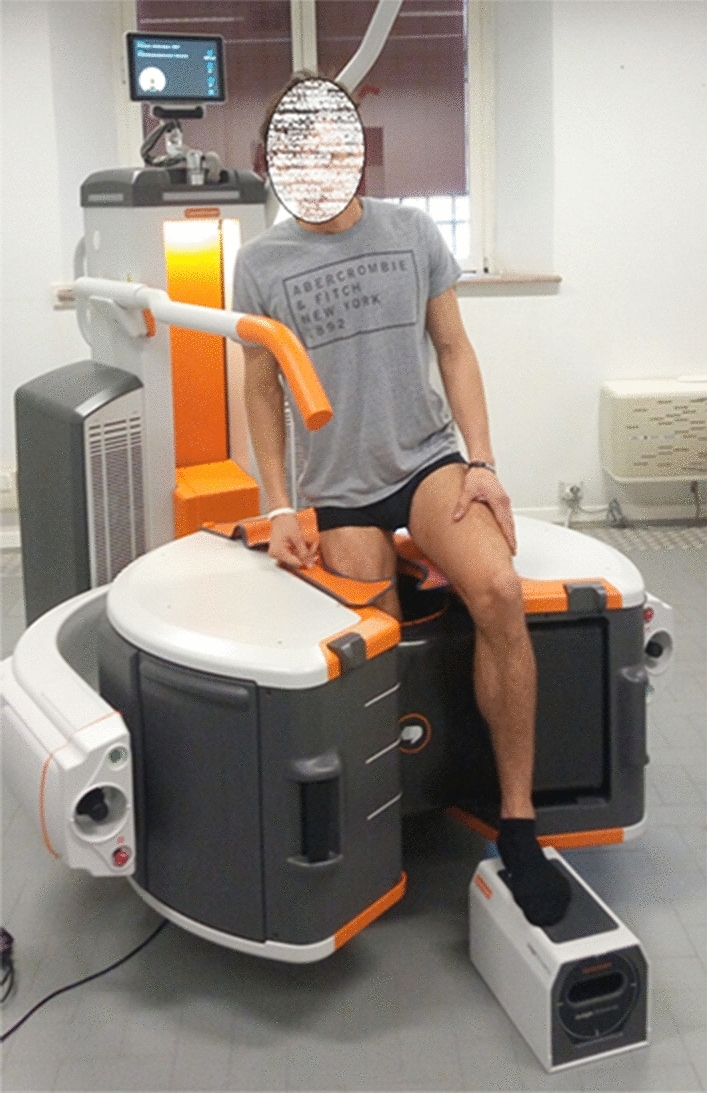
To compare weight-bearing cone-beam computer tomography (CBCT) and conventional computer tomography (CT)-based measurements of patellofemoral alignment and stability in patients surgically treated for recurrent patellar dislocation. These scans implied respectively single-leg up-right posture, the knee flexed, and lower limb muscles activation, versus supine position with the knee extended.
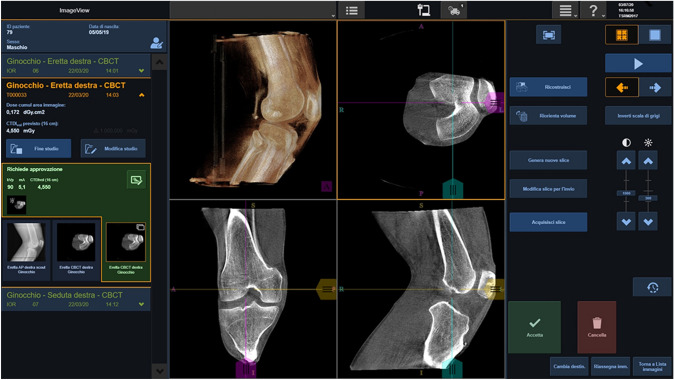
A total of 17 patients (11 males/6 females) after surgical reconstruction with fascia lata allograft for recurrent patellofemoral dislocation were analyzed at 60-month follow-up. Tilt and congruence angles and tibial tuberosity-trochlear groove (TT-TG) offset were measured on images obtained from CBCT and conventional CT scans by three independent and expert radiologists. Paired t tests were performed to compare measurements obtained from the two scans. Inter-rater reliability was assessed using a two-way mixed-effects model intra-class correlation coefficient (ICC).
Only TT-TG offset was found significantly smaller (p < 0.001) in CBCT (mean 9.9 ± 5.3 mm) than in conventional CT (mean 15.9 ± 4.9 mm) scans. ICC for tilt and congruence angles and for TT-TG offset ranged between 0.80-0.94 with measurements in CBCT scans, between 0.52 and0.78 in conventional CT.
In patients surgically treated for recurrent patellar dislocation, TT-TG offset was found overestimated with conventional CT. All measurements of patellofemoral stability and alignment were found more consistent when obtained with weight-bearing CBCT compared to conventional CT.
比较负重锥形束 CT(CBCT)与基于传统 CT 的测量在接受复发性髌骨脱位手术治疗的患者中的髌股对线和稳定性。这些扫描分别模拟单腿直立姿势、膝关节弯曲和下肢肌肉激活,与仰卧位、膝关节伸展。
共分析 17 例(11 男/6 女)接受阔筋膜同种异体重建后复发性髌股脱位患者,随访 60 个月。由 3 名独立且经验丰富的放射科医生分别在 CBCT 和常规 CT 扫描图像上测量倾斜角和吻合角以及胫骨结节-滑车沟(TT-TG)偏移。采用配对 t 检验比较两种扫描方法的测量值。采用双向混合效应模型组内相关系数(ICC)评估观察者间的可靠性。
仅 TT-TG 偏移在 CBCT(平均 9.9±5.3 mm)中明显小于常规 CT(平均 15.9±4.9 mm)(p<0.001)。CBCT 中倾斜角和吻合角以及 TT-TG 偏移的 ICC 范围为 0.80-0.94,常规 CT 为 0.52-0.78。
在接受复发性髌骨脱位手术治疗的患者中,常规 CT 发现 TT-TG 偏移过大。与常规 CT 相比,负重 CBCT 获得的髌股稳定性和对线的所有测量值更一致。