Apari Péter, Földvári Gábor
Institute of Evolution Centre for Ecological Research Budapest Hungary.
Evol Appl. 2020 Sep 29;14(2):271-277. doi: 10.1111/eva.13123. eCollection 2021 Feb.
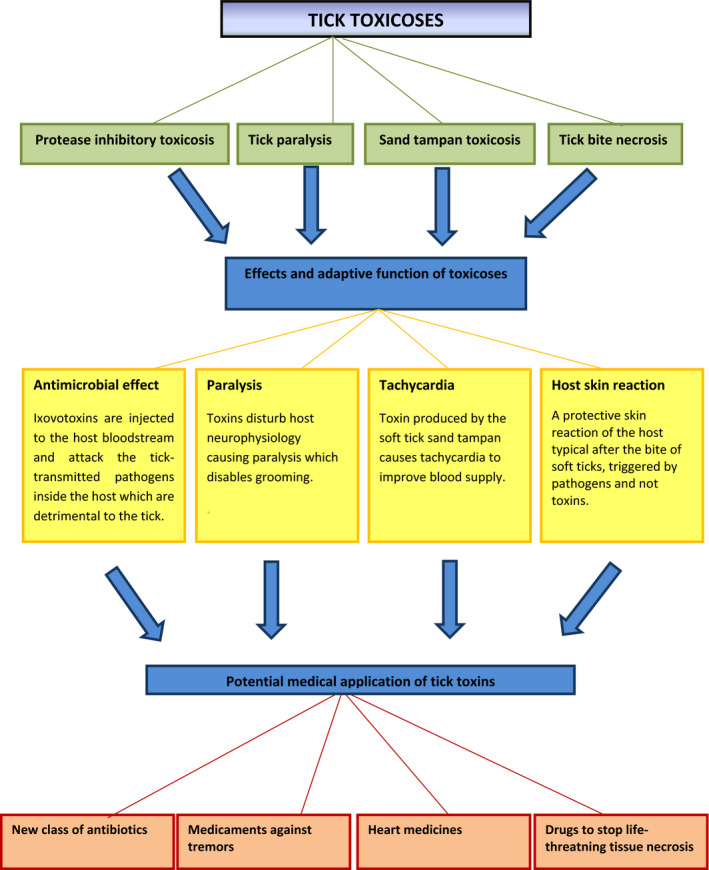
The existence of tick toxins is an old enigma that has intrigued scientists for a long time. The adaptive value of using deadly toxins for predatory animals is obvious: they try to kill the prey in the most effective way or protect themselves from their natural enemies. Ticks, however, are blood-sucking parasites, and it seems paradoxical that they have toxins similar to spiders, scorpions and snakes. Based on published data, here we examine the potential adaptive function of different types of toxins produced by soft and hard ticks. We hypothesize that there are diverse evolutionary roles behind (a) to attack and reduce the tick-transmitted pathogens inside the vertebrate host systemically to protect the tick, (b) to paralyse the host to stop grooming, (c) to speed up host heartbeat to improve blood supply and (d) to inhibit the process of necroptosis to prevent the rejection of hard ticks. We will provide published evidence that supports the above-mentioned hypotheses, and we will give an outlook how these new scientific results might be applied in modern pharmacology and medicine.
蜱虫毒素的存在是一个长期困扰科学家的古老谜题。掠食性动物使用致命毒素的适应性价值显而易见:它们试图以最有效的方式杀死猎物或保护自己免受天敌侵害。然而,蜱虫是吸血寄生虫,它们拥有与蜘蛛、蝎子和蛇类似的毒素,这似乎自相矛盾。基于已发表的数据,我们在此研究软蜱和硬蜱产生的不同类型毒素的潜在适应性功能。我们假设,(a)在脊椎动物宿主系统内攻击并减少蜱虫传播的病原体以保护蜱虫,(b)使宿主麻痹以停止梳理行为,(c)加快宿主心跳以改善血液供应,以及(d)抑制坏死性凋亡过程以防止硬蜱被排斥,这些背后存在多种进化作用。我们将提供支持上述假设的已发表证据,并展望这些新的科学成果如何应用于现代药理学和医学。