Cai Qingjin, Liao Wanshan, Xue Fangchao, Wang Xiaochen, Zhou Weiming, Li Yanzhao, Zeng Wen
Department of Cell Biology, Third Military Medical University, Chongqing, 400038, China.
State Key Laboratory of Trauma, Burn and Combined Injury, Chongqing, China.
Bioact Mater. 2021 Feb 6;6(8):2557-2568. doi: 10.1016/j.bioactmat.2020.12.021. eCollection 2021 Aug.
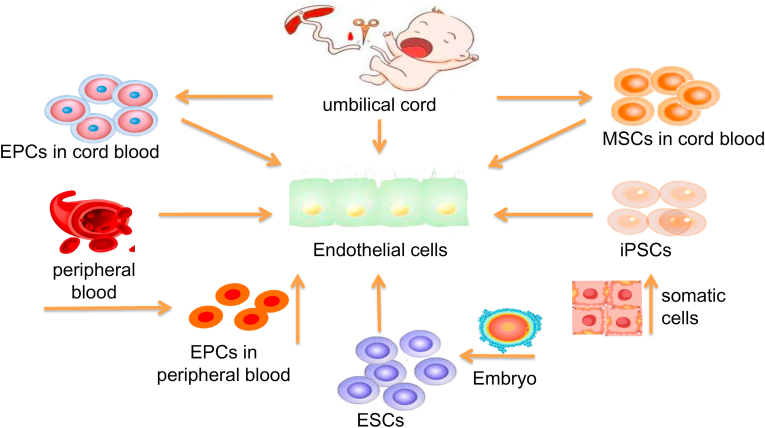
Tissue-engineered vascular grafts (TEVGs) have enormous potential for vascular replacement therapy. However, thrombosis and intimal hyperplasia are important problems associated with TEVGs especially small diameter TEVGs (<6 mm) after transplantation. Endothelialization of TEVGs is a key point to prevent thrombosis. Here, we discuss different types of endothelialization and different seed cells of tissue-engineered vascular grafts. Meanwhile, endothelial heterogeneity is also discussed. Based on it, we provide a new perspective for selecting suitable types of endothelialization and suitable seed cells to improve the long-term patency rate of tissue-engineered vascular grafts with different diameters and lengths.
组织工程血管移植物(TEVGs)在血管替代治疗方面具有巨大潜力。然而,血栓形成和内膜增生是与TEVGs相关的重要问题,尤其是移植后的小直径TEVGs(<6毫米)。TEVGs的内皮化是预防血栓形成的关键。在此,我们讨论了组织工程血管移植物的不同内皮化类型和不同种子细胞。同时,也讨论了内皮异质性。在此基础上,我们为选择合适的内皮化类型和合适的种子细胞提供了一个新的视角,以提高不同直径和长度的组织工程血管移植物的长期通畅率。