Li Miaomiao, Liang Shujia, Zhou Chao, Chen Min, Liang Shu, Liu Chunhua, Zuo Zhongbao, Liu Lei, Feng Yi, Song Chang, Xing Hui, Ruan Yuhua, Shao Yiming, Liao Lingjie
National Center for AIDS/STD Control and Prevention, Chinese Center for Disease Control and Prevention, Beijing 102206, China.
Guangxi Center for Disease Control and Prevention, Guangxi, Nanning 530028, China.
Pathogens. 2021 Feb 25;10(3):264. doi: 10.3390/pathogens10030264.
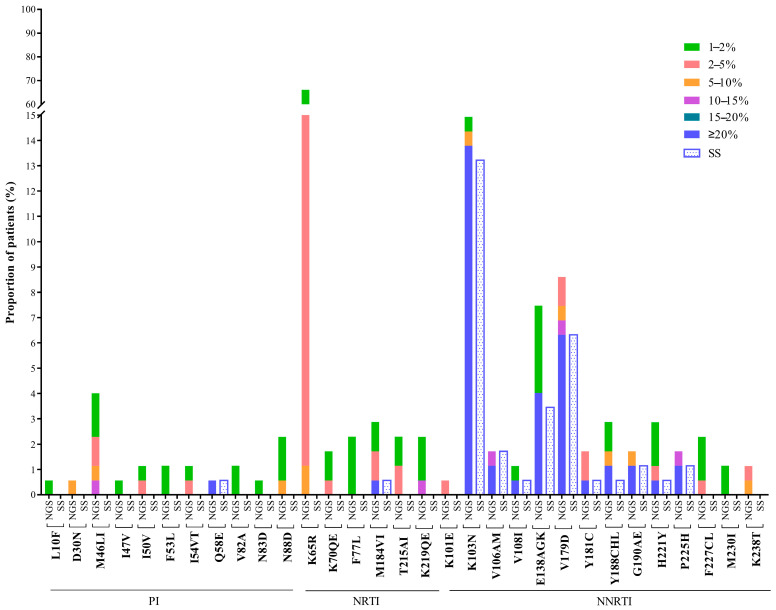
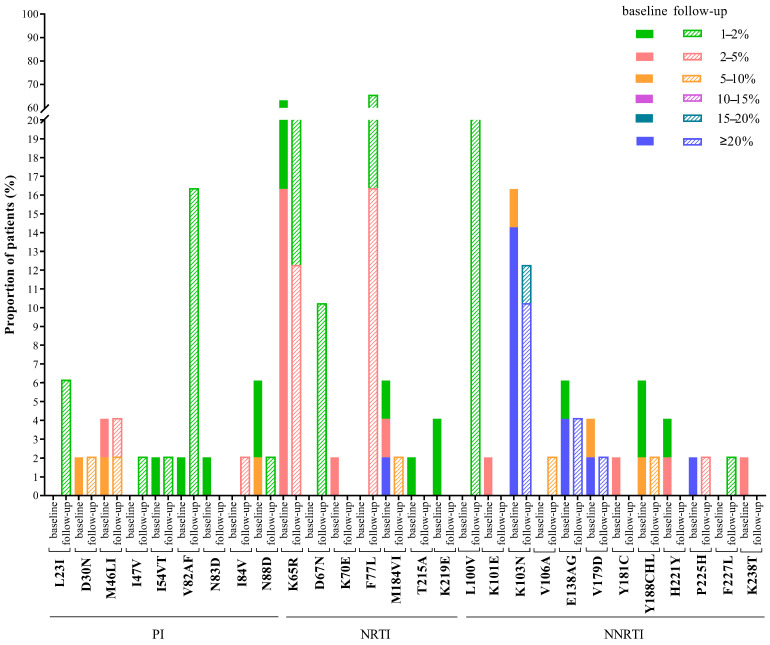
Patients with antiretroviral therapy interruption have a high risk of virological failure when re-initiating antiretroviral therapy (ART), especially those with HIV drug resistance. Next-generation sequencing may provide close scrutiny on their minority drug resistance variant. A cross-sectional study was conducted in patients with ART interruption in five regions in China in 2016. Through Sanger and next-generation sequencing in parallel, HIV drug resistance was genotyped on their plasma samples. Rates of HIV drug resistance were compared by the McNemar tests. In total, 174 patients were included in this study, with a median 12 (interquartile range (IQR), 6-24) months of ART interruption. Most (86.2%) of them had received efavirenz (EFV)/nevirapine (NVP)-based first-line therapy for a median 16 (IQR, 7-26) months before ART interruption. Sixty-one (35.1%) patients had CRF07_BC HIV-1 strains, 58 (33.3%) CRF08_BC and 35 (20.1%) CRF01_AE. Thirty-four (19.5%) of the 174 patients were detected to harbor HIV drug-resistant variants on Sanger sequencing. Thirty-six (20.7%), 37 (21.3%), 42 (24.1%), 79 (45.4%) and 139 (79.9) patients were identified to have HIV drug resistance by next-generation sequencing at 20% (v.s. Sanger, = 0.317), 10% (v.s. Sanger, = 0.180), 5% (v.s. Sanger, = 0.011), 2% (v.s. Sanger, < 0.001) and 1% (v.s. Sanger, < 0.001) of detection thresholds, respectively. K65R was the most common minority mutation, of 95.1% (58/61) and 93.1% (54/58) in CRF07_BC and CRF08_BC, respectively, when compared with 5.7% (2/35) in CRF01_AE ( < 0.001). In 49 patients that followed-up a median 10 months later, HIV drug resistance mutations at >20% frequency such as K103N, M184VI and P225H still existed, but with decreased frequencies. The prevalence of HIV drug resistance in ART interruption was higher than 15% in the survey. Next-generation sequencing was able to detect more minority drug resistance variants than Sanger. There was a sharp increase in minority drug resistance variants when the detection threshold was below 5%.
抗逆转录病毒治疗中断的患者在重新开始抗逆转录病毒治疗(ART)时存在病毒学失败的高风险,尤其是那些具有HIV耐药性的患者。新一代测序可能会对其少数耐药变异体进行仔细检查。2016年在中国五个地区对接受ART中断治疗的患者进行了一项横断面研究。通过同时进行桑格测序和新一代测序,对他们的血浆样本进行HIV耐药基因分型。采用McNemar检验比较HIV耐药率。本研究共纳入174例患者,ART中断的中位时间为12(四分位间距(IQR),6 - 24)个月。其中大多数(86.2%)在ART中断前接受了以依非韦伦(EFV)/奈韦拉平(NVP)为基础的一线治疗,中位时间为16(IQR,7 - 26)个月。61例(35.1%)患者感染CRF07_BC型HIV - 1毒株,58例(33.3%)为CRF08_BC型,35例(20.1%)为CRF01_AE型。在174例患者中,34例(19.5%)通过桑格测序检测到携带HIV耐药变异体。在新一代测序中,分别在20%(与桑格测序相比,P = 0.317)、10%(与桑格测序相比,P = 0.180)、5%(与桑格测序相比,P = 0.011)、2%(与桑格测序相比,P < 0.001)和1%(与桑格测序相比,P < 0.001)的检测阈值下,有36例(20.7%)、37例(21.3%)、42例(24.1%)、79例(45.4%)和139例(79.9%)患者被鉴定为具有HIV耐药性。K65R是最常见的少数变异,在CRF07_BC型中分别为95.1%(58/61),在CRF08_BC型中为93.1%(54/58),而在CRF01_AE型中为5.7%(2/35)(P < 0.001)。在中位时间10个月后随访的49例患者中,频率>20%的HIV耐药突变如K第103位密码子由天冬酰胺突变为天冬氨酸(K103N)、M第184位密码子由缬氨酸突变为异亮氨酸(M184VI)和P第225位密码子由组氨酸突变为酪氨酸(P225H)仍然存在,但频率降低。在该调查中,ART中断患者中HIV耐药的患病率高于15%。新一代测序比桑格测序能够检测到更多的少数耐药变异体。当检测阈值低于时,少数耐药变异体急剧增加。 5%