Beijing Ditan Hospital, Capital Medical University, Beijing, China.
Clinical Center for HIV/AIDS, Capital Medical University, Beijing, China.
Biomed Res Int. 2022 Nov 23;2022:2100254. doi: 10.1155/2022/2100254. eCollection 2022.
Drug resistance testing in HIV-1 low-level viremia (LLV) samples is challenging yet critical. Our study is aimed at assessing the performance of lentivirus concentration reagent (LCR) in combination with a validated Sanger sequencing (SS) for monitoring drug resistance mutations (DRMs) in LLV samples.
A series of clinical samples were diluted and amplified for genotypic resistance testing (GRT) to prove the performance of the LCR. The Stanford HIV-1 drug resistance database (HIVdb version 8.9) was used to analyze the mutations. HIV-1 subtypes and CRFs were determined using the COMET online tool. The overall success rate of genotyping was compared with ultracentrifugation combined with SS. Furthermore, the success rates at varied VL of the two concentration methods were evaluated, and the DRMs of diluted samples were compared with those undiluted samples.
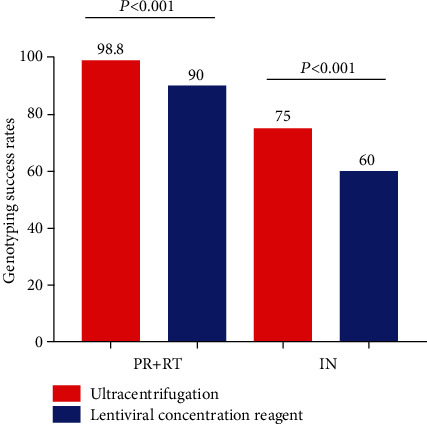
When LCR was used, the overall success rate was 90% (72/80) in the PR and RT regions and 60% (48/80) in the IN region. In addition, when HIV RNA was 1000 copies/ml, 400 copies/ml, 200 copies/ml, and 100 copies/ml, the success rates of PR and RT regions were 100%, 100%, 95%, and 65%, respectively, while the success rates of IN region were 85%, 60%, 45%, and 50%, respectively. We found that the sample DR-387A2 missed the E138A mutation, and mutations in other samples were consistent with undiluted samples using LCR.
LCR will support monitoring DRMs in HIV-1 patients with LLV and can be an effective alternative for small- and medium-sized laboratories that cannot afford an ultracentrifuge.
在 HIV-1 低病毒载量(LLV)样本中进行耐药性检测具有挑战性,但至关重要。我们的研究旨在评估慢病毒浓缩试剂(LCR)与经过验证的 Sanger 测序(SS)相结合在监测 LLV 样本中耐药突变(DRMs)方面的性能。
对一系列临床样本进行稀释和扩增,进行基因型耐药性检测(GRT),以证明 LCR 的性能。使用斯坦福 HIV-1 耐药性数据库(HIVdb 版本 8.9)分析突变。使用 COMET 在线工具确定 HIV-1 亚型和 CRFs。比较了超离心与 SS 联合进行基因分型的总体成功率。此外,评估了两种浓缩方法在不同 VL 下的成功率,并比较了稀释样本和未稀释样本的 DRMs。
使用 LCR 时,PR 和 RT 区的总体成功率为 90%(72/80),IN 区的成功率为 60%(48/80)。此外,当 HIV RNA 为 1000 拷贝/ml、400 拷贝/ml、200 拷贝/ml 和 100 拷贝/ml 时,PR 和 RT 区的成功率分别为 100%、100%、95%和 65%,而 IN 区的成功率分别为 85%、60%、45%和 50%。我们发现,样本 DR-387A2 错过了 E138A 突变,而使用 LCR 的其他样本中的突变与未稀释样本一致。
LCR 将支持监测 HIV-1 低病毒载量患者的 DRMs,并且可以作为无法负担超速离心机的中小实验室的有效替代方法。