Department of Horticulture, Division of Applied Life Science (BK21 Four), Gyeongsang National University, Jinju 52828, Korea.
Institute of Agriculture & Life Science, Gyeongsang National University, Jinju 52828, Korea.
Int J Mol Sci. 2021 Feb 25;22(5):2279. doi: 10.3390/ijms22052279.
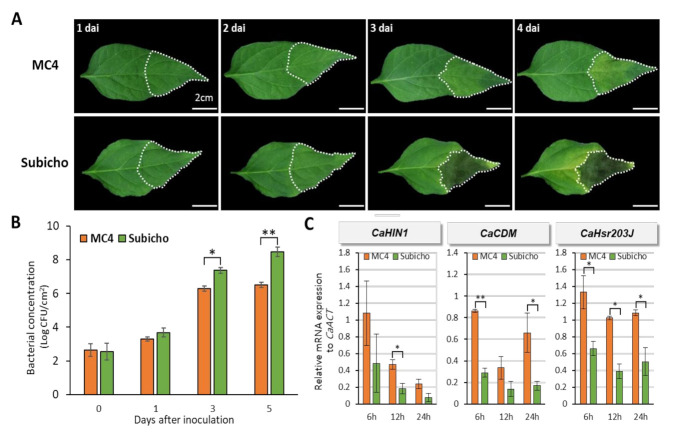
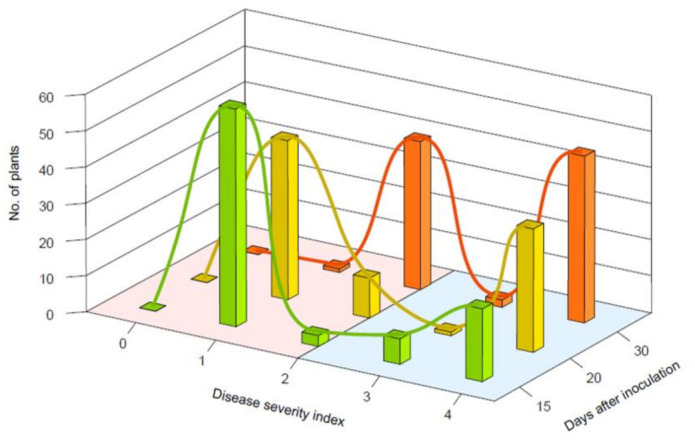
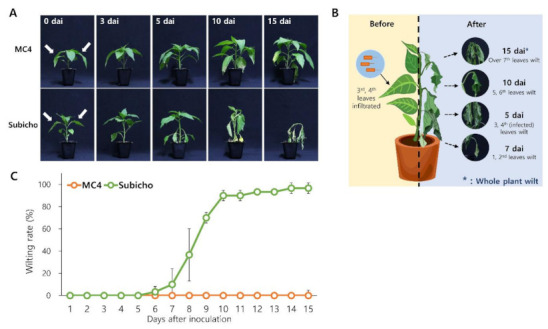
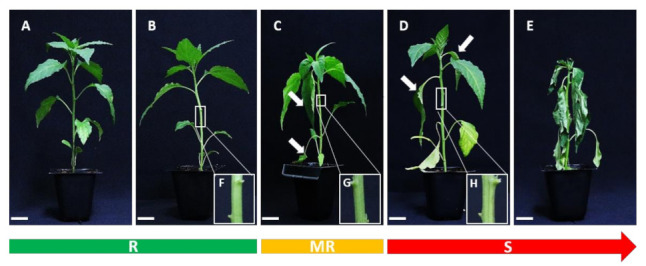
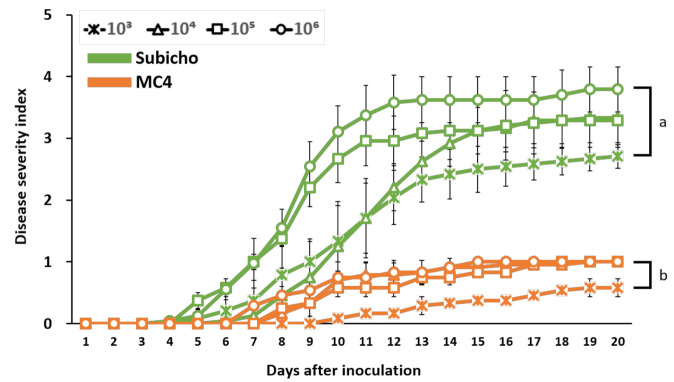
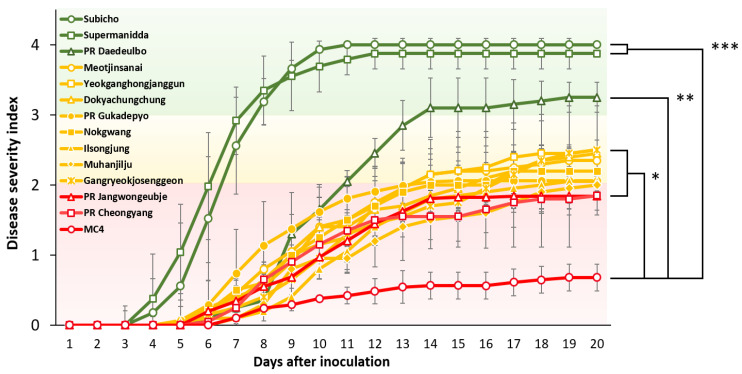
Bacterial wilt (BW) disease from is a serious disease and causes severe yield losses in chili peppers worldwide. Resistant cultivar breeding is the most effective in controlling BW. Thus, a simple and reliable evaluation method is required to assess disease severity and to investigate the inheritance of resistance for further breeding programs. Here, we developed a reliable leaf-to-whole plant spread bioassay for evaluating BW disease and then, using this, determined the inheritance of resistance to in peppers. 'MC4' displayed a completely resistant response with fewer disease symptoms, a low level of bacterial cell growth, and significant up-regulations of defense genes in infected leaves compared to those in susceptible 'Subicho'. We also observed the spreading of wilt symptoms from the leaves to the whole susceptible plant, which denotes the normal BW wilt symptoms, similar to the drenching method. Through this, we optimized the evaluation method of the resistance to BW. Additionally, we performed genetic analysis for resistance inheritance. The parents, F and 90 F progenies, were evaluated, and the two major complementary genes involved in the BW resistance trait were confirmed. These could provide an accurate evaluation to improve resistant pepper breeding efficiency against BW.
辣椒青枯病是一种严重的疾病,会导致全球辣椒产量严重损失。培育抗病品种是控制青枯病最有效的方法。因此,需要一种简单可靠的评价方法来评估疾病严重程度,并研究抗性的遗传,以进一步进行育种计划。在这里,我们开发了一种可靠的叶片到全株传播生物测定法来评估青枯病,然后使用该方法确定了辣椒对 的抗性遗传。与易感品种“Subicho”相比,‘MC4’表现出完全抗性反应,病斑较少,细菌细胞生长水平较低,感染叶片中防御基因的表达水平显著上调。我们还观察到萎蔫症状从叶片扩散到整个易感植株,这表示出现了正常的青枯病萎蔫症状,类似于浸灌法。通过这种方法,我们优化了对 BW 抗性的评价方法。此外,我们还进行了遗传分析以确定抗性遗传。对亲本、F 和 90 F 后代进行了评价,并证实了与 BW 抗性性状相关的两个主要互补基因。这些可以提供准确的评估,以提高对 BW 的抗性辣椒育种效率。