IRCCS Fondazione Don Carlo Gnocchi, 20148 Milano, Italy.
Department of Pathophysiology and Transplantation, University of Milano, 20122 Milano, Italy.
Molecules. 2021 Feb 11;26(4):953. doi: 10.3390/molecules26040953.
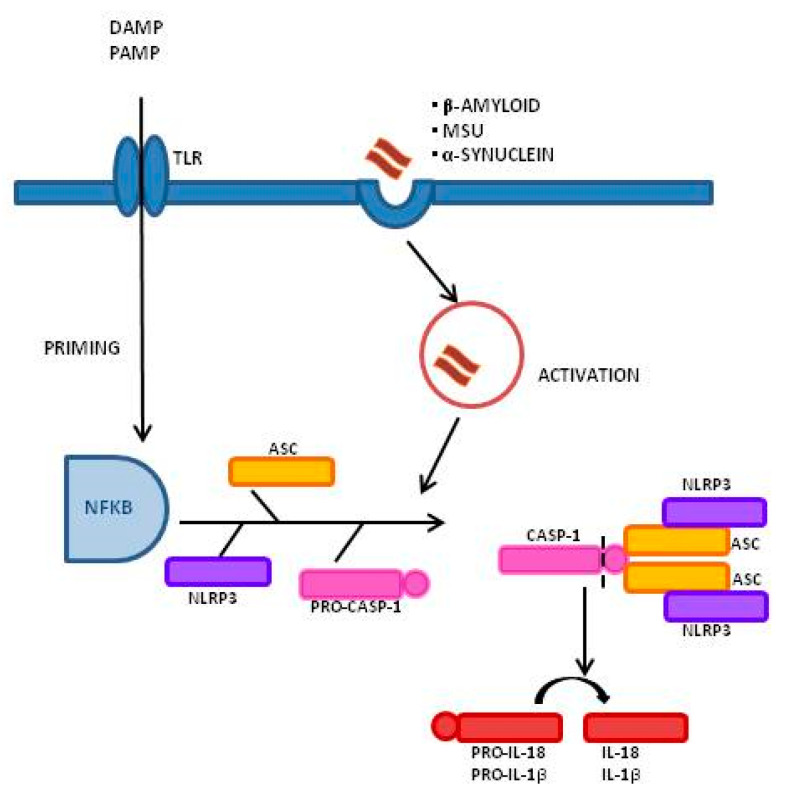
Neurodegenerative diseases are chronic, progressive disorders that occur in the central nervous system (CNS). They are characterized by the loss of neuronal structure and function and are associated with inflammation. Inflammation of the CNS is called neuroinflammation, which has been implicated in most neurodegenerative diseases, including Alzheimer's disease (AD), Parkinson's disease (PD), amyotrophic lateral sclerosis (ALS) and multiple sclerosis (MS). Much evidence indicates that these different conditions share a common inflammatory mechanism: the activation of the inflammasome complex in peripheral monocytes and in microglia, with the consequent production of high quantities of the pro-inflammatory cytokines IL-1β and IL-18. Inflammasomes are a group of multimeric signaling complexes that include a sensor Nod-like receptor (NLR) molecule, the adaptor protein ASC, and caspase-1. The NLRP3 inflammasome is currently the best-characterized inflammasome. Multiple signals, which are potentially provided in combination and include endogenous danger signals and pathogens, trigger the formation of an active inflammasome, which, in turn, will stimulate the cleavage and the release of bioactive cytokines including IL-1β and IL-18. In this review, we will summarize results implicating the inflammasome as a pivotal player in the pathogenesis of neurodegenerative diseases and discuss how compounds that hamper the activation of the NLRP3 inflammasome could offer novel therapeutic avenues for these diseases.
神经退行性疾病是发生在中枢神经系统(CNS)的慢性、进行性疾病。它们的特征是神经元结构和功能的丧失,并与炎症有关。CNS 的炎症称为神经炎症,它与大多数神经退行性疾病有关,包括阿尔茨海默病(AD)、帕金森病(PD)、肌萎缩侧索硬化症(ALS)和多发性硬化症(MS)。大量证据表明,这些不同的疾病有共同的炎症机制:外周单核细胞和小胶质细胞中炎性小体复合物的激活,随之产生大量的促炎细胞因子 IL-1β 和 IL-18。炎性小体是一组多聚体信号复合物,包括传感器 Nod 样受体(NLR)分子、衔接蛋白 ASC 和半胱天冬酶-1。NLRP3 炎性小体是目前研究最充分的炎性小体。多种信号(可能以组合的方式提供),包括内源性危险信号和病原体,触发活性炎性小体的形成,反过来又会刺激生物活性细胞因子(包括 IL-1β 和 IL-18)的切割和释放。在这篇综述中,我们将总结表明炎性小体作为神经退行性疾病发病机制中的关键因素的结果,并讨论如何抑制 NLRP3 炎性小体的激活的化合物可能为这些疾病提供新的治疗途径。