Department of Sociology, Zhou Enlai School of Government, Computational Social Science Lab, Nankai University, Tianjin 300353, China.
Department of Sociology, University of South Florida, Tampa, FL 33620, USA.
Int J Environ Res Public Health. 2021 Feb 11;18(4):1748. doi: 10.3390/ijerph18041748.
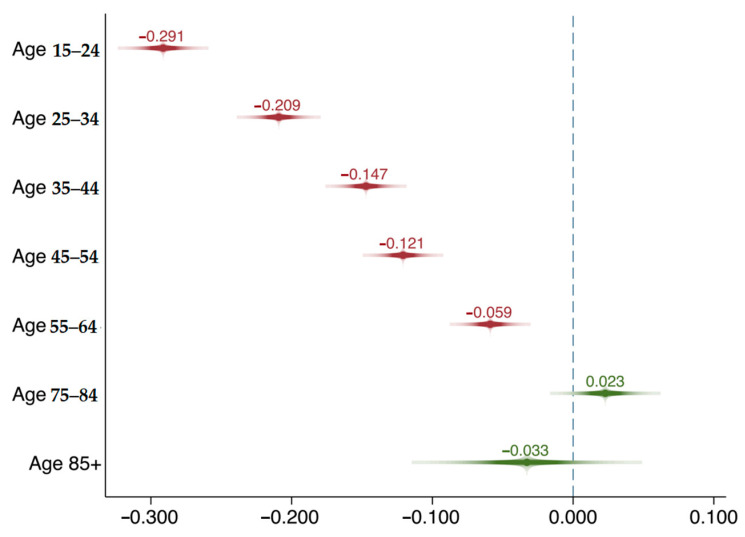
Population change and environmental degradation have become two of the most pressing issues for sustainable development in the contemporary world, while the effect of population aging on pro-environmental behavior remains controversial. In this paper, we examine the effects of individual and population aging on pro-environmental behavior through multilevel analyses of cross-national data from 31 countries. Hierarchical linear models with random intercepts are employed to analyze the data. The findings reveal a positive relationship between aging and pro-environmental behavior. At the individual level, older people are more likely to participate in environmental behavior ( = 0.052, < 0.001), and at the national level, living in a country with a greater share of older persons encourages individuals to behave sustainably ( = 0.023, < 0.01). We also found that the elderly are more environmentally active in an aging society. The findings imply that the longevity of human beings may offer opportunities for the improvement of the natural environment.
人口变化和环境恶化已成为当代世界可持续发展的两个最紧迫的问题,而人口老龄化对环保行为的影响仍存在争议。本文通过对来自 31 个国家的跨国数据进行多层次分析,研究了人口老龄化对环保行为的影响。采用具有随机截距的层次线性模型对数据进行分析。研究结果表明,老龄化与环保行为之间存在正相关关系。在个体层面上,老年人更有可能参与环境行为( = 0.052, < 0.001),在国家层面上,生活在一个老年人比例较高的国家会鼓励个人采取可持续的行为( = 0.023, < 0.01)。我们还发现,在老龄化社会中,老年人的环保意识更强。研究结果表明,人类的长寿可能为改善自然环境提供机会。