Grujcic Djordje, Yazici Atilla Mustafa, Tutus Yusuf, Cakmak Ismail, Singh Bal Ram
Faculty of Environmental Sciences and Natural Resource Management, Norwegian University of Life Science, 1432 Ås, Norway.
Faculty of Engineering and Natural Sciences, Sabanci University, Istanbul 34956, Turkey.
Plants (Basel). 2021 Feb 18;10(2):391. doi: 10.3390/plants10020391.
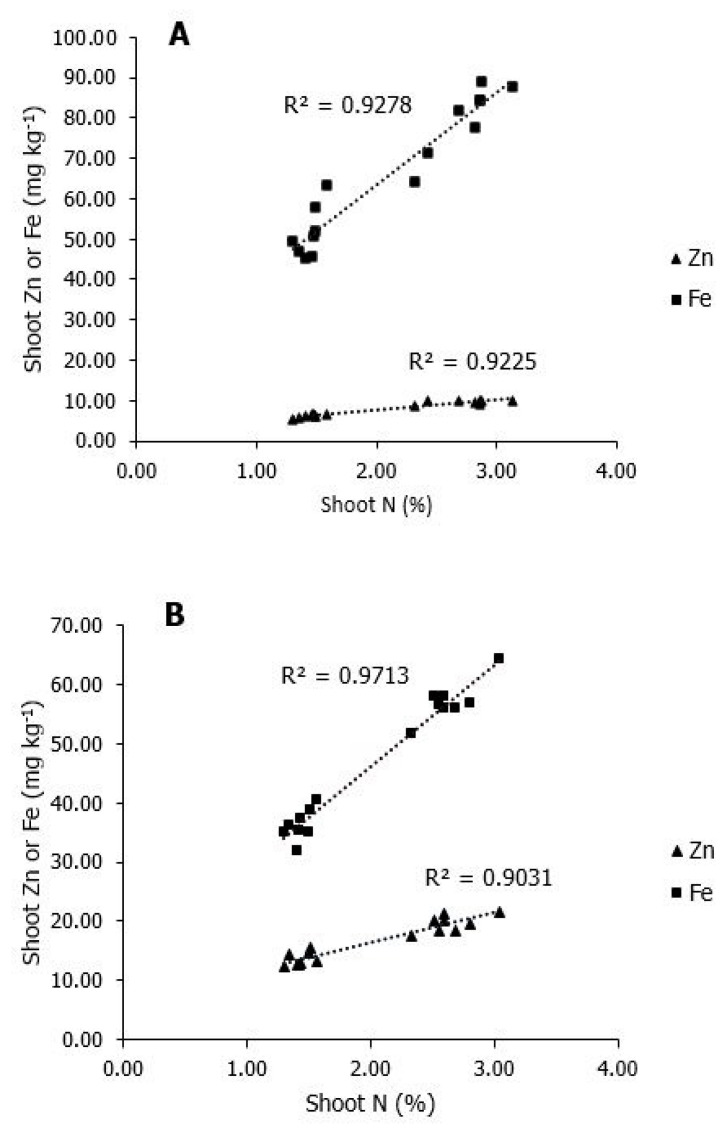
Agronomic biofortification is one of the main strategies for alleviation of micronutrient deficiencies in human populations and promoting sustainable production of food and feed. The aim of this study was to investigate the effect of nitrogen (N)fertilization on biofortification of maize crop ( L.) with zinc (Zn), iron (Fe) and selenium (Se) grown on a micronutrient deficient soil under greenhouse conditions. Factorial design experiment was set under greenhouse conditions. The experiment consisted of two levels of each N, Zn, Fe and Se. The levels for N were 125 and 250 mg N kg soil; Zn were 1 and 5 mg Zn kg soil; levels of Fe were 0 and 10 mg Fe kg soil; levels of Se were 0 and 0.02 mg Se kg soil. An additional experiment was also conducted to study the effect of the Zn form applied as a ZnO or ZnSO on shoot growth, shoot Zn concentration and total shoot Zn uptake per plant. Shoot Zn concentrations increased by increasing soil Zn application both with ZnSO and ZnO treatments, but the shoot Zn concentration and total Zn uptake were much greater with ZnSO than the ZnO application. Under given experimental conditions, increasing soil N supply improved shoot N concentration; but had little effect on shoot dry matter production. The concentrations of Zn and Fe in shoots were significantly increased by increasing N application. In case of total uptake of Zn and Fe, the positive effect of N nutrition was more pronounced. Although Se soil treatment had significant effect, N application showed no effect on Se concentration and accumulation in maize shoots. The obtained results show that N fertilization is an effective tool in improving the Zn and Fe status of silage maize and contribute to the better-quality feed.
农艺生物强化是缓解人群微量营养素缺乏和促进粮食及饲料可持续生产的主要策略之一。本研究的目的是在温室条件下,研究在缺乏微量营养素的土壤上种植的玉米作物(L.)施氮(N)对锌(Zn)、铁(Fe)和硒(Se)生物强化的影响。在温室条件下进行析因设计实验。实验包括氮、锌、铁和硒各两个水平。氮的水平为125和250毫克氮/千克土壤;锌为1和5毫克锌/千克土壤;铁的水平为0和10毫克铁/千克土壤;硒的水平为0和0.02毫克硒/千克土壤。还进行了一项额外实验,研究以氧化锌或硫酸锌形式施用锌对地上部生长、地上部锌浓度和单株地上部总锌吸收量的影响。在硫酸锌和氧化锌处理中,地上部锌浓度均随土壤锌施用量的增加而增加,但硫酸锌处理的地上部锌浓度和总锌吸收量远高于氧化锌处理。在给定的实验条件下,增加土壤氮供应可提高地上部氮浓度;但对地上部干物质产量影响不大。施氮显著提高了地上部锌和铁的浓度。在锌和铁的总吸收量方面,氮营养的积极作用更为明显。虽然土壤硒处理有显著影响,但施氮对玉米地上部硒浓度和积累没有影响。所得结果表明,施氮是改善青贮玉米锌和铁状况的有效手段,有助于提高饲料质量。