de Lagarde Maud, Vanier Ghyslaine, Arsenault Julie, Fairbrother John Morris Morris
OIE Reference Laboratory for Escherichia coli, Faculty of Veterinary Medicine, Université de Montréal, Saint-Hyacinthe, QC J2S2M2, Canada.
Swine and Poultry Infectious Research Center (CRIPA-FQRNT), Faculty of Veterinary Medicine, Université de Montréal, Saint-Hyacinthe, QC J2S2M2, Canada.
Antibiotics (Basel). 2021 Feb 28;10(3):244. doi: 10.3390/antibiotics10030244.
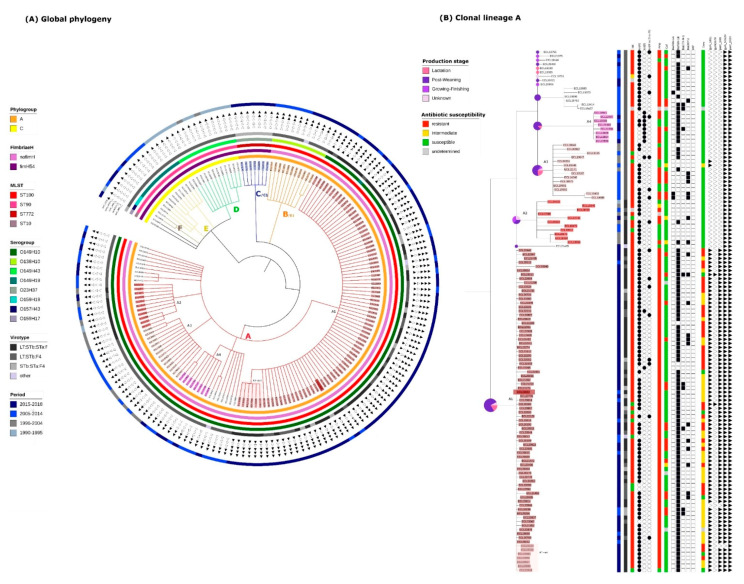
The definition of a high risk clone for antibiotic resistance dissemination was initially established for human medicine. We propose a revised definition of a high risk clone adapted to the One Health context. Then, we applied our criteria to a cluster of enrofloxacin non susceptible ETEC:F4 isolates which emerged in 2013 in diseased pigs in Quebec. The whole genomes of 183 ETEC:F4 strains isolated in Quebec from 1990 to 2018 were sequenced. The presence of virulence and resistance genes and replicons was examined in 173 isolates. Maximum likelihood phylogenetic trees were constructed based on SNP data and clones were identified using a set of predefined criteria. The strains belonging to the clonal lineage ST100/O149:H10 isolated in Quebec in 2013 or later were compared to ETEC:F4 whole genome sequences available in GenBank. Prior to 2000, ETEC:F4 isolates from pigs in Quebec were mostly ST90 and belonged to several serotypes. After 2000, the isolates were mostly ST100/O149:H10. In this article, we demonstrated the presence of a ETEC:F4 high risk clone. This clone (1) emerged in 2013, (2) is multidrug resistant, (3) has a widespread distribution over North America and was able to persist several months on farms, and (4) possesses specific virulence genes. It is crucial to detect and characterize high risk clones in animal populations to increase our understanding of their emergence and their dissemination.
抗生素耐药性传播高风险克隆的定义最初是为人类医学制定的。我们提出了一个适用于“同一健康”背景的高风险克隆的修订定义。然后,我们将我们的标准应用于2013年在魁北克患病猪中出现的一群对恩诺沙星不敏感的产肠毒素大肠杆菌F4分离株。对1990年至2018年在魁北克分离的183株产肠毒素大肠杆菌F4菌株的全基因组进行了测序。在173株分离株中检测了毒力、抗性基因和复制子的存在。基于单核苷酸多态性数据构建了最大似然系统发育树,并使用一组预定义标准鉴定了克隆。将2013年或之后在魁北克分离的属于克隆谱系ST100/O149:H10的菌株与GenBank中可获得的产肠毒素大肠杆菌F4全基因组序列进行了比较。2000年之前,魁北克猪的产肠毒素大肠杆菌F4分离株大多为ST90,属于几种血清型。2000年之后,分离株大多为ST100/O149:H10。在本文中,我们证明了产肠毒素大肠杆菌F4高风险克隆的存在。这个克隆(1)于2013年出现,(2)具有多重耐药性,(3)在北美广泛分布且能够在农场持续存在数月,以及(4)拥有特定的毒力基因。检测和鉴定动物群体中的高风险克隆对于增进我们对其出现和传播的理解至关重要。