Department of Computer Science, Memorial University of Newfoundland, St. John's, NL A1B 3X5, Canada.
Biomedical and Mobile Health Technology Laboratory, Department of Health Sciences and Technology, ETH Zürich, 8008 Zürich, Switzerland.
Sensors (Basel). 2021 Feb 22;21(4):1504. doi: 10.3390/s21041504.
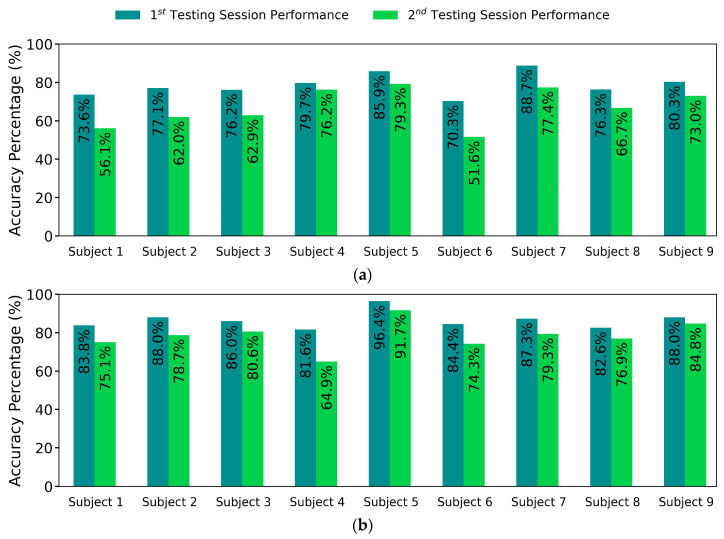
ForceMyography (FMG) is an emerging competitor to surface ElectroMyography (sEMG) for hand gesture recognition. Most of the state-of-the-art research in this area explores different machine learning algorithms or feature engineering to improve hand gesture recognition performance. This paper proposes a novel signal processing pipeline employing a manifold learning method to produce a robust signal representation to boost hand gesture classifiers' performance. We tested this approach on an FMG dataset collected from nine participants in 3 different data collection sessions with short delays between each. For each participant's data, the proposed pipeline was applied, and then different classification algorithms were used to evaluate the effect of the pipeline compared to raw FMG signals in hand gesture classification. The results show that incorporating the proposed pipeline reduced variance within the same gesture data and notably maximized variance between different gestures, allowing improved robustness of hand gestures classification performance and consistency across time. On top of that, the pipeline improved the classification accuracy consistently regardless of different classifiers, gaining an average of 5% accuracy improvement.
力感肌电(FMG)是一种新兴的对手表肌电(sEMG)的竞争者,用于手势识别。该领域的大多数最新研究都探索了不同的机器学习算法或特征工程,以提高手势识别性能。本文提出了一种新颖的信号处理管道,采用流形学习方法来生成稳健的信号表示,从而提高手势分类器的性能。我们在从 9 名参与者收集的 FMG 数据集上测试了该方法,这些参与者在每次采集之间有很短的时间间隔。对于每个参与者的数据,应用了所提出的管道,然后使用不同的分类算法来评估与原始 FMG 信号相比,该管道在手势分类中的效果。结果表明,在相同的手势数据中,采用所提出的管道可以减少方差,并且在不同的手势之间显著地最大化方差,从而允许手势分类性能具有更好的稳健性和一致性。此外,该管道无论使用哪种分类器,都能一致地提高分类准确性,平均提高了 5%的准确性。