Engelhardt Institute of Molecular Biology, Russian Academy of Sciences, Moscow 119991, Russia.
Institute for Atherosclerosis Research, Skolkovo Innovative Center, Moscow 121609, Russia.
Cells. 2021 Feb 15;10(2):395. doi: 10.3390/cells10020395.
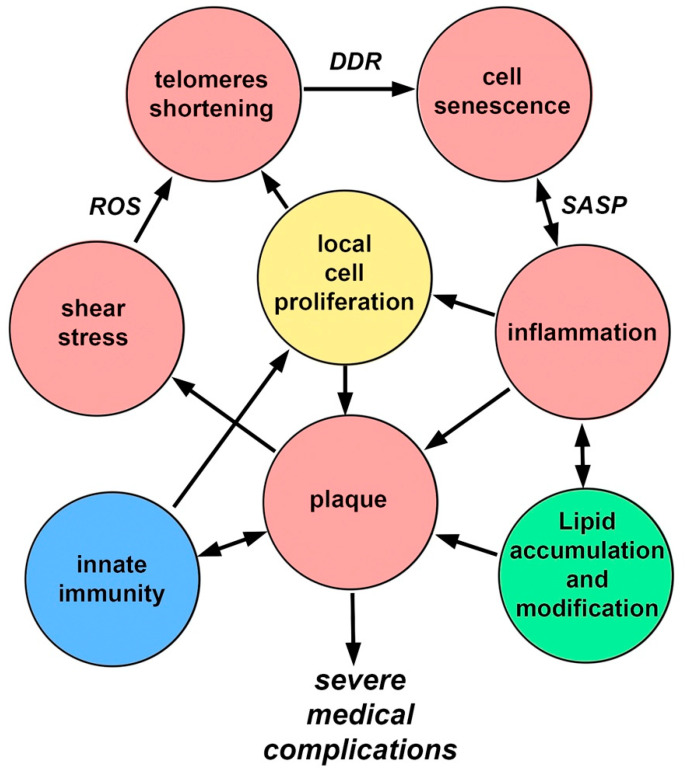
It is known that the shortening of the telomeres leads to cell senescence, accompanied by acquiring of pro-inflammatory phenotype. The expression of telomerase can elongate telomeres and resist the onset of senescence. The initiation of atherosclerosis is believed to be associated with local senescence of the endothelial cells of the arteries in places with either low or multidirectional oscillatory wall shear stress. The process of regeneration of the artery surface that has begun does not lead to success for several reasons. Atherosclerotic plaques are formed, which, when developed, lead to fatal consequences, which are the leading causes of death in the modern world. The pronounced age dependence of the manifestations of atherosclerosis pushes scientists to try to link the development of atherosclerosis with telomere length. The study of the role of telomere shortening in atherosclerosis is mainly limited to measuring the telomeres of blood cells, and only in rare cases (surgery or post-mortem examination) are the telomeres of local cells available for measurement. The review discusses the basic issues of cellular aging and the interpretation of telomere measurement data in atherosclerosis, as well as the prospects for the prevention and possible treatment of atherosclerosis.
众所周知,端粒缩短会导致细胞衰老,并伴有促炎表型的获得。端粒酶的表达可以延长端粒,抵抗衰老的发生。动脉粥样硬化的发生被认为与低或多向振荡壁切应力部位的动脉内皮细胞局部衰老有关。已经开始的动脉表面再生过程由于多种原因未能成功。动脉粥样硬化斑块形成,当发展到一定程度时,会导致致命的后果,这是现代世界死亡的主要原因。动脉粥样硬化表现出明显的年龄依赖性,促使科学家试图将动脉粥样硬化的发展与端粒长度联系起来。端粒缩短在动脉粥样硬化中的作用研究主要局限于测量血细胞的端粒,只有在极少数情况下(手术或死后检查)才能测量局部细胞的端粒。该综述讨论了细胞衰老的基本问题和端粒测量数据在动脉粥样硬化中的解释,以及动脉粥样硬化的预防和可能的治疗前景。