IDI-IRCCS, Dermatological Research Hospital, Via dei Monti di Creta 104, 00167 Rome, Italy.
Department of Pharmaceutical and Pharmacological Sciences, University of Padua, 35121 Padua, Italy.
Biomolecules. 2021 Feb 23;11(2):332. doi: 10.3390/biom11020332.
Systemic photoprotection (i.e., administration of substances such as nicotinamide, carotenoids, and vitamin D) may be important to reduce photocarcinogenesis or to support long-term protection against UV irradiation. Clinical trials showed that oral nicotinamide is effective in reducing the onset of new nonmelanoma skin cancers (NMSCs), while other oral photoprotectors failed to achieve the reduction of new melanoma or NMSC formation in humans. The aim of this study was to summarize the current state of knowledge of systemic photoprotection and to evaluate the knowledge and attitude of dermatologists regarding these treatments.
The survey was conducted on a sample of dermatologists recruited according to a snowball sampling procedure. The questionnaire consisted of a first part asking for characteristics of the participant and a second part with 12 specific questions on their knowledge about systemic photoprotection, particularly their knowledge of astaxanthin, β-carotene, nicotinamide, and vitamin D3.
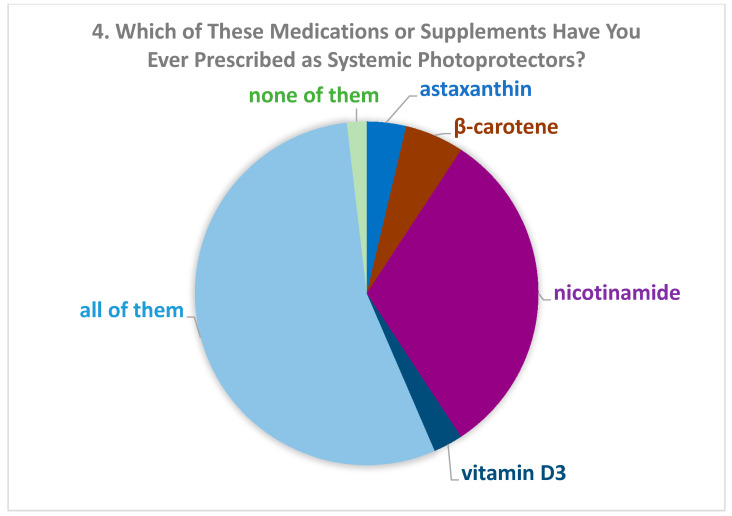
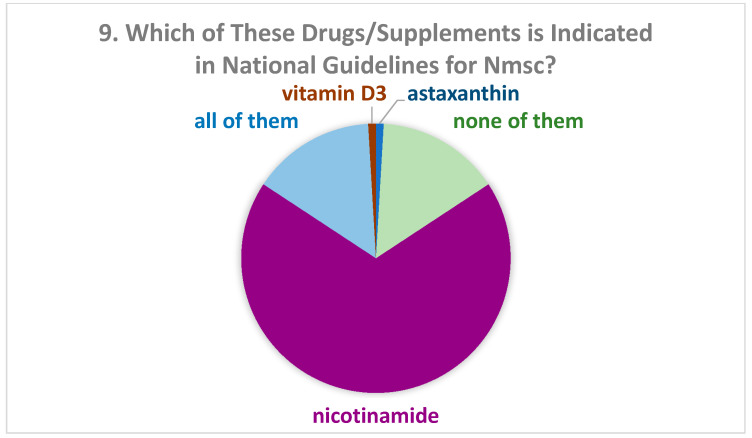
One hundred eight dermatologists answered the survey. Most of them (85.2%) stated that oral photoprotectors have a role in the prevention of skin cancer, and responses mainly mentioned nicotinamide. More than half of them (54.6%) had prescribed all the considered oral photoprotectors, but the majority of them had prescribed nicotinamide, mainly for 2 to 3 months during summer, almost invariably ( = 106) associated with topical photoprotectors. Most dermatologists (>80%) were aware of scientific publications demonstrating an effect of systemic photoprotectors on NMSC.
Most Italian dermatologists have positive views on oral photoprotection in skin cancer and are aware of the demonstrated potential of nicotinamide in the prevention of NMSCs.
全身光防护(即给予烟酰胺、类胡萝卜素和维生素 D 等物质)对于减少光致癌或长期抵抗紫外线照射可能很重要。临床试验表明,口服烟酰胺可有效减少新发非黑素瘤皮肤癌(NMSC)的发生,而其他口服光防护剂未能降低人类新发黑色素瘤或 NMSC 的形成。本研究旨在总结全身光防护的现有知识,并评估皮肤科医生对这些治疗方法的认识和态度。
该调查是根据滚雪球抽样程序对招募的皮肤科医生进行的。问卷分为两部分:第一部分询问参与者的特征,第二部分有 12 个关于他们对全身光防护知识的具体问题,特别是对虾青素、β-胡萝卜素、烟酰胺和维生素 D3 的了解。
108 名皮肤科医生回答了这项调查。他们中的大多数(85.2%)表示口服光防护剂在预防皮肤癌方面有作用,且反应主要提到了烟酰胺。超过一半的人(54.6%)开了所有考虑的口服光防护剂,但他们中的大多数人开了烟酰胺,主要是在夏季持续 2 到 3 个月,几乎总是(=106)与局部光防护剂一起使用。大多数皮肤科医生(>80%)了解证明全身光防护剂对 NMSC 有影响的科学出版物。
大多数意大利皮肤科医生对口服光防护在皮肤癌中的作用持积极态度,并且意识到烟酰胺在预防 NMSC 方面的已证实潜力。