D&R Institute of Hygiene, Microbiology and Environmental Medicine, Medical University Graz, Neue Stiftingtalstrasse 6, A-8010 Graz, Austria
Department of Microbiology, University Hospital Center Zagreb, 10000 Zagreb, Croatia.
Int J Environ Res Public Health. 2021 Feb 23;18(4):2171. doi: 10.3390/ijerph18042171.
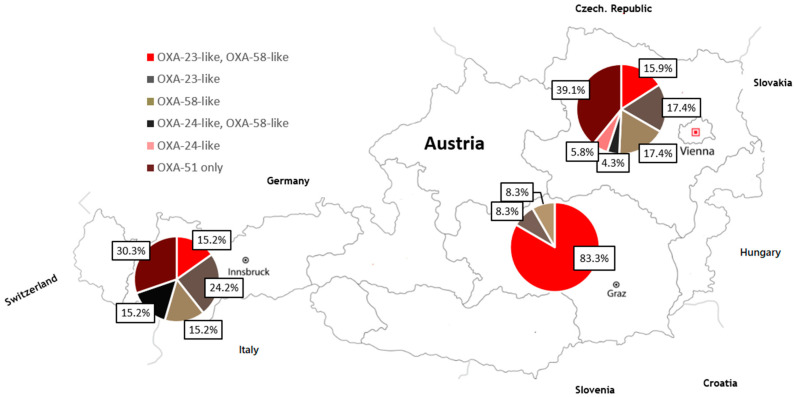
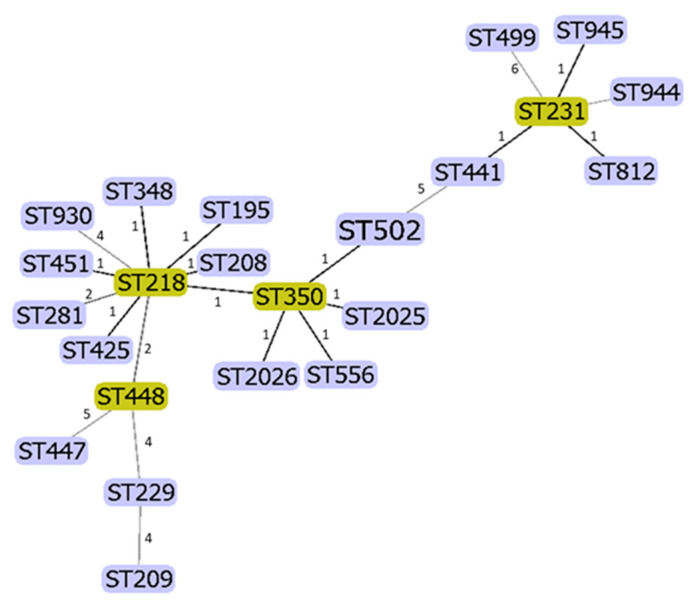
Carbapenem-resistant is a significant health problem worldwide. A multicenter study on was performed to investigate the molecular epidemiology and genetic background of carbapenem resistance of isolates collected from 2014-2017 in Austria. In total, 117 non-repetitive spp. assigned to ( = 114) and ( = 3) were collected from four centers in Austria. The isolates were uniformly resistant to piperacillin/tazobactam, ceftazidime, and carbapenems, and resistance to imipenem and meropenem was 97.4% and 98.2%, respectively. The most prominent OXA-types were OXA-58-like (46.5%) and OXA-23-like (41.2%), followed by OXA-24-like (10.5%), with notable regional differences. Carbapenem-hydrolyzing class D carbapenemases (CHDLs) were the only carbapenemases found in isolates in Austria since no metallo-β-lactamases (MBLs) nor KPC or GES carbapenemases were detected in any of the isolates. One-third of the isolates harbored multiple CHDLs. The population structure of isolates from Austria was found to be very diverse, while a total of twenty-three different sequence types (STs) were identified. The most frequent was ST195 found in 15.8%, followed by ST218 and ST231 equally found in 11.4% of isolates. Two new ST types, ST2025 and ST2026, were detected. In one isolate, was detected for the first time in Austria.
耐碳青霉烯肠杆菌科细菌是全球范围内一个重大的健康问题。一项针对奥地利 2014-2017 年采集的耐碳青霉烯肠杆菌科细菌的分子流行病学和遗传背景的多中心研究表明,从奥地利的四个中心共收集到 117 株非重复的 spp.,其中 (=114)和 (=3)。这些分离株对哌拉西林/他唑巴坦、头孢他啶和碳青霉烯类药物均具有均匀的耐药性,对亚胺培南和美罗培南的耐药率分别为 97.4%和 98.2%。最主要的 OXA 型别为 OXA-58 样(46.5%)和 OXA-23 样(41.2%),其次为 OXA-24 样(10.5%),具有显著的地区差异。在奥地利的 分离株中发现了唯一的碳青霉烯水解酶类 D 型碳青霉烯酶(CHDLs),因为在任何分离株中均未检测到金属β-内酰胺酶(MBLs)或 KPC 或 GES 碳青霉烯酶。三分之一的分离株携带多种 CHDLs。奥地利 分离株的种群结构被发现非常多样化,共鉴定出 23 种不同的序列型(STs)。最常见的是 ST195,占 15.8%,其次是 ST218 和 ST231,各占 11.4%。还检测到两种新的 ST 型,ST2025 和 ST2026。在一个 分离株中,首次在奥地利检测到 。