Neri Iria, Evangelista Valeria, Guglielmo Alba, Sechi Andrea, Virdi Annalucia
Dermatology-IRCCS Policlinico di Sant'Orsola-Department of Experimental, Diagnostic and Specialty Medicine (DIMES), Alma Mater Studiorum-University of Bologna, 40138 Bologna, Italy.
Dermatopathology (Basel). 2021 Feb 23;8(1):33-36. doi: 10.3390/dermatopathology8010006.
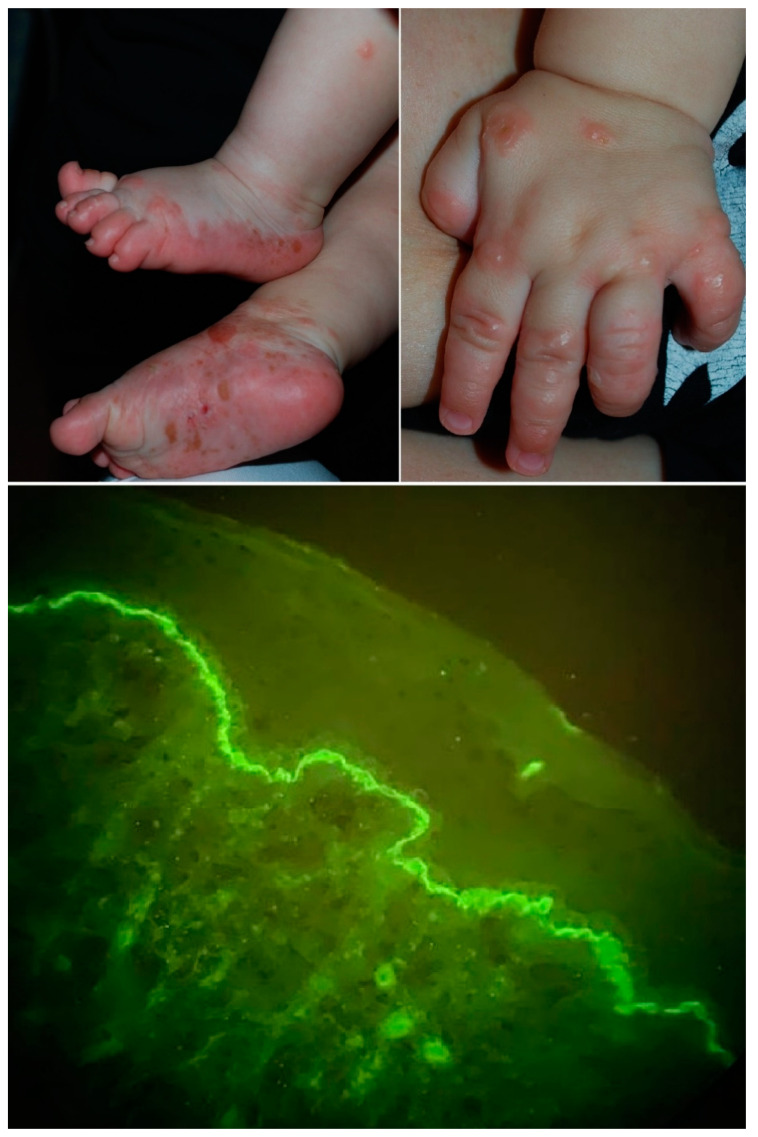
Bullous pemphigoid (BP) is an autoimmune bullous disease and is a rare condition in childhood. Acquired tense acral bullae and fixed urticarial annular lesions on the trunk are diagnostic clues of infantile BP. Diagnosis is supported by immunosorbent assay (IgG anti-BP180 and BP230) and direct immunofluorescence (linear deposition of IgG at the dermo-epidermal junction). Topical and/or systemic corticosteroids are the first-line treatment. The prognosis is good with a self-limited clinical course. Differential diagnoses include impetigo and other bullous diseases in children, such as dermatitis herpetiformis, linear IgA bullous dermatosis and erythema multiforme. The etiopathogenesis is still unknown, and the role of antigen stimuli such as infections, drugs and vaccination is still debated.
大疱性类天疱疮(BP)是一种自身免疫性大疱性疾病,在儿童期较为罕见。获得性紧张性肢端大疱和躯干上的固定性荨麻疹环形皮损是婴儿期BP的诊断线索。免疫吸附试验(抗BP180和BP230 IgG)和直接免疫荧光(IgG在真皮-表皮交界处呈线性沉积)有助于诊断。局部和/或全身用糖皮质激素是一线治疗方法。临床病程自限,预后良好。鉴别诊断包括脓疱病和儿童期其他大疱性疾病,如疱疹样皮炎、线状IgA大疱性皮病和多形红斑。其发病机制尚不清楚,感染、药物和疫苗接种等抗原刺激因素的作用仍存在争议。