Sturtevant Rochelle, Lower El, Bartos Austin, Elgin Ashley
Michigan Sea Grant, Michigan State University Extension, NOAA-GLERL, Ann Arbor, MI 48108, USA.
Michigan Sea Grant, University of Michigan, NOAA-GLERL, Ann Arbor, MI 48108, USA.
Plants (Basel). 2021 Feb 20;10(2):406. doi: 10.3390/plants10020406.
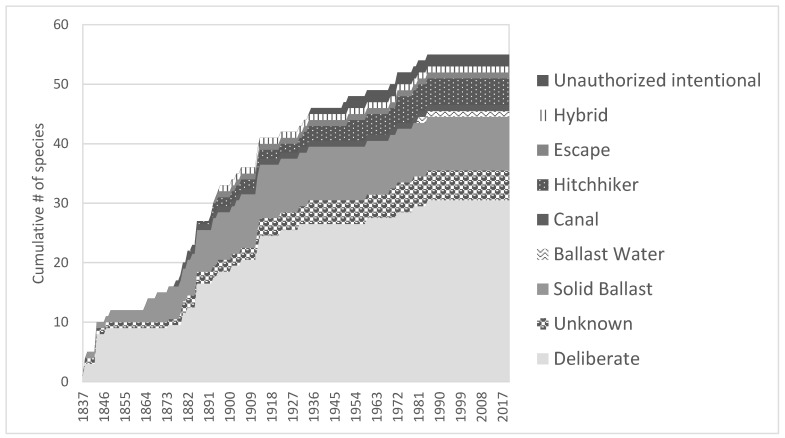
The Laurentian Great Lakes of North America are home to thousands of native fishes, invertebrates, plants, and other species that not only provide recreational and economic value to the region but also hold an important ecological value. However, there are also 55 nonindigenous species of aquatic plants that may be competing with native species and affecting this value. Here, we use a key regional database-the Great Lakes Aquatic Nonindigenous Species Information System (GLANSIS)-to describe the introduction of nonindigenous aquatic plants in the Great Lakes region and to examine patterns relating to their capacity to compete with native plants species. Specifically, we used an existing catalog of environmental impact assessments to qualitatively evaluate the potential for each nonindigenous plant species to outcompete native plant species for available resources. Despite an invasion record spanning nearly two centuries (1837-2020), a great deal remains unknown about the impact of competition by these species. Nonetheless, our synthesis of existing documentation reveals that many of these nonindigenous species have notable impacts on the native plant communities of the region in general and on species of concern in particular. Furthermore, we provide a thorough summary of the diverse adaptations that may contribute to giving these nonindigenous plants a competitive advantage. Adaptations that have been previously found to aid successful invasions were common in 98% of the nonindigenous aquatic plant species in the database.
北美洲的五大湖是数千种本地鱼类、无脊椎动物、植物和其他物种的家园,这些物种不仅为该地区提供了娱乐和经济价值,还具有重要的生态价值。然而,也有55种非本地水生植物物种,它们可能正在与本地物种竞争并影响这一价值。在这里,我们使用一个关键的区域数据库——五大湖水生非本地物种信息系统(GLANSIS)——来描述五大湖地区非本地水生植物的引入情况,并研究与它们与本地植物物种竞争能力相关的模式。具体来说,我们使用现有的环境影响评估目录,定性评估每种非本地植物物种在获取可用资源方面胜过本地植物物种的潜力。尽管入侵记录跨越了近两个世纪(1837年至2020年),但关于这些物种竞争影响的许多情况仍然未知。尽管如此,我们对现有文献的综合分析表明,这些非本地物种中的许多对该地区的本地植物群落,尤其是对受关注物种,都有显著影响。此外,我们全面总结了可能有助于这些非本地植物获得竞争优势的各种适应性特征。数据库中98%的非本地水生植物物种都具有先前发现有助于成功入侵的适应性特征。