College of Management, Fujian Agriculture and Forestry University, Fuzhou 350002, China.
School of Business, Renmin University of China, Beijing 100089, China.
Int J Environ Res Public Health. 2021 Feb 14;18(4):1860. doi: 10.3390/ijerph18041860.
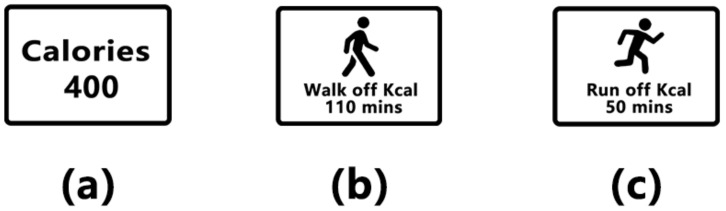
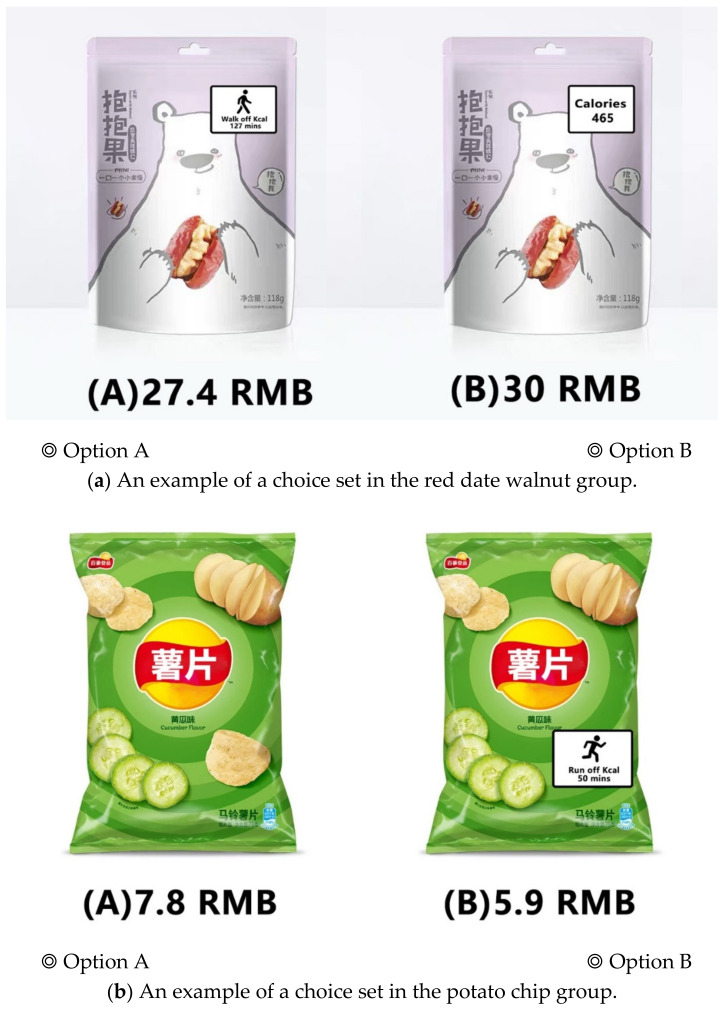
: Since numerical calorie labels have limited effects on less-calorie food ordering, an alternative called physical activity calorie equivalent (PACE) labels, which exhibit calories using visible symbols and the minutes of exercise to burn off the calories, may be more effective in reducing calories ordered. : By using a choice experiment (CE) approach, the aims of this study were to estimate the effects of PACE labels on consumer preferences for healthy and unhealth food. Red date walnuts and potato chips were used as the representatives of healthy and unhealthy foods respectively in this study. Moreover, future time perspective (FTP) is an individual trait variable of consumers, which has been recognized as a significant driver of healthy behaviors. We also included FTP into the interaction with PACE labels. : Firstly, the results were opposite between the healthy and unhealthy food groups. Respondents showed significantly more positive attitudes toward red date walnuts (i.e., healthy food) with PACE labels, while they showed significantly more negative preferences for chips (i.e., unhealthy food) with PACE labels. Secondly, people with higher FTP are preferred red date walnuts with PACE labels, while PACE labels on chips could undermine the preferences of respondents with higher FTP. Thirdly, we found that women (vs. men) were less inclined to choose healthy food with standard calorie labels and labels showing the minutes of running to burn off the calories, as well as that the elderly (vs. younger) people in the healthy food group preferred the labels showing the minutes of running to burn off the calories. People with a higher body mass index (BMI) were reluctant to purchase walnuts with the information about the minutes of walking. : Results from this study showed that PACE labels have significant effects on consumers' preferences for food products.
由于数字卡路里标签对低卡路里食物的点餐效果有限,一种名为体力活动卡路里等效 (PACE) 标签的替代标签可能更有效,它使用可见符号和消耗卡路里所需的运动分钟数来显示卡路里。
本研究采用选择实验 (CE) 方法,旨在估计 PACE 标签对健康和不健康食品消费者偏好的影响。本研究分别将红枣核桃和薯片作为健康和不健康食品的代表。此外,未来时间视角 (FTP) 是消费者的个体特质变量,已被认为是健康行为的重要驱动因素。我们还将 FTP 纳入与 PACE 标签的交互作用中。
首先,健康食品组和不健康食品组的结果相反。有 PACE 标签时,受访者对红枣核桃(即健康食品)表现出明显更积极的态度,而有 PACE 标签时,他们对薯片(即不健康食品)表现出明显更消极的偏好。其次,FTP 较高的人更喜欢带有 PACE 标签的红枣核桃,而 PACE 标签会降低 FTP 较高的人的薯片偏好。第三,我们发现,女性(与男性相比)不太倾向于选择带有标准卡路里标签和显示消耗卡路里所需跑步分钟数的健康食品标签,而健康食品组中的老年人(与年轻人相比)更倾向于选择显示消耗卡路里所需跑步分钟数的标签。BMI 较高的人不太愿意购买有关步行分钟数的核桃信息。
本研究结果表明,PACE 标签对消费者对食品产品的偏好有显著影响。