Turanli Beste, Yildirim Esra, Gulfidan Gizem, Arga Kazim Yalcin, Sinha Raghu
Department of Bioengineering, Marmara University, 34722 Istanbul, Turkey.
Turkish Institute of Public Health and Chronic Diseases, 34718 Istanbul, Turkey.
J Pers Med. 2021 Feb 14;11(2):127. doi: 10.3390/jpm11020127.
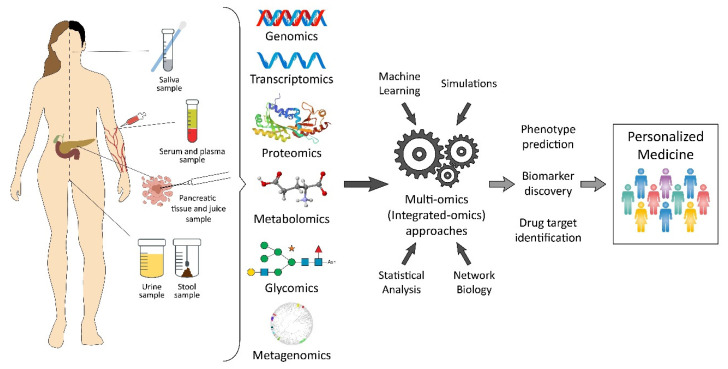
Pancreatic cancer is one of the most fatal malignancies and the seventh leading cause of cancer-related deaths related to late diagnosis, poor survival rates, and high incidence of metastasis. Unfortunately, pancreatic cancer is predicted to become the third leading cause of cancer deaths in the future. Therefore, diagnosis at the early stages of pancreatic cancer for initial diagnosis or postoperative recurrence is a great challenge, as well as predicting prognosis precisely in the context of biomarker discovery. From the personalized medicine perspective, the lack of molecular biomarkers for patient selection confines tailored therapy options, including selecting drugs and their doses or even diet. Currently, there is no standardized pancreatic cancer screening strategy using molecular biomarkers, but CA19-9 is the most well known marker for the detection of pancreatic cancer. In contrast, recent innovations in high-throughput techniques have enabled the discovery of specific biomarkers of cancers using genomics, transcriptomics, proteomics, metabolomics, glycomics, and metagenomics. Panels combining CA19-9 with other novel biomarkers from different "omics" levels might represent an ideal strategy for the early detection of pancreatic cancer. The systems biology approach may shed a light on biomarker identification of pancreatic cancer by integrating multi-omics approaches. In this review, we provide background information on the current state of pancreatic cancer biomarkers from multi-omics stages. Furthermore, we conclude this review on how multi-omics data may reveal new biomarkers to be used for personalized medicine in the future.
胰腺癌是最致命的恶性肿瘤之一,是癌症相关死亡的第七大主要原因,这与诊断延迟、生存率低以及转移发生率高有关。不幸的是,预计胰腺癌在未来将成为癌症死亡的第三大主要原因。因此,在胰腺癌早期进行初始诊断或术后复发诊断是一项巨大挑战,在生物标志物发现的背景下精确预测预后也是如此。从精准医学的角度来看,缺乏用于患者选择的分子生物标志物限制了个性化治疗方案,包括选择药物及其剂量甚至饮食。目前,尚无使用分子生物标志物的标准化胰腺癌筛查策略,但CA19-9是检测胰腺癌最知名的标志物。相比之下,高通量技术的最新创新使得能够利用基因组学、转录组学、蛋白质组学、代谢组学、糖组学和宏基因组学发现癌症的特定生物标志物。将CA19-9与来自不同“组学”水平的其他新型生物标志物相结合的检测板可能是早期检测胰腺癌的理想策略。系统生物学方法可能通过整合多组学方法为胰腺癌的生物标志物识别提供线索。在本综述中,我们提供了来自多组学阶段的胰腺癌生物标志物当前状态的背景信息。此外,我们在本综述结尾讨论了多组学数据如何可能揭示未来用于精准医学的新生物标志物。