Amaro Francisco, Morón Álvaro, Díaz Silvia, Martín-González Ana, Gutiérrez Juan Carlos
Department of Genetics, Physiology and Microbiology, Faculty of Biology, Complutense University of Madrid, 28040 Madrid, Spain.
Microorganisms. 2021 Feb 12;9(2):364. doi: 10.3390/microorganisms9020364.
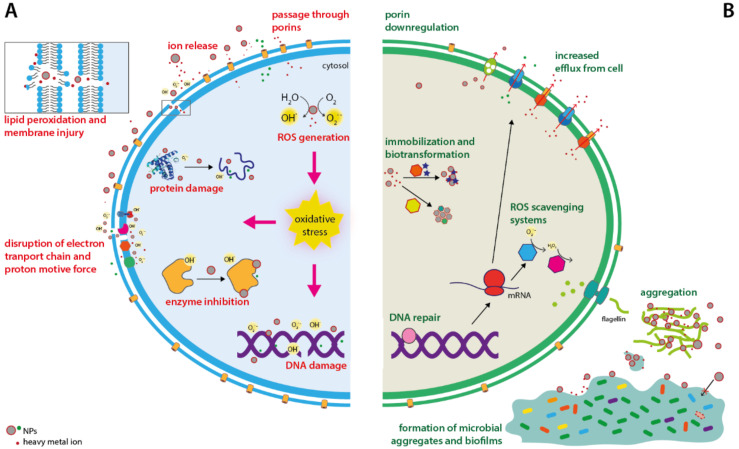
The rapid spread of antibiotic resistances among bacteria demands novel strategies for infection control, and metallic nanoparticles appear as promising tools because of their unique size and tunable properties that allow their antibacterial effects to be maximized. Furthermore, their diverse mechanisms of action towards multiple cell components have suggested that bacteria could not easily develop resistance against nanoparticles. However, research published over the last decade has proven that bacteria can indeed evolve stable resistance mechanisms upon continuous exposure to metallic nanoparticles. In this review, we summarize the currently known individual and collective strategies employed by bacteria to cope with metallic nanoparticles. Importantly, we also discuss the adverse side effects that bacterial exposure to nanoparticles may have on antibiotic resistance dissemination and that might constitute a challenge for the implementation of nanoparticles as antibacterial agents. Overall, studies discussed in this review point out that careful management of these very promising antimicrobials is necessary to preserve their efficacy for infection control.
细菌中抗生素耐药性的迅速传播需要新的感染控制策略,金属纳米颗粒因其独特的尺寸和可调节的特性而成为有前景的工具,这些特性可使它们的抗菌效果最大化。此外,它们对多种细胞成分的多样作用机制表明,细菌不容易对纳米颗粒产生耐药性。然而,过去十年发表的研究证明,细菌在持续接触金属纳米颗粒后确实能够进化出稳定的耐药机制。在这篇综述中,我们总结了目前已知的细菌应对金属纳米颗粒所采用的个体和集体策略。重要的是,我们还讨论了细菌接触纳米颗粒可能对抗生素耐药性传播产生的不良副作用,这可能对将纳米颗粒用作抗菌剂构成挑战。总体而言,本综述中讨论的研究指出,必须谨慎管理这些非常有前景的抗菌剂,以保持它们对感染控制的功效。