Mitchell Stephanie L, Hudson-Smith Natalie V, Cahill Meghan S, Reynolds Benjamin N, Frand Seth D, Green Curtis M, Wang Chenyu, Hang Mimi N, Hernandez Rodrigo Tapia, Hamers Robert J, Feng Z Vivian, Haynes Christy L, Carlson Erin E
Department of Chemistry , University of Minnesota , 207 Pleasant St. SE , Minneapolis , MN 55455 , USA . Email:
Department of Biochemistry, Molecular Biology, and Biophysics , University of Minnesota , 321 Church Street SE , Minneapolis , Minnesota 55454 , USA.
Chem Sci. 2019 Aug 30;10(42):9768-9781. doi: 10.1039/c9sc01942a. eCollection 2019 Nov 14.
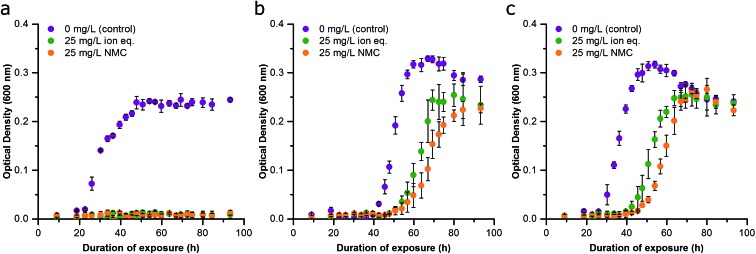
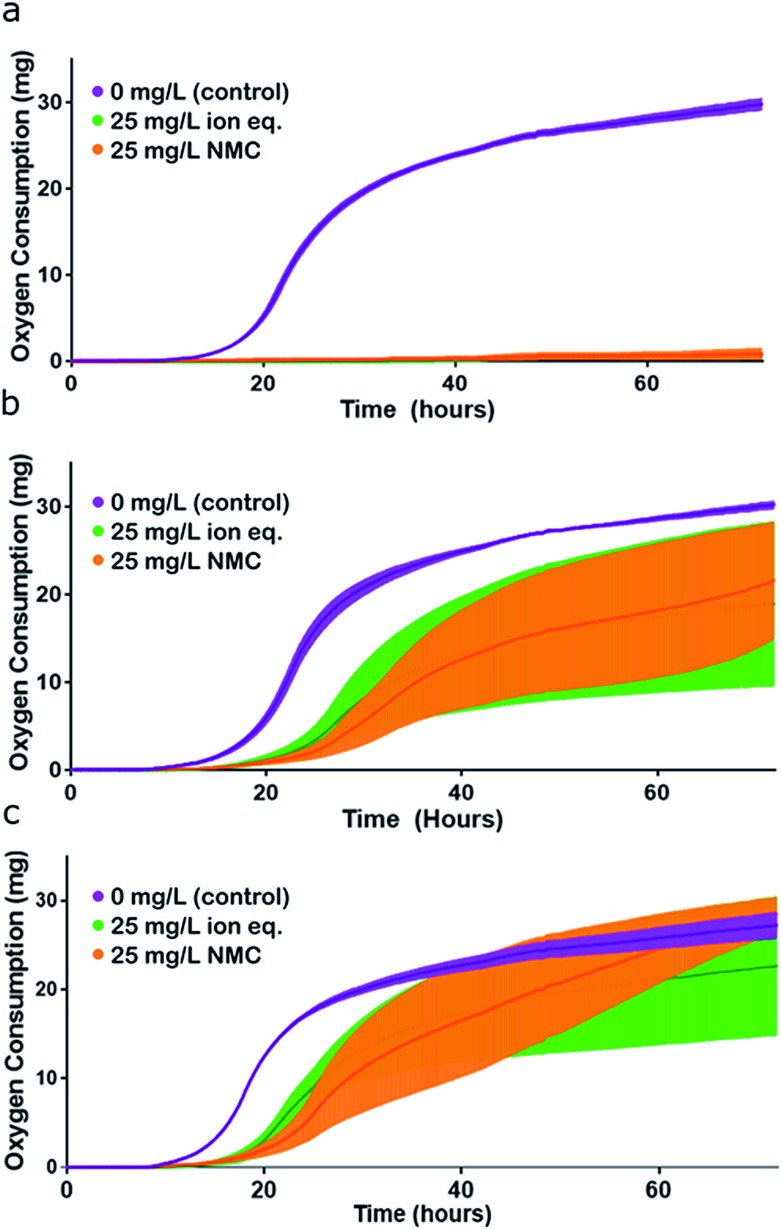
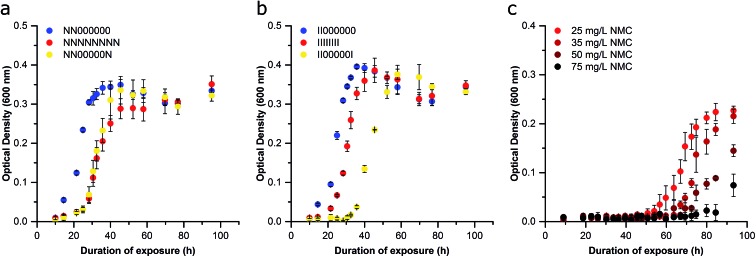
Engineered nanoparticles are incorporated into numerous emerging technologies because of their unique physical and chemical properties. Many of these properties facilitate novel interactions, including both intentional and accidental effects on biological systems. Silver-containing particles are widely used as antimicrobial agents and recent evidence indicates that bacteria rapidly become resistant to these nanoparticles. Much less studied is the chronic exposure of bacteria to particles that were not designed to interact with microorganisms. For example, previous work has demonstrated that the lithium intercalated battery cathode nanosheet, nickel manganese cobalt oxide (NMC), is cytotoxic and causes a significant delay in growth of MR-1 upon acute exposure. Here, we report that MR-1 rapidly adapts to chronic NMC exposure and is subsequently able to survive in much higher concentrations of these particles, providing the first evidence of permanent bacterial resistance following exposure to nanoparticles that were not intended as antibacterial agents. We also found that when NMC-adapted bacteria were subjected to only the metal ions released from this material, their specific growth rates were higher than when exposed to the nanoparticle. As such, we provide here the first demonstration of bacterial resistance to complex metal oxide nanoparticles with an adaptation mechanism that cannot be fully explained by multi-metal adaptation. Importantly, this adaptation persists even after the organism has been grown in pristine media for multiple generations, indicating that MR-1 has developed permanent resistance to NMC.
由于其独特的物理和化学性质,工程纳米颗粒被应用于众多新兴技术中。这些特性中的许多都促进了新型相互作用,包括对生物系统有意和意外的影响。含银颗粒被广泛用作抗菌剂,最近的证据表明细菌会迅速对这些纳米颗粒产生抗性。而对于细菌长期暴露于并非设计用于与微生物相互作用的颗粒的研究则少得多。例如,先前的研究表明,锂插层电池阴极纳米片镍锰钴氧化物(NMC)具有细胞毒性,急性暴露时会导致MR-1的生长显著延迟。在此,我们报告称MR-1能迅速适应长期NMC暴露,随后能够在更高浓度的这些颗粒中存活,这首次证明了暴露于非抗菌剂纳米颗粒后细菌产生了永久性抗性。我们还发现,当适应NMC的细菌仅接触该材料释放的金属离子时,其比生长速率高于暴露于纳米颗粒时。因此,我们在此首次证明了细菌对复杂金属氧化物纳米颗粒具有抗性,其适应机制无法完全用多金属适应来解释。重要的是,即使在生物体在原始培养基中培养多代后,这种适应性仍然存在,这表明MR-1已对NMC产生了永久性抗性。