Université Clermont Auvergne, CNRS, LaPSCo, Physiological and Psychosocial Stress, F-63000 Clermont-Ferrand, France.
CHU Clermont-Ferrand, Emergency Medicine, F-63000 Clermont-Ferrand, France.
Nutrients. 2021 Feb 27;13(3):784. doi: 10.3390/nu13030784.
Ghrelin is an orexigenic hormone which favors food-seeking behavior and has been postulated to be a biomarker of stress. We conducted a systematic review and meta-analysis on the evolution of ghrelin levels following acute stress.
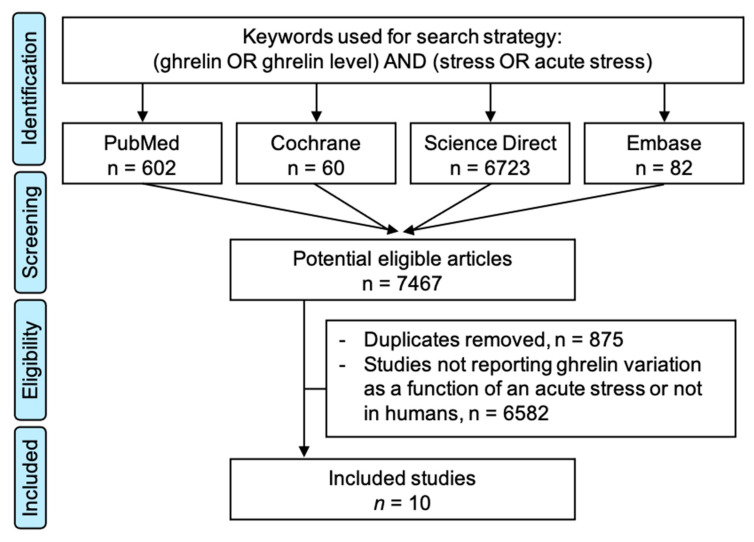
The PubMed, Cochrane Library, Embase, and ScienceDirect databases were searched for studies reporting ghrelin levels before and after acute stress in humans.
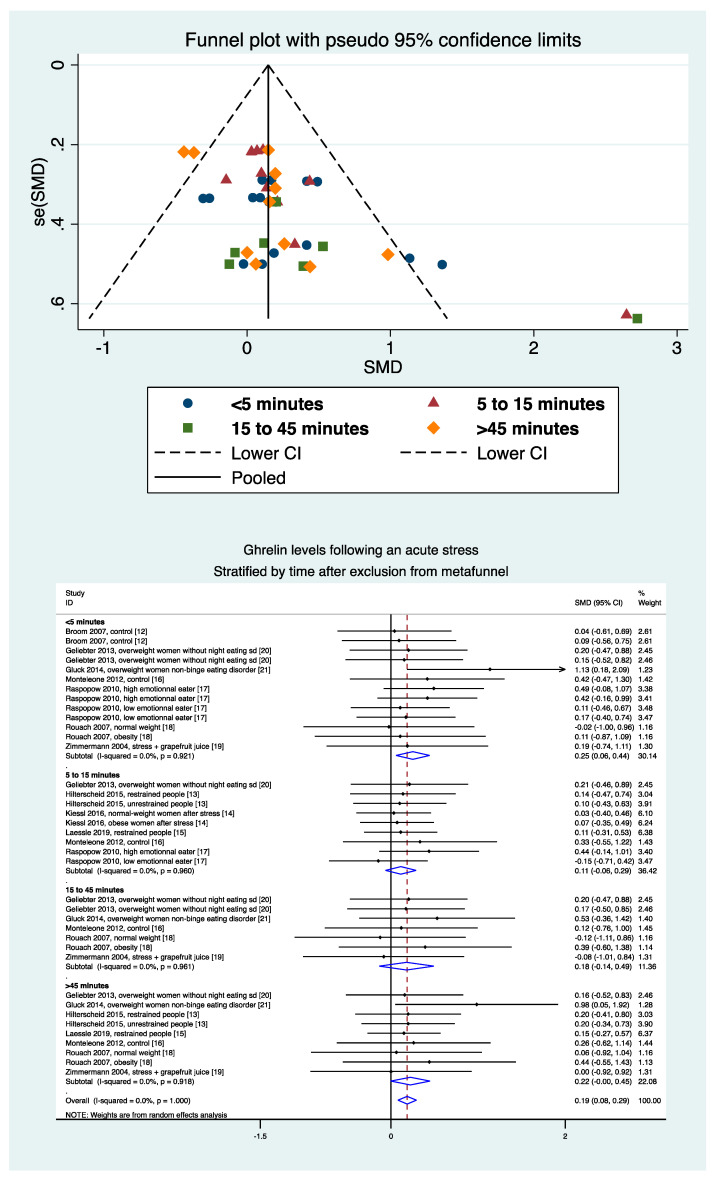
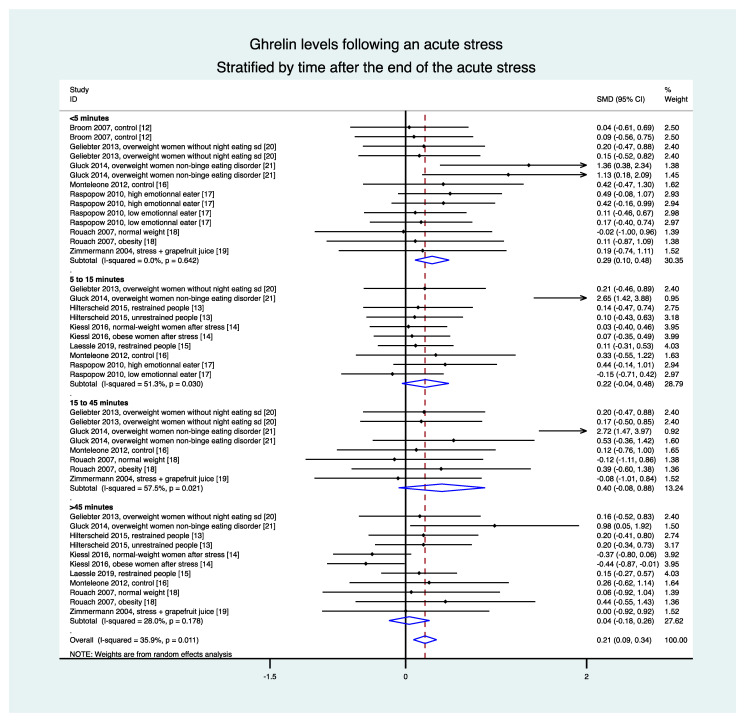
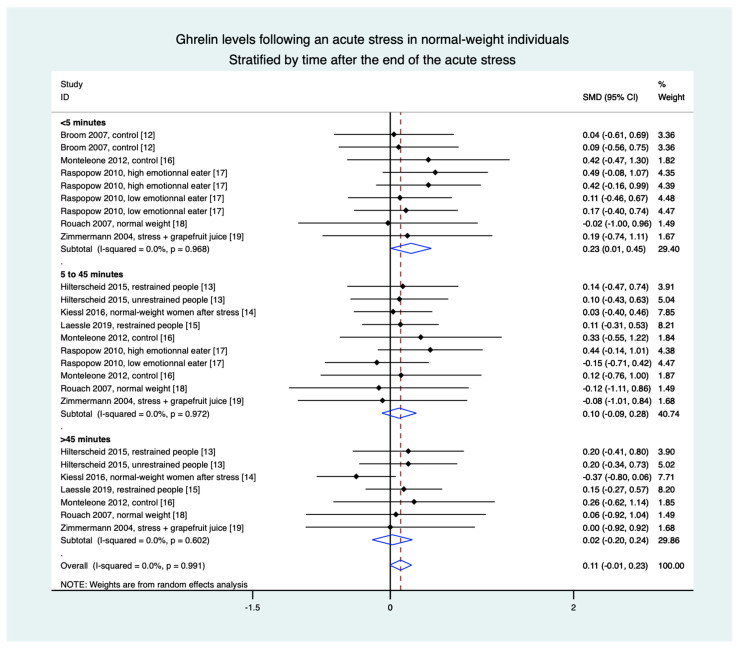
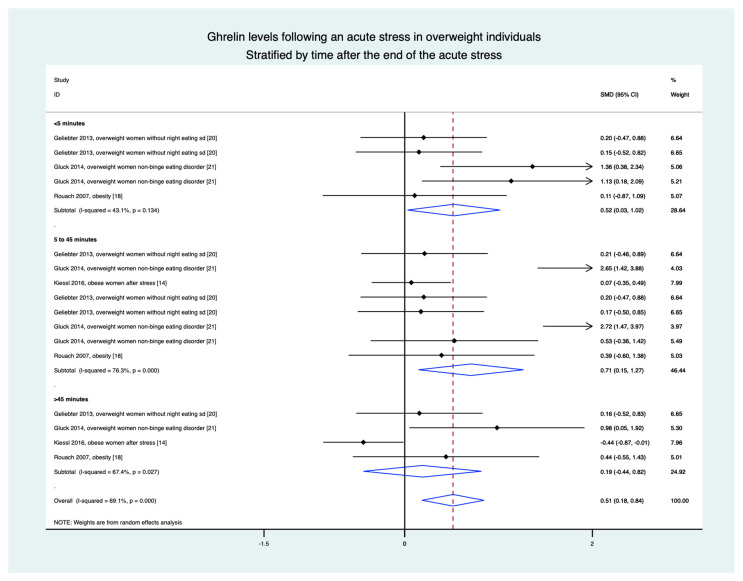
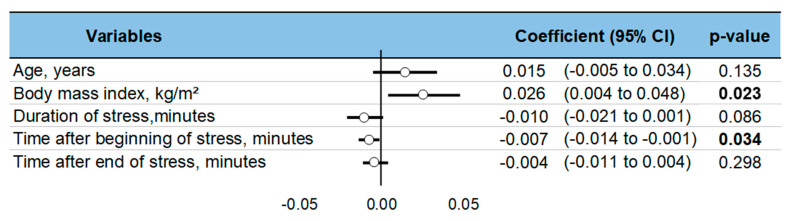
We included ten studies for a total of 348 patients. Acute stress (intervention) was always in a laboratory. Acute stress was psychological (Trier Social Stress Test), physical, or mixed (cold pressure test). The overall meta-analysis demonstrated an increase in ghrelin after the stress intervention (ES = 0.21, 95CI 0.09 to 0.34) compared with baseline levels. Stratification by time demonstrated an acute increase in ghrelin levels in the five minutes immediately following the initiation of stress (0.29, 0.10 to 0.48) but without any difference after. Obese individuals had a more significant (ES = 0.51, 95CI 0.18 to 0.84) and prolonged increase in ghrelin levels for up to 45 min compared with non-obese individuals who had a significant increase only five minutes after stress. Moreover, the ghrelin levels increased in response to stress with BMI (coefficient 0.028, 0.01 to 0.49; = 0.013) and decreased with the time after the stress intervention (coefficient -0.007, -0.014 to -0.001; = 0.025).
Ghrelin is a biomarker of stress, with a short-term increase following acute stress. Obese individuals have both a higher and prolonged response, emphasizing the link between obesity and stress.
Ghrelin 是一种食欲刺激激素,它有利于寻找食物的行为,并且被认为是应激的生物标志物。我们对急性应激后 ghrelin 水平的变化进行了系统评价和荟萃分析。
在 PubMed、Cochrane 图书馆、Embase 和 ScienceDirect 数据库中检索了报告人类急性应激前后 ghrelin 水平的研究。
我们纳入了 10 项研究,共 348 例患者。急性应激(干预)始终在实验室中进行。急性应激是心理的(特里尔社会应激测试)、身体的或混合的(冷压测试)。总体荟萃分析显示,与基线水平相比,应激干预后 ghrelin 水平升高(ES=0.21,95CI0.09-0.34)。按时间分层显示,应激开始后 5 分钟内 ghrelin 水平急剧升高(0.29,0.10-0.48),但之后没有差异。与非肥胖个体相比,肥胖个体的 ghrelin 水平升高更显著(ES=0.51,95CI0.18-0.84)且持续时间更长,可达 45 分钟,而应激后仅 5 分钟肥胖个体的 ghrelin 水平就显著升高。此外,ghrelin 水平随着 BMI(系数 0.028,0.01-0.49;=0.013)对应激的反应而增加,随着应激干预后时间的延长(系数-0.007,-0.014 至-0.001;=0.025)而减少。
Ghrelin 是应激的生物标志物,急性应激后会短期增加。肥胖个体的反应更高且持续时间更长,强调了肥胖与应激之间的联系。