Habib Saffiya, Singh Moganavelli
Nano-Gene and Drug Delivery Group, Discipline of Biochemistry, School of Life Sciences, University of KwaZulu-Natal, Private Bag X54001, Durban 4000, South Africa.
Nanomaterials (Basel). 2021 Feb 27;11(3):597. doi: 10.3390/nano11030597.
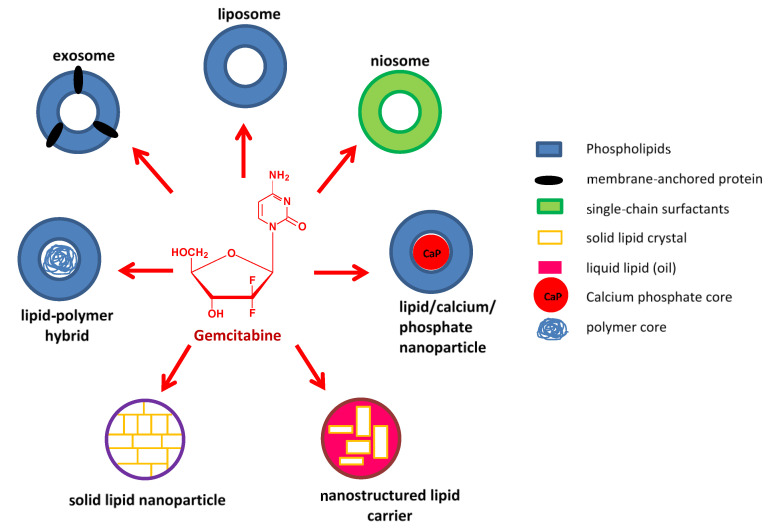
The anti-metabolite drug gemcitabine is widely used for the treatment of a variety of cancers. At present, gemcitabine is administered as a hydrochloride salt that is delivered by slow intravenous injection in cycles of three or four weeks. Although regarded as a 'front-line' chemotherapeutic agent, its efficacy is hampered by poor target cell specificity, sub-optimal cellular uptake, rapid clearance from circulation, the development of chemoresistance, and undesirable side-effects. The use of organic, inorganic, and metal-based nanoparticles as delivery agents presents an opportunity to overcome these limitations and safely harness optimal drug efficacy and enhance their therapeutic indices. Among the many and varied nano delivery agents explored, the greatest body of knowledge has been generated in the field of lipid-mediated delivery. We review here the liposomes, niosomes, solid lipid nanoparticles, nanostructured lipid carriers, exosomes, lipid-polymer hybrids, and other novel lipid-based agents that have been developed within the past six years for the delivery of gemcitabine and its co-drugs.
抗代谢药物吉西他滨被广泛用于治疗多种癌症。目前,吉西他滨以盐酸盐的形式给药,通过缓慢静脉注射,每三到四周为一个周期。尽管被视为“一线”化疗药物,但其疗效受到靶细胞特异性差、细胞摄取不理想、从循环中快速清除、化疗耐药性的产生以及不良副作用的阻碍。使用有机、无机和金属基纳米颗粒作为递送剂为克服这些限制并安全地发挥最佳药物疗效和提高其治疗指数提供了机会。在探索的众多不同的纳米递送剂中,脂质介导递送领域积累了最多的知识。我们在此回顾过去六年中开发的用于递送吉西他滨及其联合药物的脂质体、非离子表面活性剂泡囊、固体脂质纳米粒、纳米结构脂质载体、外泌体、脂质-聚合物杂化物和其他新型脂质基制剂。