School of Public Health, Xi'an Jiaotong University, Xi'an, Shaanxi, China.
College of Geomatics, Xi'an University of Science and Technology, Xi'an, Shaanxi, China.
Environ Sci Pollut Res Int. 2021 Jul;28(27):35584-35596. doi: 10.1007/s11356-021-12934-6. Epub 2021 Mar 5.
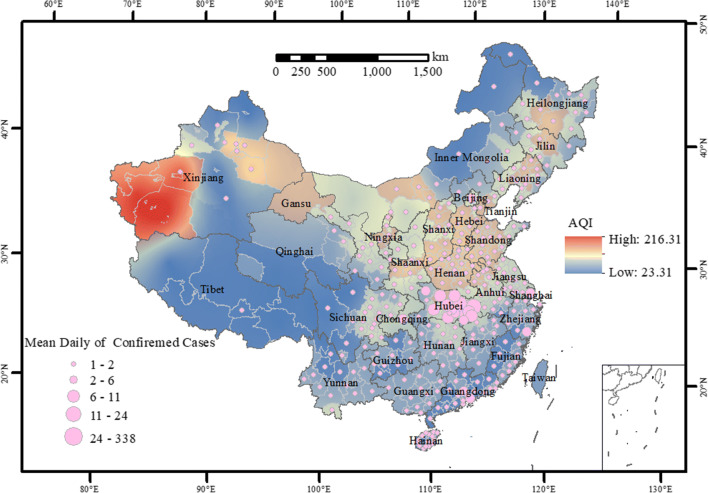
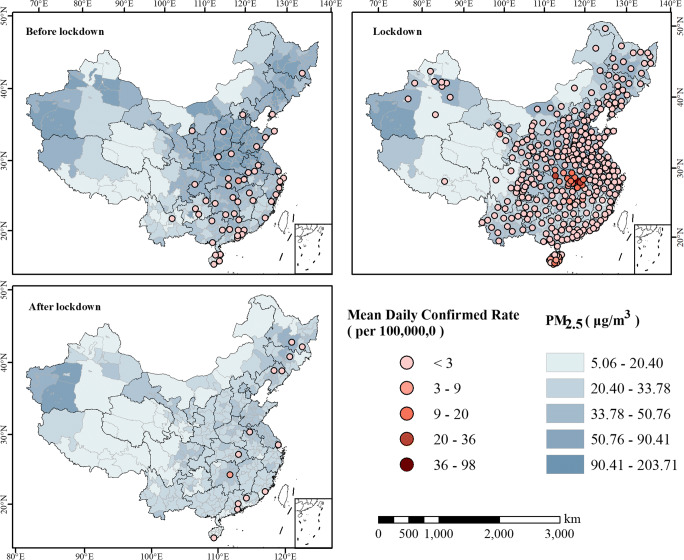
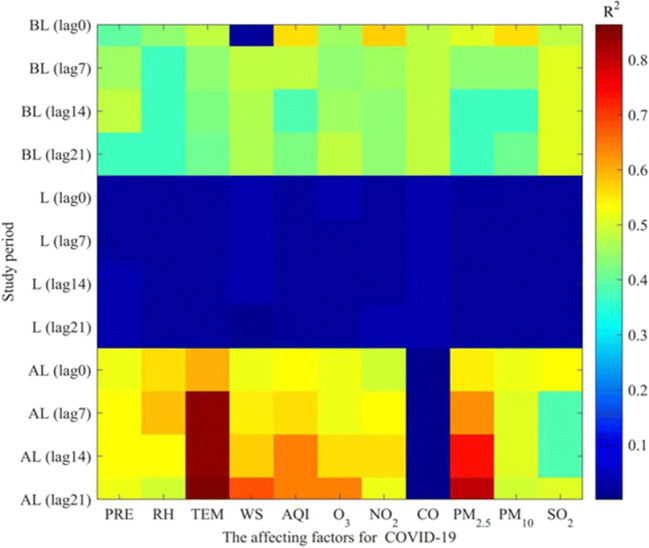
The COVID-19 is still a huge challenge that seriously threatens public health globally. Previous studies focused on the influence of air pollutants and probable meteorological parameters on confirmed COVID-19 infections via epidemiological methods, whereas the findings of relations between possible variables and COVID-19 incidences using geographical perspective were scarce. In the present study, data concerning confirmed COVID-19 cases and possible affecting factors were collected for 325 cities across China up to May 27, 2020. The geographically weighted regression (GWR) model was introduced to explore the impact of probable determinants on confirmed COVID-19 incidences. Some results were obtained. AQI, PM, and PM demonstrated significantly positive impacts on COVID-19 during the most study period with the majority lag group (P< 0.05). Nevertheless, the relation of temperature with COVID-19 was significantly negative (P< 0.05). Especially, CO exhibited a negative effect on COVID-19 in most study period with the majority lag group. The impacts of each possible determinant on COVID-19 represented significantly spatial heterogeneity. The obvious influence of the majority of possible factors on COVID-19 was mainly detected during the after lockdown period with the lag 21 group. Although the COVID-19 spreading has been effectively controlled by tough measures taken by the Chinese government, the study findings remind us to address the air pollution issues persistently for protecting human health.
新型冠状病毒肺炎仍然是一个巨大的挑战,严重威胁着全球公众健康。先前的研究主要通过流行病学方法关注空气污染物和可能的气象参数对确诊的新型冠状病毒肺炎感染的影响,而从地理角度研究可能的变量与新型冠状病毒肺炎发病率之间关系的发现则很少。本研究收集了截至 2020 年 5 月 27 日中国 325 个城市的确诊新型冠状病毒肺炎病例和可能的影响因素数据。引入地理加权回归(GWR)模型来探讨可能的决定因素对确诊新型冠状病毒肺炎发病率的影响。得到了一些结果。在大多数研究期间,空气质量指数(AQI)、PM10 和 PM2.5 对新型冠状病毒肺炎有显著的正向影响,且大部分滞后组(P<0.05)。然而,温度与新型冠状病毒肺炎的关系呈显著负相关(P<0.05)。特别是,在大多数研究期间,CO 对新型冠状病毒肺炎有负向影响,且大部分滞后组。每个可能决定因素对新型冠状病毒肺炎的影响表现出明显的空间异质性。在锁定后阶段的 21 天滞后组,大多数可能因素对新型冠状病毒肺炎的明显影响主要被检测到。虽然中国政府采取了严厉措施,有效地控制了新型冠状病毒肺炎的传播,但研究结果提醒我们要持续关注空气污染问题,以保护人类健康。