Department of Occupational Health and Occupational Medicine, Guangdong Provincial Key Laboratory of Tropical Disease Research, School of Public Health, Southern Medical University, Guangzhou, 510515, People's Republic of China.
Department of Epidemiology and Statistics, School of Public Health, Guilin Medical University, Guilin, 541001, People's Republic of China.
Environ Sci Pollut Res Int. 2021 Jun;28(21):27056-27066. doi: 10.1007/s11356-021-12648-9. Epub 2021 Jan 27.
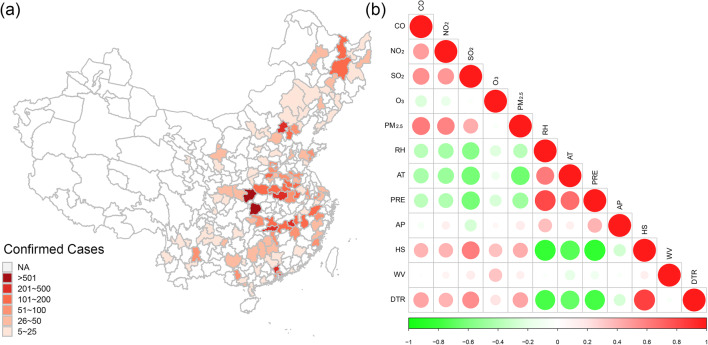
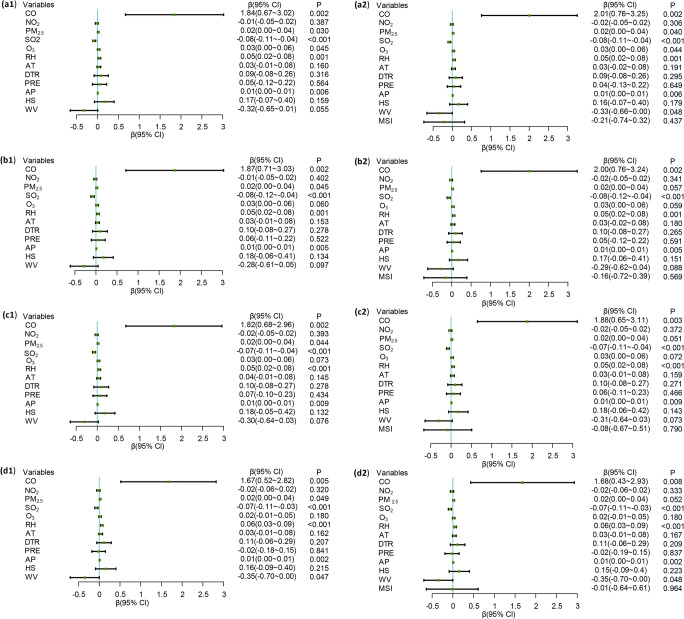
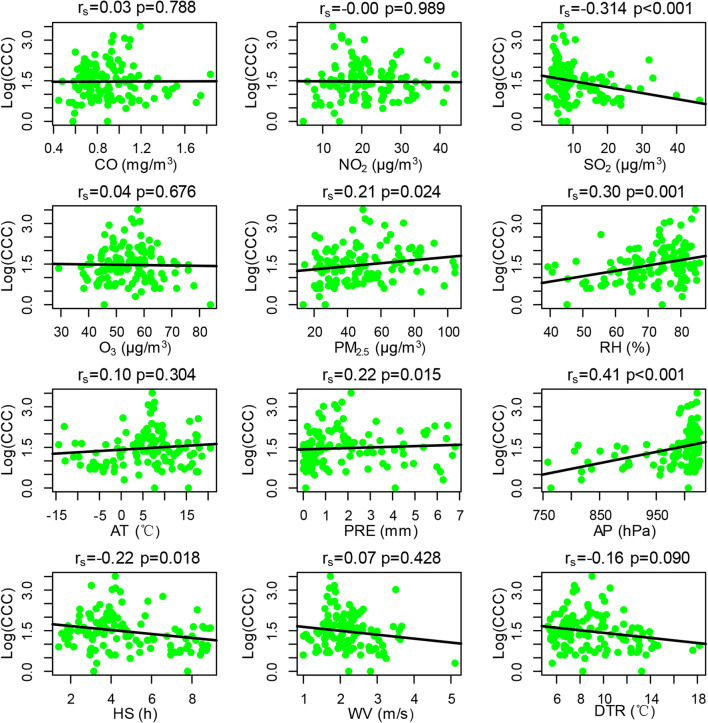
Emerging evidence has confirmed meteorological factors and air pollutants affect novel coronavirus disease 2019 (COVID-19). However, no studies to date have considered the impact of interactions between meteorological factors and air pollutants on COVID-19 transmission. This study explores the association between ambient air pollutants (PM, NO, SO, CO, and O), meteorological factors (average temperature, diurnal temperature range, relative humidity, wind velocity, air pressure, precipitation, and hours of sunshine), and their interaction on confirmed case counts of COVID-19 in 120 Chinese cities. We modeled total confirmed cases of COVID-19 as the dependent variable with meteorological factors, air pollutants, and their interactions as the independent variables. To account for potential migration effects, we included the migration scale index (MSI) from Wuhan to each of the 120 cities included in the model, using data from 15 Jan. to 18 Mar. 2020. As an important confounding factor, MSI was considered in a negative binomial regression analysis. Positive associations were found between the number of confirmed cases of COVID-19 and CO, PM, relative humidity, and O, with and without MSI-adjustment. Negative associations were also found for SO and wind velocity both with and without controlling for population migration. In addition, air pollutants and meteorological factors had interactive effects on COVID-19 after controlling for MSI. In conclusion, air pollutants, meteorological factors, and their interactions all affect COVID-19 cases.
新出现的证据证实了气象因素和空气污染物会影响 2019 年新型冠状病毒病(COVID-19)。然而,迄今为止,尚无研究考虑气象因素和空气污染物之间的相互作用对 COVID-19 传播的影响。本研究探讨了环境空气污染物(PM、NO、SO、CO 和 O)、气象因素(平均温度、日较差、相对湿度、风速、气压、降水和日照时数)及其相互作用与 120 个中国城市确诊 COVID-19 病例之间的关系。我们将 COVID-19 的总确诊病例作为因变量,将气象因素、空气污染物及其相互作用作为自变量进行建模。为了考虑潜在的迁移效应,我们在模型中包含了武汉到 120 个城市中的每个城市的迁移规模指数(MSI),数据来源于 2020 年 1 月 15 日至 3 月 18 日。作为一个重要的混杂因素,MSI 被纳入了负二项回归分析。在调整或不调整 MSI 的情况下,COVID-19 确诊病例数与 CO、PM、相对湿度和 O 之间均呈正相关。SO 和风速与人口迁移控制或不控制时均呈负相关。此外,在控制 MSI 后,空气污染物和气象因素对 COVID-19 有交互作用。总之,空气污染物、气象因素及其相互作用均会影响 COVID-19 病例。