Centre for Global Child Health, Hospital for Sick Children, Toronto, Ontario, Canada.
Translational Medicine Program, Hospital for Sick Children, Toronto, Ontario, Canada.
Am J Clin Nutr. 2021 Apr 6;113(4):1009-1022. doi: 10.1093/ajcn/nqaa410.
Lack of robust estimates of human-milk nutrient composition and influential maternal factors, such as body composition, are barriers to informing nutrition policies and programs.
The objective was to understand the relation between maternal BMI and human-milk energy, fat, and/or total protein.
Four electronic databases (MEDLINE, Embase, CINAHL, and Web of Science) were searched. Outcomes assessed were human-milk energy (kcal/L), fat (g/L), and total protein (g/L) from mothers 1 to 6 mo postpartum. Studies with data on maternal BMI or weight and height that quantified human-milk energy, fat, or protein between 1 and 6 mo postpartum were eligible. Random-effects meta-regression weighted by the inverse of the study-level SE was completed for each of the 3 outcomes. The certainty of evidence for each outcome was assessed using the GRADE (Grading of Recommendations Assessment, Development, and Evaluation) approach.
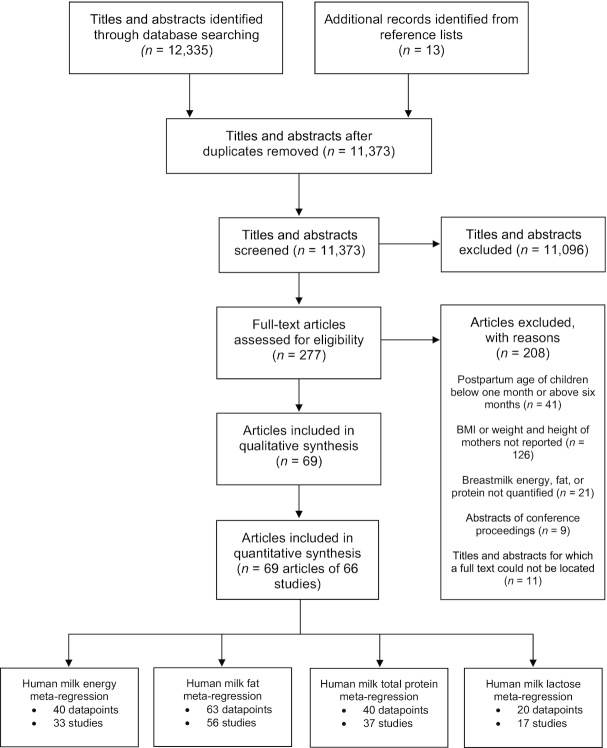
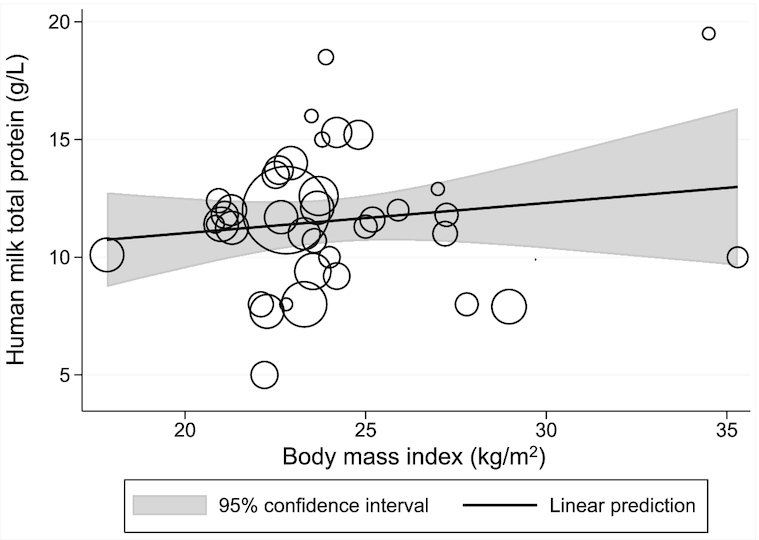
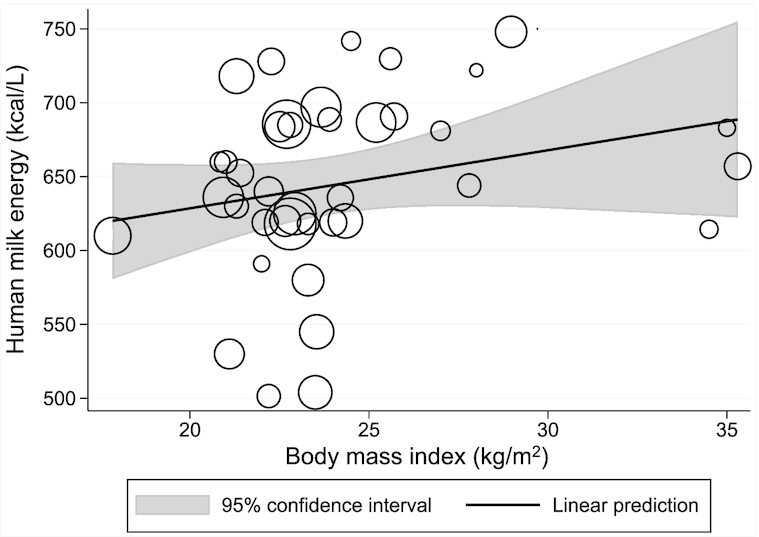
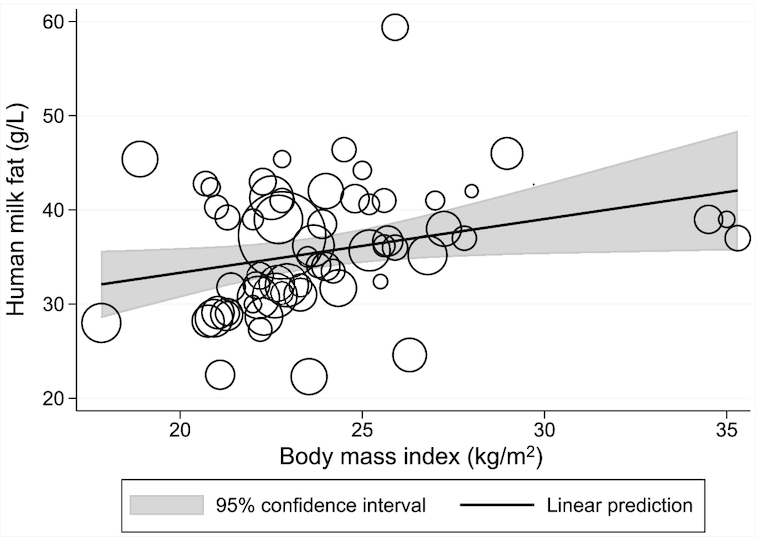
A total of 11,373 titles and abstracts were identified, and after full-text screening, 69 articles of 66 studies were included. Meta-regression results showed a positive association between maternal BMI and human-milk fat (β: 0.56 g/L; 95% CI: 0.034, 1.1; P = 0.04; I2 = 93.7%, n = 63 datapoints). There was no significant association between maternal BMI and human-milk energy (β: 3.9 kcal/L; 95% CI: -1.6, 9.5; P = 0.16, I2 = 93.3%, n = 40 datapoints) or total protein (β: 0.13 g/L; 95% CI: -0.16, 0.41; P = 0.37, I2 = 99.1%, n = 40 datapoints). The certainty of evidence for human-milk energy was low and the certainty of evidence for fat and total protein was very low.
Meta-regression analysis of available literature suggested an association between maternal BMI and human-milk fat between 1 and 6 mo postpartum. Future studies are needed to confirm the relation between maternal BMI; variation in human-milk energy, fat, and protein content; and the implications for child growth and development. This review is registered with International Prospective Register of Systematic Reviews (PROSPERO 2018 CRD42018098808) at https://www.crd.york.ac.uk/prospero/.
缺乏关于人乳营养成分和母体因素(如身体成分)的有力估计,是制定营养政策和计划的障碍。
了解母体 BMI 与人乳能量、脂肪和/或总蛋白之间的关系。
检索了四个电子数据库(MEDLINE、Embase、CINAHL 和 Web of Science)。评估的结果是母亲产后 1 至 6 个月的人乳能量(千卡/升)、脂肪(克/升)和总蛋白(克/升)。符合条件的研究是指在产后 1 至 6 个月期间,有关于母体 BMI 或体重和身高数据,并量化人乳能量、脂肪或蛋白质的研究。对每个结果都进行了随机效应元回归,权重为研究水平 SE 的倒数。使用 GRADE(推荐评估、制定和评估分级)方法评估每个结果的证据确定性。
共确定了 11373 个标题和摘要,经过全文筛选,有 69 篇文章的 66 项研究符合纳入标准。元回归结果表明,母体 BMI 与人乳脂肪呈正相关(β:0.56 克/升;95%置信区间:0.034,1.1;P = 0.04;I2 = 93.7%,n = 63 个数据点)。母体 BMI 与人乳能量(β:3.9 千卡/升;95%置信区间:-1.6,9.5;P = 0.16,I2 = 93.3%,n = 40 个数据点)或总蛋白(β:0.13 克/升;95%置信区间:-0.16,0.41;P = 0.37,I2 = 99.1%,n = 40 个数据点)之间无显著关联。人乳能量的证据确定性为低,脂肪和总蛋白的证据确定性为极低。
对现有文献的荟萃回归分析表明,母体 BMI 与人乳脂肪在产后 1 至 6 个月之间存在关联。需要进一步的研究来证实母体 BMI 与人乳能量、脂肪和蛋白质含量之间的关系,以及对儿童生长发育的影响。本综述在国际前瞻性系统评价注册库(PROSPERO 2018 CRD42018098808)进行了注册,网址为 https://www.crd.york.ac.uk/prospero/。