Department of Epidemiology of Microbial Diseases, Yale School of Public Health, 60 College Street, New Haven CT 06510 United States.
Chronic and Airborne Disease Surveillance Coordination, Ministry of Health, SRTVN Qd. 701, Via W5 Norte, Lote D, Ed. PO 700, Brasília Brazil.
Epidemics. 2021 Jun;35:100443. doi: 10.1016/j.epidem.2021.100443. Epub 2021 Feb 20.
Evidence on local disease burden and the completeness of case detection represent important information for TB control programs. We present a new method for estimating subnational TB incidence and the fraction of individuals with incident TB who are diagnosed and treated in Brazil.
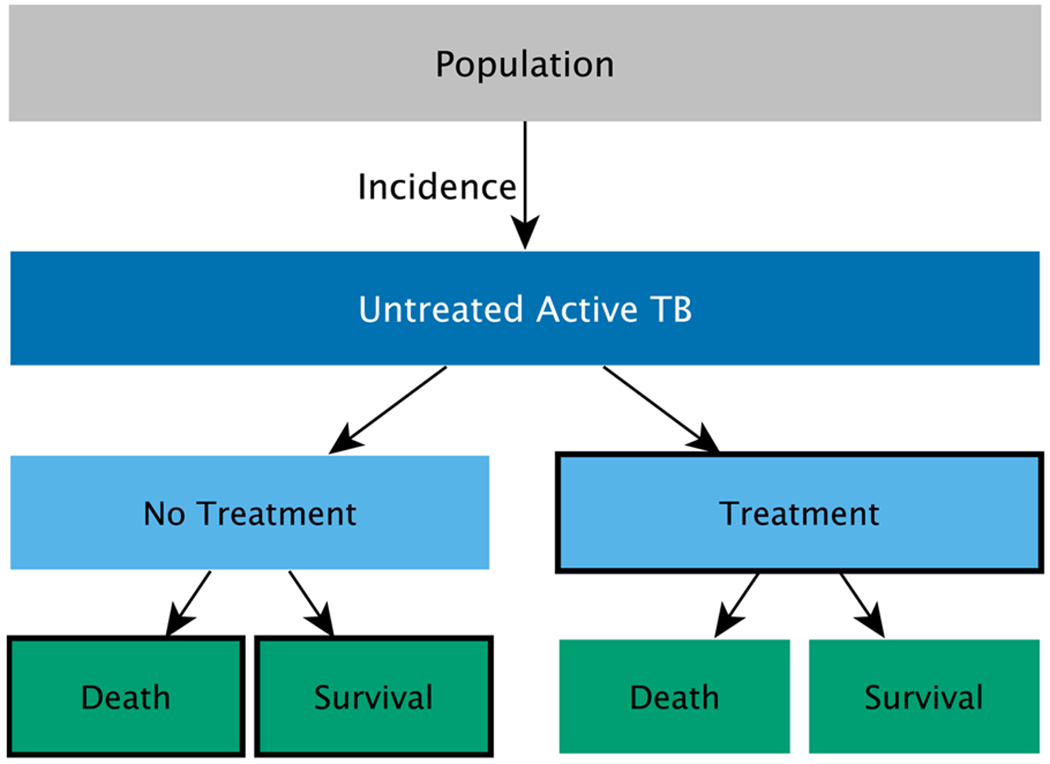
We compiled data on TB notifications and TB-related mortality in Brazil and specified an analytic model approximating incidence as the number of individuals exiting untreated active disease (sum of treatment initiation, death before treatment, and self-cure). We employed a Bayesian inference approach to synthesize data and adjust for known sources of bias. We estimated TB incidence and the fraction of cases treated, for each Brazilian state and the Federal District over 2008-2017.
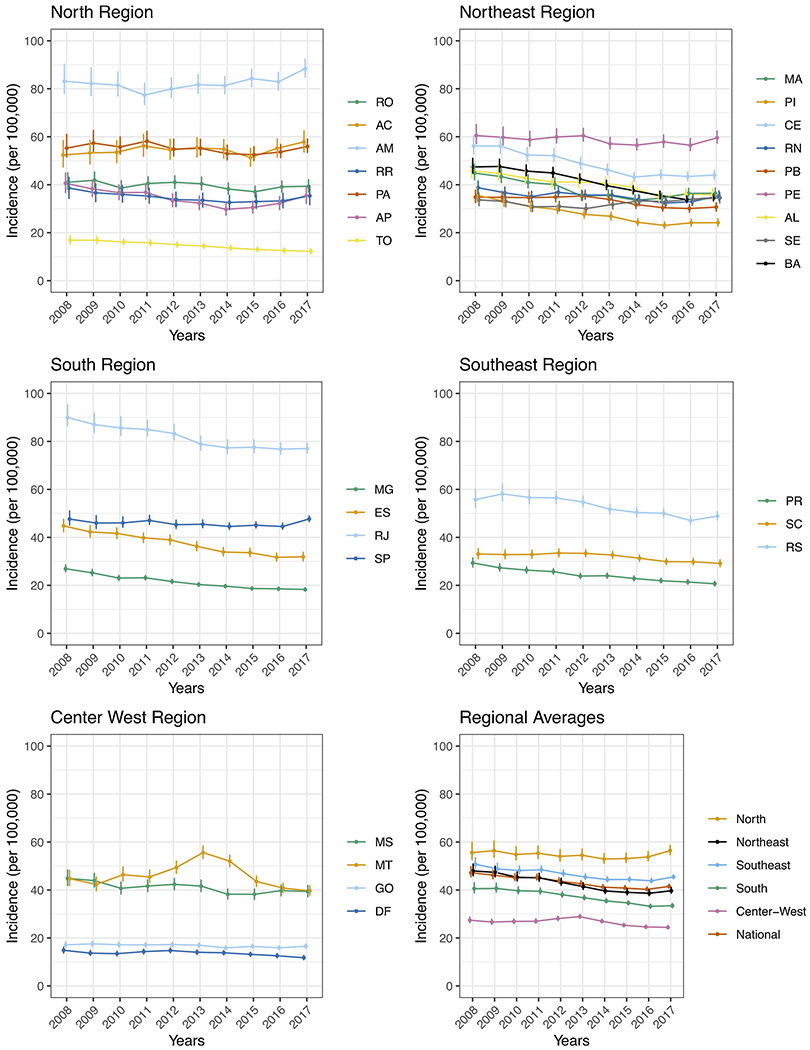
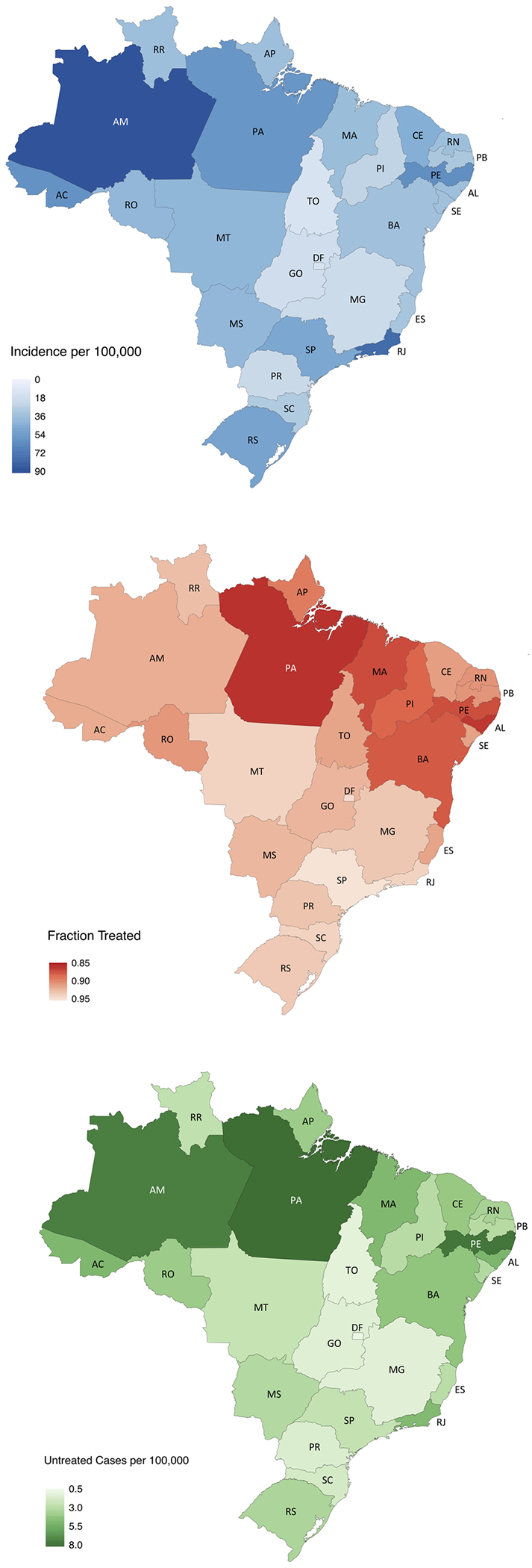
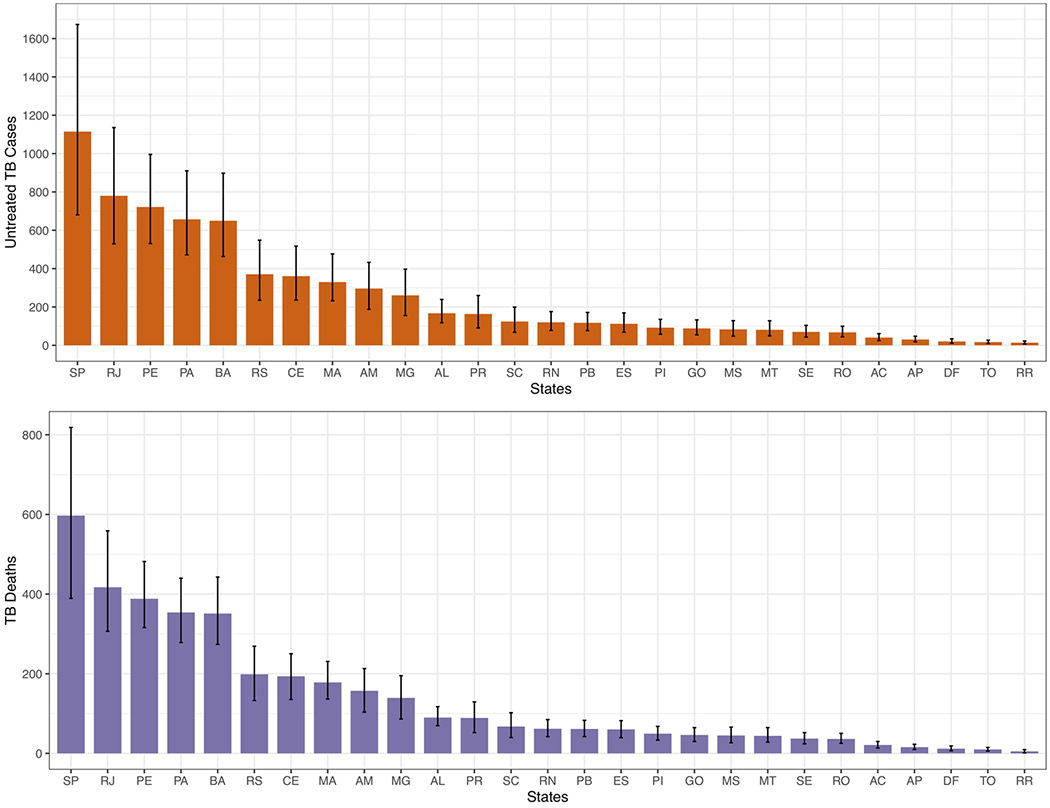
For 2017, TB incidence was estimated as 41.5 (95 % interval: 40.7, 42.5) per 100 000 nationally, and ranged from 11.7-88.3 per 100 000 across states. The fraction of cases treated was estimated as 91.9 % (89.6 %, 93.7 %) nationally and ranged 86.0 %-94.8 % across states, with an estimated 6.9 (5.3, 9.2) thousand cases going untreated in 2017. Over 2008-2017, incidence declined at an average annual rate of 1.4 % (1.1 %, 1.9 %) nationally, and -1.1%-4.2 % across states. Over this period there was a 0.5 % (0.2 %, 0.9 %) average annual increase in the fraction of incident TB cases treated.
Time-series estimates of TB burden and the fraction of cases treated can be derived from routinely-collected data and used to understand variation in TB outcomes and trends.
地方疾病负担和病例发现的完整性的证据是结核病控制规划的重要信息。我们提出了一种新方法,用于估计巴西的国家级和省级结核病发病率以及新发病例中被诊断和治疗的个体比例。
我们收集了巴西的结核病报告和与结核病相关的死亡率数据,并指定了一个分析模型,该模型将发病率近似为未接受治疗的活动性疾病患者的数量(治疗开始、治疗前死亡和自行治愈的总和)。我们采用贝叶斯推理方法综合数据并调整已知的偏倚来源。我们估计了 2008-2017 年期间巴西每个州和联邦区的结核病发病率和治疗病例比例。
2017 年,全国结核病发病率估计为 41.5(95%可信区间:40.7,42.5)/100000,各州发病率范围为 11.7-88.3/100000。治疗病例比例估计为全国 91.9%(89.6%,93.7%),各州范围为 86.0%-94.8%,估计 2017 年有 6900(5300,9200)例未接受治疗的病例。2008-2017 年期间,全国发病率平均每年下降 1.4%(1.1%,1.9%),各州下降 1.1%-4.2%。在此期间,治疗新发病例的比例平均每年增加 0.5%(0.2%,0.9%)。
从常规收集的数据中可以得出结核病负担和治疗病例比例的时间序列估计值,并用于了解结核病结果和趋势的变化。