Churchyard Gavin, Kim Peter, Shah N Sarita, Rustomjee Roxana, Gandhi Neel, Mathema Barun, Dowdy David, Kasmar Anne, Cardenas Vicky
Aurum Institute, Johannesburg, South Africa.
School of Public Health, University of the Witwatersrand, Johannesburg, South Africa.
J Infect Dis. 2017 Nov 3;216(suppl_6):S629-S635. doi: 10.1093/infdis/jix362.
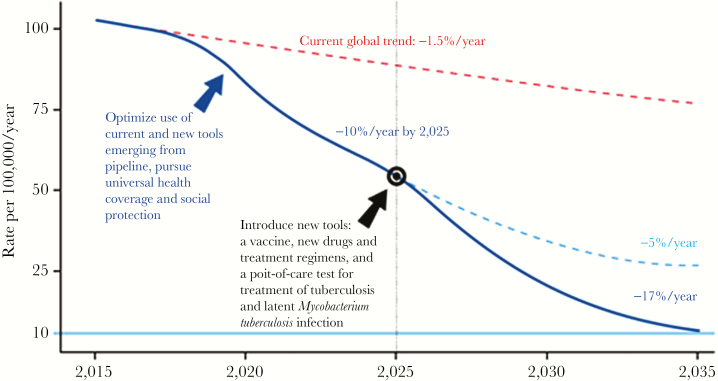
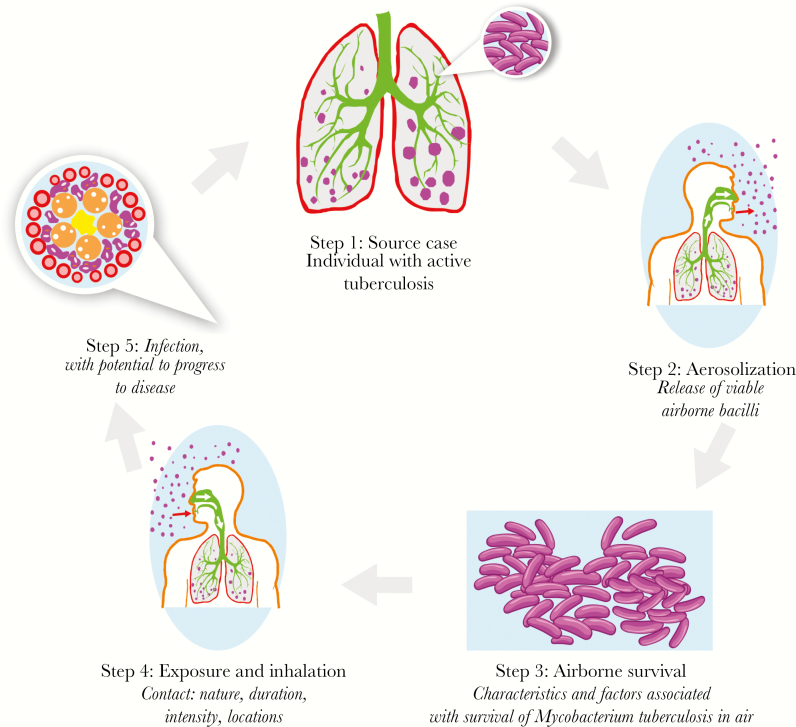
Tuberculosis remains a global health problem with an enormous burden of disease, estimated at 10.4 million new cases in 2015. To stop the tuberculosis epidemic, it is critical that we interrupt tuberculosis transmission. Further, the interventions required to interrupt tuberculosis transmission must be targeted to high-risk groups and settings. A simple cascade for tuberculosis transmission has been proposed in which (1) a source case of tuberculosis (2) generates infectious particles (3) that survive in the air and (4) are inhaled by a susceptible individual (5) who may become infected and (6) then has the potential to develop tuberculosis. Interventions that target these events will interrupt tuberculosis transmission and accelerate the decline in tuberculosis incidence and mortality. The purpose of this article is to provide a high-level overview of what is known about tuberculosis transmission, using the tuberculosis transmission cascade as a framework, and to set the scene for the articles in this series, which address specific aspects of tuberculosis transmission.
结核病仍然是一个全球性的健康问题,疾病负担巨大,2015年估计有1040万新发病例。为了阻止结核病的流行,关键是要阻断结核病的传播。此外,阻断结核病传播所需的干预措施必须针对高危人群和场所。有人提出了一个简单的结核病传播级联模型,即(1)结核病源病例(2)产生传染性颗粒(3)这些颗粒在空气中存活(4)并被易感个体吸入(5)该个体可能被感染(6)然后有可能发展为结核病。针对这些环节的干预措施将阻断结核病传播,并加速结核病发病率和死亡率的下降。本文的目的是利用结核病传播级联模型作为框架,对已知的结核病传播情况进行高层次概述,并为本系列中论述结核病传播具体方面的文章奠定基础。