Institute of Care Excellence, Nottingham University Hospitals NHS Trust, Derwent House, City Campus, Hucknall Road, Nottingham, NG5 1PB, UK.
School of Health Sciences, University of Nottingham, Nottingham, UK.
BMC Geriatr. 2021 Mar 6;21(1):165. doi: 10.1186/s12877-021-02107-y.
Rehabilitation interventions are frequently cited as key in supporting frail older people's recovery following periods of decompensation and acute ill-health. Clinicians are required to make decisions about a patient's potential to respond to rehabilitation. 'Rehabilitation potential' decisions can determine access to services. In acute settings clinicians have limited time to assess and work with patients, families and carers. The complexities of ageing, recovery, rehabilitation and frailty may not be fully appreciated. This study aimed to explore multiple perspectives of the concept of rehabilitation potential and how it is assessed in older people living with frailty in the acute healthcare setting.
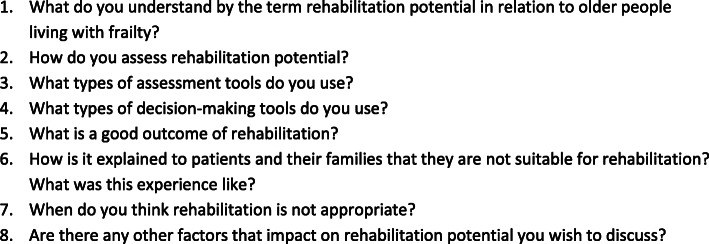
Five focus groups with a purposive sample of 28 participants which included clinicians and members of the public were conducted. Analysis comprised a thematic approach using the Framework method.
Rehabilitation potential was found to encapsulate a complex decision-making process where clinicians judged an individual's ability to benefit from and participate in targeted rehabilitation. They asked, "Will it work?", "Is it wanted?" and "Is it available?" In order to predict who would benefit from rehabilitation interventions, clinicians assessed a range of holistic clinical and non-clinical factors. An iterative approach to assessment delivered by a multi-disciplinary team, centred around patient and carer needs and wants was needed to accommodate complexity. Participants believed that everyone had some form of potential but this was dependent on availability of rehabilitation resources and conceptualisations of frailty and rehabilitation. Tensions between iterative approaches to rehabilitation potential assessment and the realities of rapid decision making in the acute hospital setting were found.
Rehabilitation potential decisions involve a complex process of multidisciplinary decision-making and prognostication on the likely outcome and benefit from rehabilitation programmes. These findings lay the foundation for developing structured approaches to rehabilitation potential decision making tools and guidance.
康复干预措施常被认为是支持体弱老年人在失代偿和急性健康不良期间康复的关键。临床医生需要对患者对康复的反应潜力做出决定。“康复潜力”决策可以决定患者能否获得服务。在急性环境中,临床医生评估和与患者、家庭和照顾者合作的时间有限。老龄化、恢复、康复和虚弱的复杂性可能未被充分认识。本研究旨在探讨衰弱老年人在急性医疗保健环境中康复潜力的概念及其评估方法的多个观点。
采用目的抽样法,对包括临床医生和公众在内的 28 名参与者进行了 5 次焦点小组讨论。分析采用框架方法的主题方法。
康复潜力被认为包含一个复杂的决策过程,其中临床医生判断个体从针对性康复中受益和参与的能力。他们会问:“这会有效吗?”“患者想要吗?”“有条件进行吗?”为了预测谁将受益于康复干预,临床医生评估了一系列全面的临床和非临床因素。需要采用多学科团队的迭代方法,以患者和照顾者的需求和意愿为中心,来适应复杂性。参与者认为每个人都有某种形式的潜力,但这取决于康复资源的可用性以及对虚弱和康复的概念化。在康复潜力评估的迭代方法与急性医院环境中快速决策的现实之间存在紧张关系。
康复潜力决策涉及多学科决策制定和预后复杂过程,即对康复计划的可能结果和收益的预测。这些发现为开发结构化的康复潜力决策工具和指南奠定了基础。