
由乳清蛋白与鼠李糖乳杆菌和加氏乳杆菌制成的新型乳源材料——发酵美拉德反应产物对产气荚膜梭菌的抗菌活性。
Antimicrobial activity of fermented Maillard reaction products, novel milk-derived material, made by whey protein and Lactobacillus rhamnosus and Lactobacillus gasseri on Clostridium perfringens.
作者信息
Kim Yujin, Kim Sejeong, Lee Soomin, Ha Jimyeong, Lee Jeeyeon, Choi Yukyung, Oh Hyemin, Lee Yewon, Oh Nam-Su, Yoon Yohan, Lee Heeyoung
机构信息
Department of Food and Nutrition, Sookmyung Women's University, Seoul 04310, Korea.
Risk Analysis Research Center, Sookmyung Women's University, Seoul 04310, Korea.
出版信息
Anim Biosci. 2021 Sep;34(9):1525-1531. doi: 10.5713/ab.20.0290. Epub 2021 Feb 15.
OBJECTIVE
The objective of this study was to evaluate the antimicrobial effects of fermented Maillard reaction products made by milk proteins (FMRPs) on Clostridium perfringens (C. perfringens), and to elucidate antimicrobial modes of FMRPs on the bacteria, using physiological and morphological analyses.
METHODS
Antimicrobial effects of FMRPs (whey protein plus galactose fermented by Lactobacillus rhamnosus [L. rhamnosus] 4B15 [Gal-4B15] or Lactobacillus gasseri 4M13 [Gal-4M13], and whey protein plus glucose fermented by L. rhamnosus 4B15 [Glc-4B15] or L. gasseri 4M13 [Glc-4M13]) on C. perfringens were tested by examining growth responses of the pathogen. Iron chelation activity analysis, propidium iodide uptake assay, and morphological analysis with field emission scanning electron microscope (FE-SEM) were conducted to elucidate the modes of antimicrobial activities of FMRPs.
RESULTS
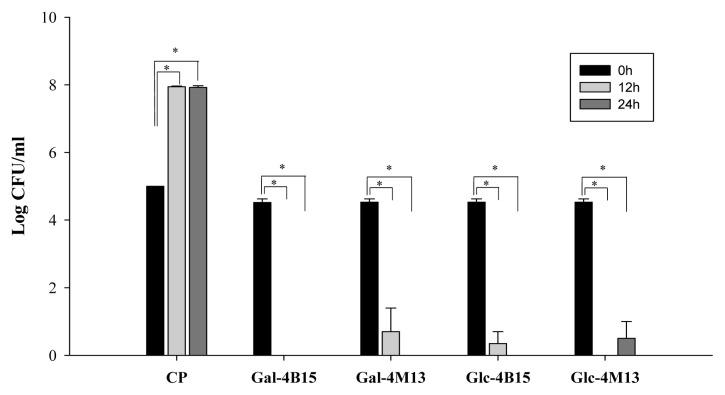
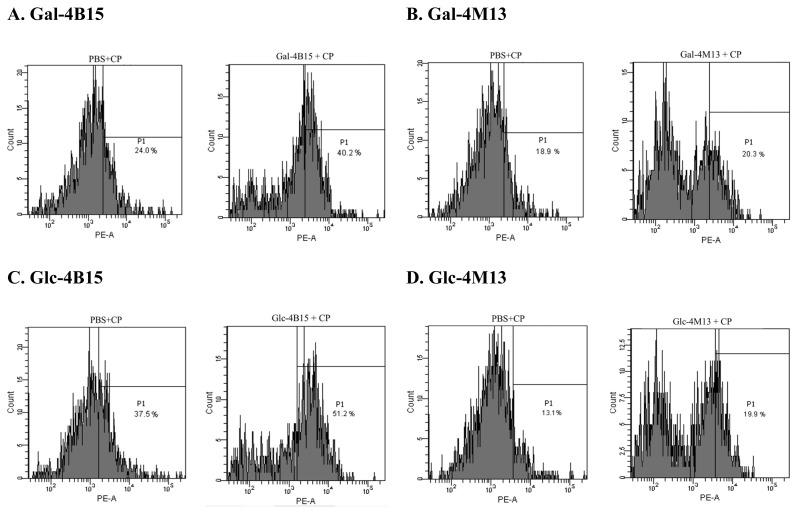
When C. perfringens were exposed to the FMRPs, C. perfringens cell counts were decreased (p<0.05) by the all tested FMRPs; iron chelation activities by FMRPs, except for Glc-4M13. Propidium iodide uptake assay indicate that bacterial cellular damage increased in all FMRPs-treated C. perfringens, and it was observed by FE-SEM.
CONCLUSION
These results indicate that the FMRPs can destroy C. perfringens by iron chelation and cell membrane damage. Thus, it could be used in dairy products, and controlling intestinal C. perfringens.
目的
本研究旨在评估乳蛋白制成的发酵美拉德反应产物(FMRPs)对产气荚膜梭菌的抗菌作用,并通过生理和形态学分析阐明FMRPs对该细菌的抗菌模式。
方法
通过检测病原体的生长反应,测试FMRPs(由鼠李糖乳杆菌[L. rhamnosus] 4B15[Gal-4B15]或加氏乳杆菌4M13[Gal-4M13]发酵的乳清蛋白加半乳糖,以及由鼠李糖乳杆菌4B15[Glc-4B15]或加氏乳杆菌4M13[Glc-4M13]发酵的乳清蛋白加葡萄糖)对产气荚膜梭菌的抗菌作用。进行铁螯合活性分析、碘化丙啶摄取试验以及用场发射扫描电子显微镜(FE-SEM)进行形态学分析,以阐明FMRPs的抗菌活性模式。
结果
当产气荚膜梭菌暴露于FMRPs时,所有测试的FMRPs均使产气荚膜梭菌细胞计数减少(p<0.05);除Glc-4M13外,FMRPs均有铁螯合活性。碘化丙啶摄取试验表明,所有经FMRPs处理的产气荚膜梭菌的细菌细胞损伤均增加,并且通过FE-SEM观察到了这一现象。
结论
这些结果表明,FMRPs可通过铁螯合和细胞膜损伤破坏产气荚膜梭菌。因此,它可用于乳制品中,并控制肠道中的产气荚膜梭菌。

 Zotero 插件