Dastgheyb Raha M, Buchholz Alison S, Fitzgerald Kathryn C, Xu Yanxun, Williams Dionna W, Springer Gayle, Anastos Kathryn, Gustafson Deborah R, Spence Amanda B, Adimora Adaora A, Waldrop Drenna, Vance David E, Milam Joel, Bolivar Hector, Weber Kathleen M, Haughey Norman J, Maki Pauline M, Rubin Leah H
Department of Neurology, Johns Hopkins University School of Medicine, Baltimore, MD, United States.
Department of Psychiatry, Johns Hopkins University School of Medicine, Baltimore, MD, United States.
Front Neurol. 2021 Feb 11;12:604984. doi: 10.3389/fneur.2021.604984. eCollection 2021.
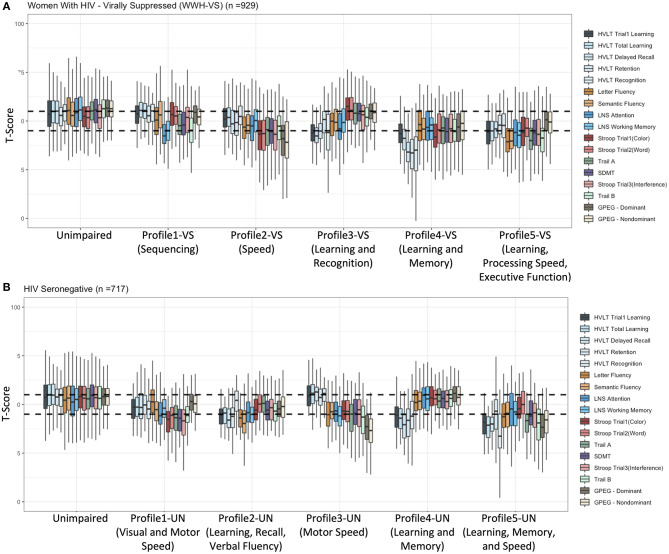
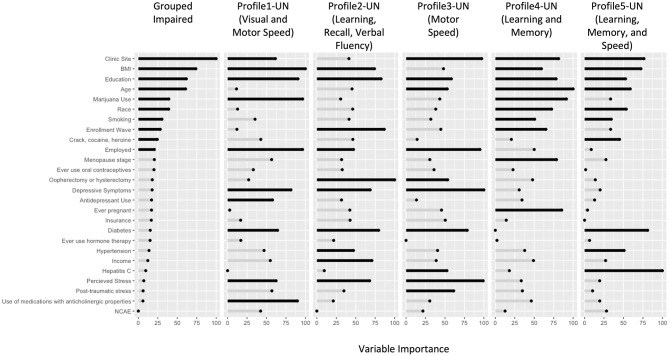
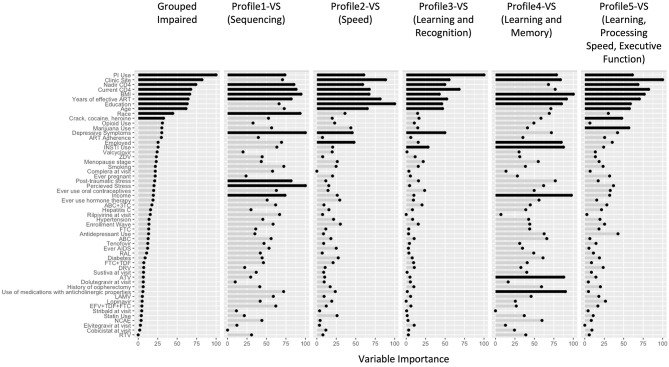
Cognitive impairment remains frequent and heterogeneous in presentation and severity among virally suppressed (VS) women with HIV (WWH). We identified cognitive profiles among 929 VS-WWH and 717 HIV-uninfected women from 11 Women's Interagency HIV Study sites at their first neuropsychological (NP) test battery completion comprised of: Hopkins Verbal Learning Test-Revised, Trail Making, Symbol Digit Modalities, Grooved Pegboard, Stroop, Letter/Animal Fluency, and Letter-Number Sequencing. Using 17 NP performance metrics (T-scores), we used Kohonen self-organizing maps to identify patterns of high-dimensional data by mapping participants to similar nodes based on T-scores and clustering those nodes. Among VS-WWH, nine clusters were identified (entropy = 0.990) with four having average T-scores ≥45 for all metrics and thus combined into an "unimpaired" profile ( = 311). Impaired profiles consisted of weaknesses in: (1) sequencing (; = 129), (2) speed (; = 144), (3) learning + recognition (; = 137), (4) learning + memory (; = 86), and (5) learning + processing speed + attention + executive function (; = 122). Sociodemographic, behavioral, and clinical variables differentiated profile membership using Random Forest models. The top 10 variables distinguishing the combined impaired vs. unimpaired profiles were: clinic site, age, education, race, illicit substance use, current and nadir CD4 count, duration of effective antiretrovirals, and protease inhibitor use. Additional variables differentiating each impaired from unimpaired profile included: depression, stress-symptoms, income (); depression, employment (); depression, integrase inhibitor (INSTI) use (); employment, INSTI use, income, atazanavir use, non-ART medications with anticholinergic properties (); and marijuana use (). Findings highlight consideration of NP profile heterogeneity and potential modifiable factors contributing to impaired profiles.
在病毒得到抑制的感染HIV的女性(WWH)中,认知障碍在表现和严重程度上仍然很常见且具有异质性。我们从11个妇女机构间HIV研究站点的929名病毒得到抑制的WWH和717名未感染HIV的女性中,在她们首次完成由以下测试组成的神经心理学(NP)测试组时确定了认知概况:霍普金斯词语学习测验修订版、连线测验、符号数字模式测验、沟槽插板测验、斯特鲁普测验、字母/动物流畅性测验和字母-数字排序测验。使用17个NP表现指标(T分数),我们使用科霍宁自组织映射通过基于T分数将参与者映射到相似节点并对这些节点进行聚类来识别高维数据的模式。在病毒得到抑制的WWH中,识别出了9个聚类(熵 = 0.990),其中4个在所有指标上的平均T分数≥45,因此合并为一个“未受损”概况(n = 311)。受损概况包括以下方面的弱点:(1)排序(n = 129),(2)速度(n = 144),(3)学习 + 识别(n = 137),(4)学习 + 记忆(n = 86),以及(5)学习 + 处理速度 + 注意力 + 执行功能(n = 122)。使用随机森林模型,社会人口统计学、行为和临床变量区分了概况成员。区分合并的受损与未受损概况的前10个变量是:诊所站点、年龄、教育程度、种族、非法药物使用、当前和最低CD4细胞计数、有效抗逆转录病毒药物的使用时长以及蛋白酶抑制剂的使用。区分每个受损概况与未受损概况的其他变量包括:抑郁、压力症状、收入(n = );抑郁、就业情况(n = );抑郁、整合酶抑制剂(INSTI)的使用(n = );就业情况、INSTI的使用、收入、阿扎那韦的使用、具有抗胆碱能特性的非抗逆转录病毒药物(n = );以及大麻的使用(n = )。研究结果突出了对NP概况异质性以及导致受损概况的潜在可改变因素的考虑。