Fuentelsaz-Romero Sara, Cuervo Andrea, Estrada-Capetillo Lizbeth, Celis Raquel, García-Campos Raquel, Ramírez Julio, Sastre Sergi, Samaniego Rafael, Puig-Kröger Amaya, Cañete Juan D
Unidad de Inmuno-Metabolismo e Inflamación, Instituto de Investigación Sanitaria Gregorio Marañón (IiSGM), Hospital General Universitario Gregorio Marañón, Madrid, Spain.
Unidad de Artritis, Servicio de Reumatología, Hospital Clínic and IDIBAPS, Barcelona, Spain.
Front Immunol. 2021 Feb 17;11:613975. doi: 10.3389/fimmu.2020.613975. eCollection 2020.
GM-CSF-dependent macrophage polarization has been demonstrated in rheumatoid arthritis (RA). Our aim was to seek diagnostic/prognostic biomarkers for undifferentiated arthritis (UA) by analyzing GM-CSF expression and source, macrophage polarization and density in joints of patients with UA evolving to RA or PsA compared with established RA or PsA, respectively.
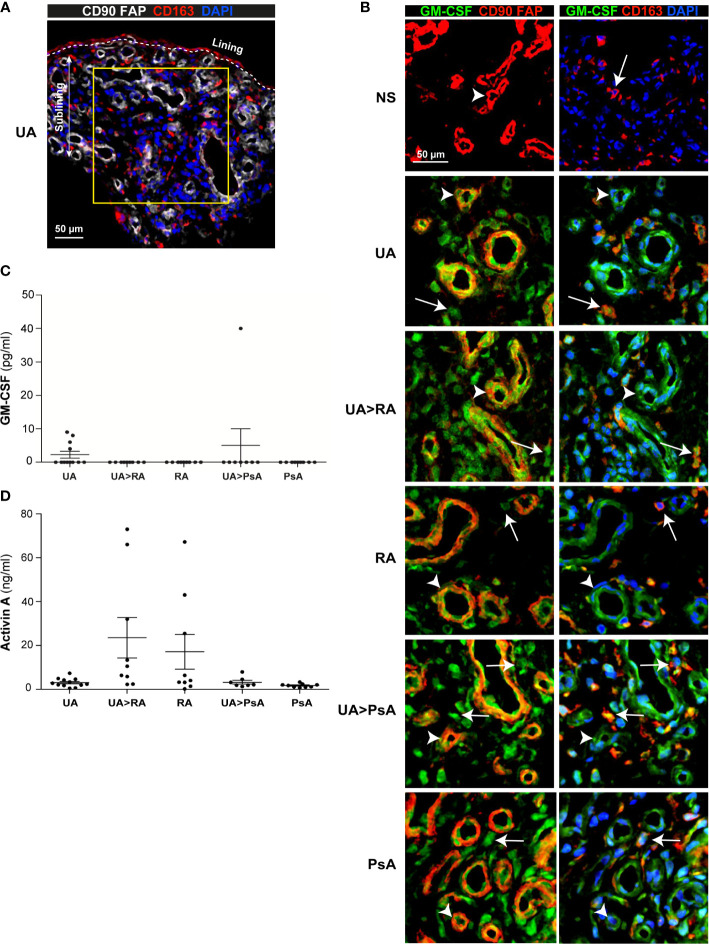
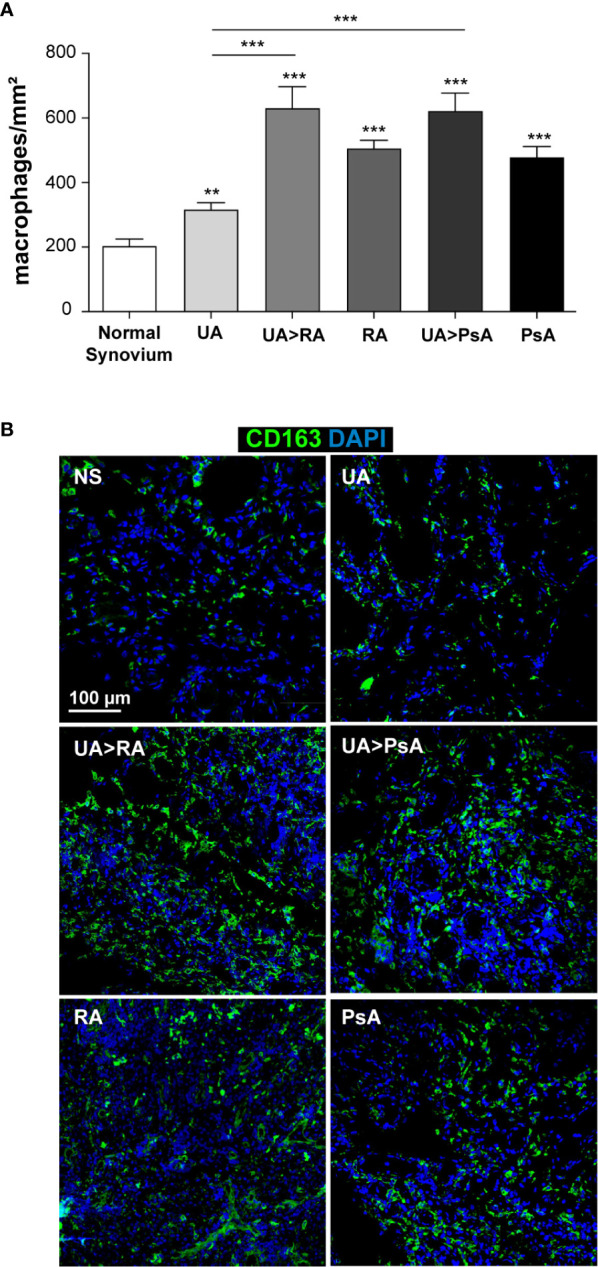
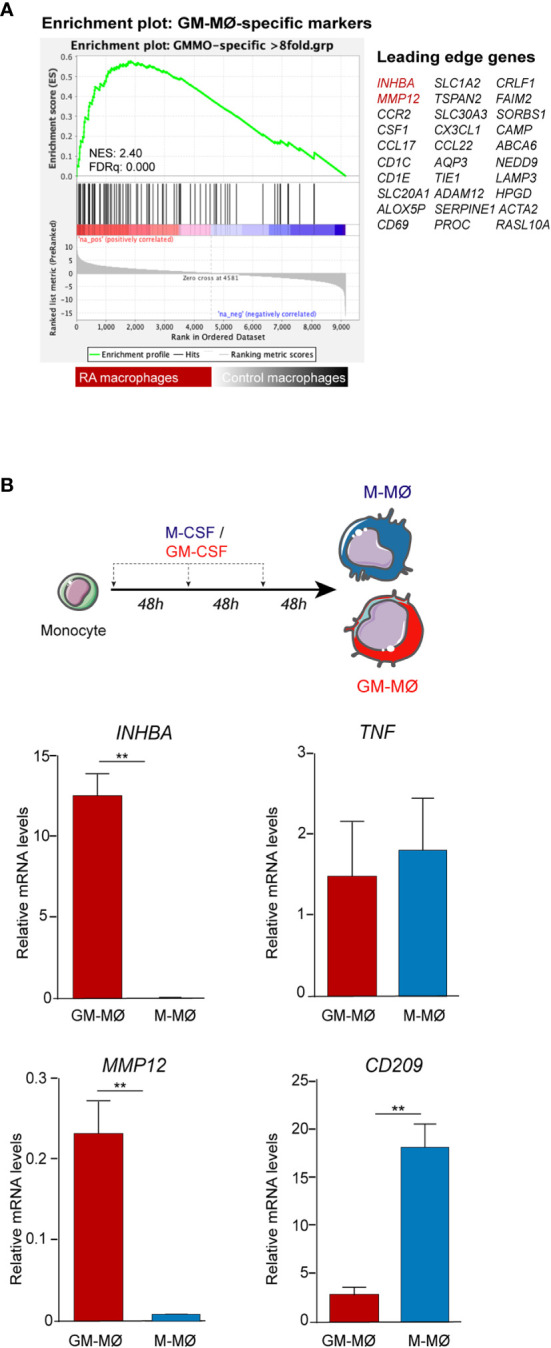
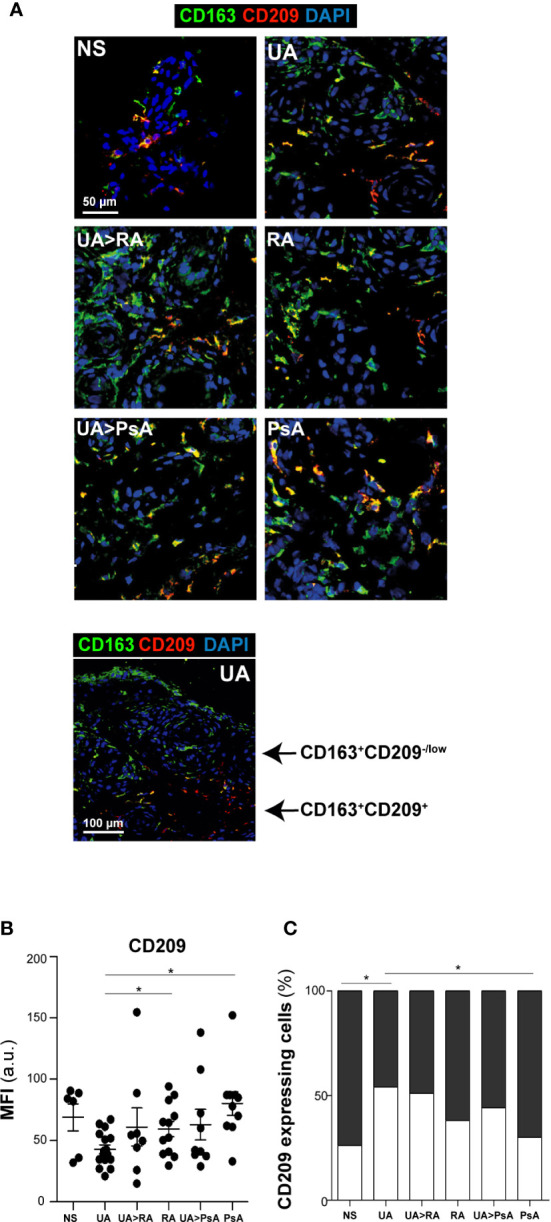
Synovial tissue (ST) from patients with UA evolving to RA (UA>RA, n=8), PsA (UA>PsA, n=9), persistent UA (UA, n=16), established RA (n=12) and PsA (n=10), and healthy controls (n=6), were analyzed. Cell source and quantitative expression of GM-CSF and proteins associated with pro-inflammatory (GM-CSF-driven) and anti-inflammatory (M-CSF-driven) macrophage polarization (activin A, TNFα, MMP12, and CD209, respectively) were assessed in ST CD163 macrophages by multicolor immunofluorescence. GM-CSF and activin A levels were also quantified in paired synovial fluid samples. CD163 macrophage density was determined in all groups by immunofluorescence.
Synovial stromal cells (FAP CD90 fibroblast, CD90 endothelial cells) and CD163 sublining macrophages were the sources of GM-CSF. ST CD163 macrophages from all groups expressed pro-inflammatory polarization markers (activin A, TNFα, and MMP12). Expression of the M-CSF-dependent anti-inflammatory marker CD209 identified two macrophage subsets (CD163 CD209 and CD163 CD209). CD209 macrophages were more abundant in ST from healthy controls and PsA patients, although both macrophage subtypes showed similar levels of pro-inflammatory markers in all groups. In paired synovial fluid samples, activin A was detected in all patients, with higher levels in UA>RA and RA, while GM-CSF was infrequently detected. ST CD163 macrophage density was comparable between UA>RA and UA>PsA patients, but significantly higher than in persistent UA.
GM-CSF is highly expressed by sublining CD90 FAP synovial fibroblasts, CD90 activated endothelium and CD163 macrophages in different types of arthritis. The polarization state of ST macrophages was similar in all UA and established arthritis groups, with a predominance of pro-inflammatory GM-CSF-associated markers. CD163 macrophage density was significantly higher in the UA phases of RA and PsA compared with persistent UA. Taken together, our findings support the idea that GM-CSF is a strong driver of macrophage polarization and a potential therapeutic target not only in RA but also in PsA and all types of UA.
在类风湿关节炎(RA)中已证实存在GM-CSF依赖的巨噬细胞极化现象。我们的目的是通过分析GM-CSF的表达及来源、巨噬细胞极化情况以及与发展为RA或银屑病关节炎(PsA)的未分化关节炎(UA)患者关节中的巨噬细胞密度,并分别与已确诊的RA或PsA患者进行比较,来寻找未分化关节炎的诊断/预后生物标志物。
分析了发展为RA(UA>RA,n = 8)、PsA(UA>PsA,n = 9)、持续性UA(UA,n = 16)、已确诊的RA(n = 12)和PsA(n = 10)患者以及健康对照(n = 6)的滑膜组织(ST)。通过多色免疫荧光法评估ST中CD163巨噬细胞内GM-CSF及其细胞来源、定量表达以及与促炎(GM-CSF驱动)和抗炎(M-CSF驱动)巨噬细胞极化相关的蛋白质(分别为激活素A、TNFα、MMP12和CD209)。还对配对的滑液样本中的GM-CSF和激活素A水平进行了定量分析。通过免疫荧光法测定所有组中的CD163巨噬细胞密度。
滑膜基质细胞(FAP CD90成纤维细胞、CD90内皮细胞)和CD163内衬巨噬细胞是GM-CSF的来源。所有组的ST CD163巨噬细胞均表达促炎极化标志物(激活素A、TNFα和MMP12)。依赖M-CSF的抗炎标志物CD209的表达确定了两个巨噬细胞亚群(CD163 CD209和CD163 CD209)。CD209巨噬细胞在健康对照和PsA患者的ST中更为丰富,尽管在所有组中两种巨噬细胞亚型的促炎标志物水平相似。在配对的滑液样本中,所有患者均检测到激活素A,在UA>RA和RA患者中水平较高,而GM-CSF很少被检测到。UA>RA和UA>PsA患者之间的ST CD163巨噬细胞密度相当,但显著高于持续性UA患者。
在不同类型的关节炎中,GM-CSF在CD90 FAP滑膜成纤维细胞、CD90激活内皮细胞和CD163巨噬细胞内衬中高表达。在所有UA组和已确诊的关节炎组中,ST巨噬细胞的极化状态相似,以促炎的GM-CSF相关标志物为主。与持续性UA相比,RA和PsA的UA阶段CD163巨噬细胞密度显著更高。综上所述,我们的研究结果支持以下观点:GM-CSF不仅是RA,也是PsA和所有类型UA中巨噬细胞极化的强大驱动因素以及潜在的治疗靶点。