Reproductive Medicine Centre, Zhongshan Hospital, Fudan University, Shanghai, China.
Department of Biology, University of Pennsylvania, Philadelphia, PA, United States.
Front Immunol. 2021 Feb 19;12:582858. doi: 10.3389/fimmu.2021.582858. eCollection 2021.
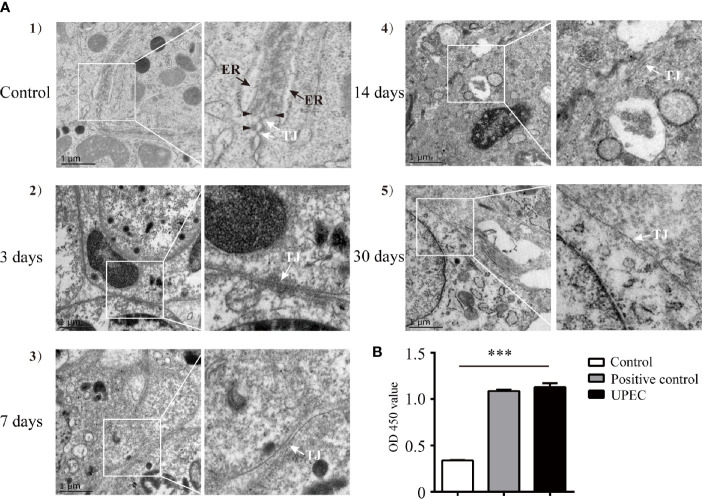
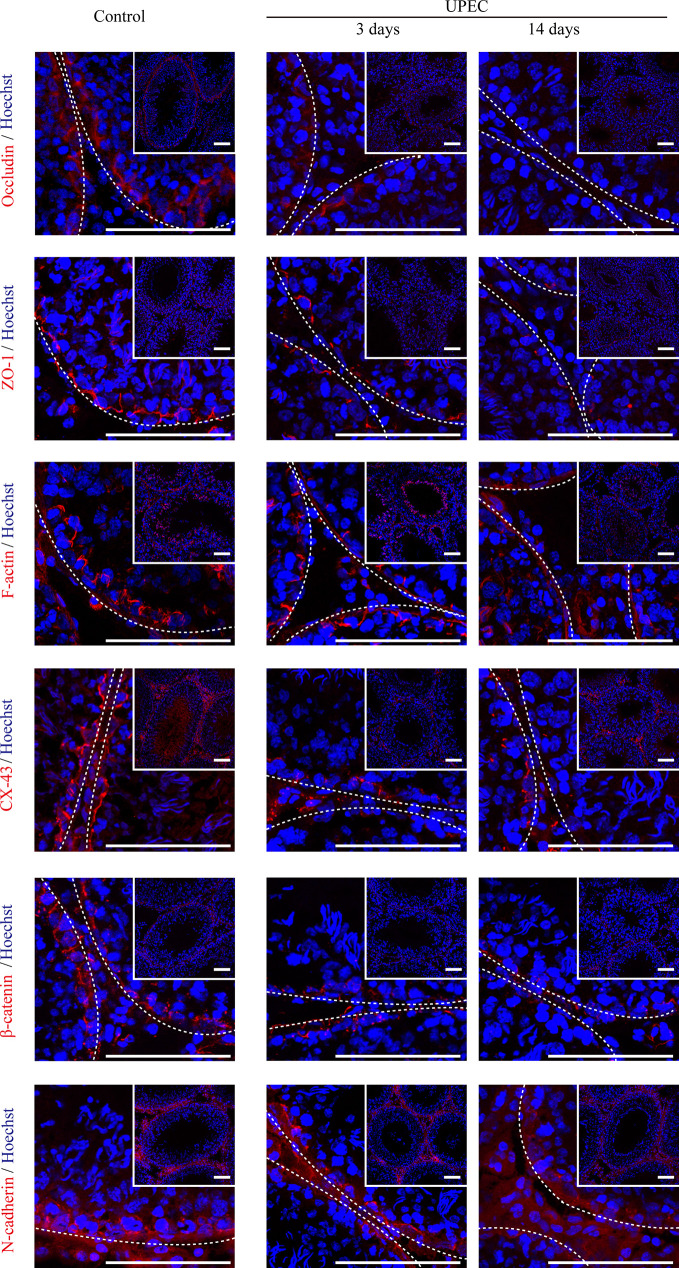
The structural and functional destruction of the blood-testis barrier (BTB) following uropathogenic (UPEC) infection may be a critical component of the pathologic progress of orchitis. Recent findings indicate that the mammalian target of the rapamycin (mTOR)-signaling pathway is implicated in the regulation of BTB assembly and restructuring. To explore the mechanisms underlying BTB damage induced by UPEC infection, we analyzed BTB integrity and the involvement of the mTOR-signaling pathway using and UPEC-infection models. We initially confirmed that soluble virulent factors secreted from UPEC trigger a stress response in Sertoli cells and disturb adjacent cell junctions down-regulation of junctional proteins, including occludin, zonula occludens-1 (ZO-1), F-actin, connexin-43 (CX-43), β-catenin, and N-cadherin. The BTB was ultimately disrupted in UPEC-infected rat testes, and blood samples from UPEC-induced orchitis in these animals were positive for anti-sperm antibodies. Furthermore, we herein also demonstrated that mTOR complex 1 (mTORC1) over-activation and mTORC2 suppression contributed to the disturbance in the balance between BTB "opening" and "closing." More importantly, rapamycin (a specific mTORC1 inhibitor) significantly restored the expression of cell-junction proteins and exerted a protective effect on the BTB during UPEC infection. We further confirmed that short-term treatment with rapamycin did not aggravate spermatogenic degeneration in infected rats. Collectively, this study showed an association between abnormal activation of the mTOR-signaling pathway and BTB impairment during UPEC-induced orchitis, which may provide new insights into a potential treatment strategy for testicular infection.
尿路上皮病原体 (UPEC) 感染后血睾屏障 (BTB) 的结构和功能破坏可能是睾丸炎病理进展的关键组成部分。最近的研究结果表明,雷帕霉素靶蛋白 (mTOR) 信号通路在调节 BTB 组装和重构中起作用。为了探讨 UPEC 感染诱导的 BTB 损伤的机制,我们使用 和 UPEC 感染模型分析了 BTB 的完整性和 mTOR 信号通路的参与。我们最初证实,UPEC 分泌的可溶性毒力因子触发了支持细胞的应激反应,并扰乱了相邻细胞连接——细胞连接蛋白包括紧密连接蛋白 (occludin)、封闭蛋白-1 (ZO-1)、F-肌动蛋白、连接蛋白-43 (CX-43)、β-连环蛋白和 N-钙黏蛋白的下调。最终,UPEC 感染的大鼠睾丸中的 BTB 被破坏,并且这些动物的 UPEC 诱导的睾丸炎血液样本中存在抗精子抗体。此外,我们还证明了 mTOR 复合物 1 (mTORC1) 的过度激活和 mTORC2 的抑制导致了 BTB“开放”和“关闭”之间平衡的紊乱。更重要的是,雷帕霉素 (一种特异性 mTORC1 抑制剂) 显著恢复了细胞连接蛋白的表达,并在 UPEC 感染期间对 BTB 发挥了保护作用。我们进一步证实,雷帕霉素的短期治疗不会加重感染大鼠的生精细胞变性。总之,这项研究表明,mTOR 信号通路的异常激活与 UPEC 诱导的睾丸炎期间 BTB 损伤之间存在关联,这可能为睾丸感染的潜在治疗策略提供新的见解。