Basti Alireza, Yalçin Müge, Herms David, Hesse Janina, Aboumanify Ouda, Li Yin, Aretz Zita, Garmshausen Josefin, El-Athman Rukeia, Hastermann Maria, Blottner Dieter, Relógio Angela
Molecular Cancer Research Center (MKFZ), Medical Department of Hematology, Oncology, and Tumor Immunology, Charité - Universitätsmedizin Berlin, corporate member of Freie Universität Berlin Humboldt - Universität zu Berlin, and Berlin Institute of Health, Berlin, Germany.
Institute for Theoretical Biology (ITB), Charité - Universitätsmedizin Berlin, corporate member of Freie Universität Berlin, Humboldt - Universität zu Berlin, and Berlin Institute of Health, Berlin, Germany.
BMJ Open Sport Exerc Med. 2021 Feb 10;7(1):e000876. doi: 10.1136/bmjsem-2020-000876. eCollection 2021.
In this study, we investigated daily fluctuations in molecular (gene expression) and physiological (biomechanical muscle properties) features in human peripheral cells and their correlation with exercise performance.
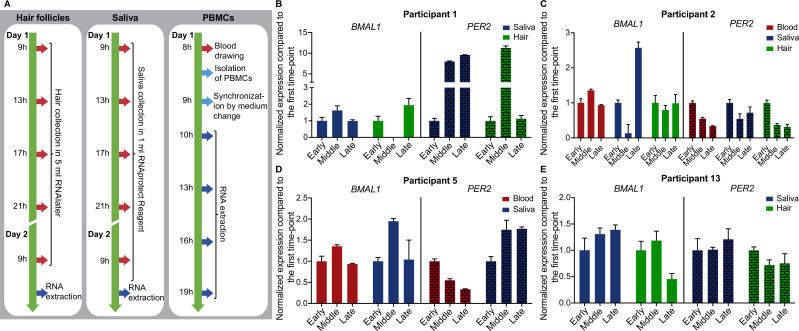
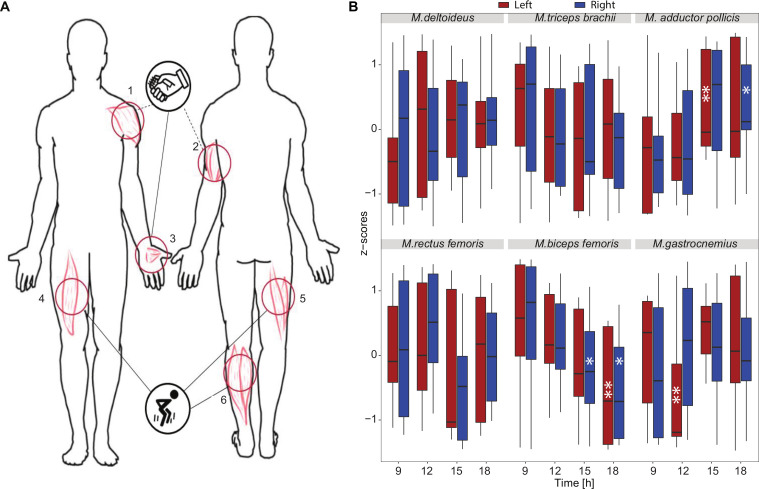
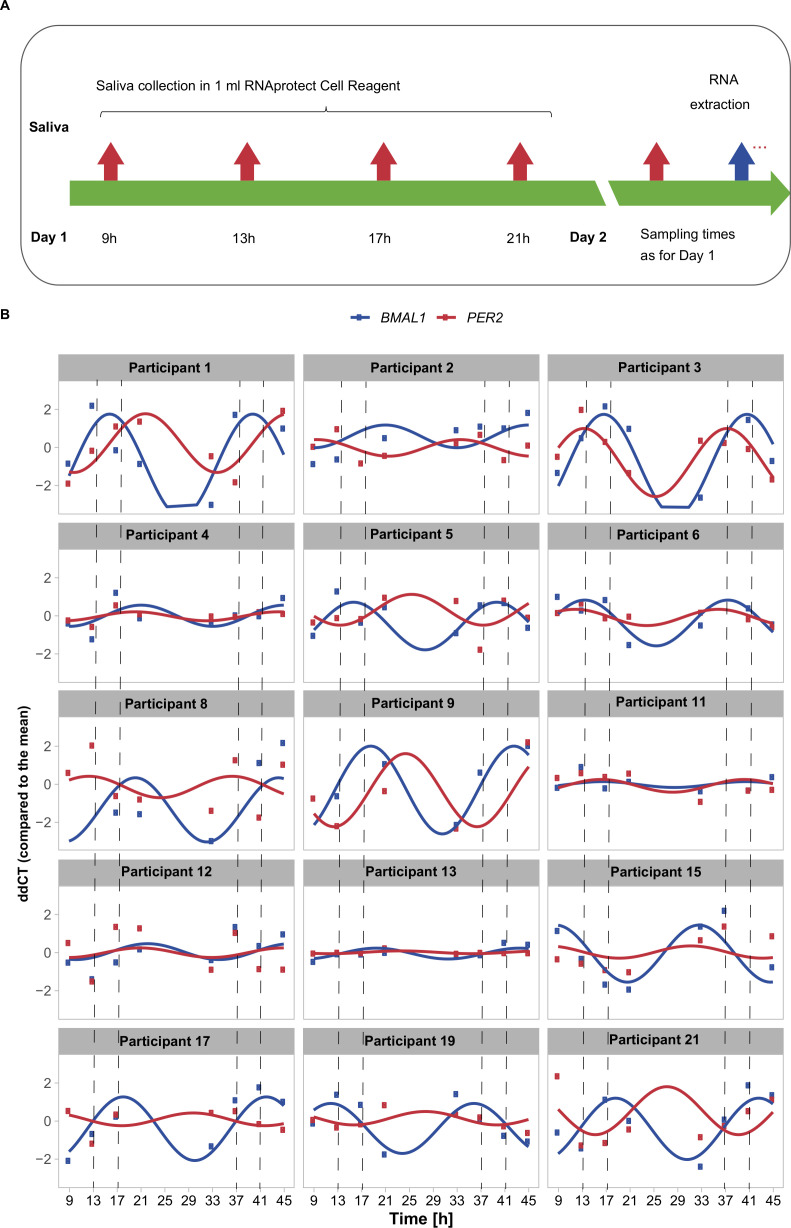
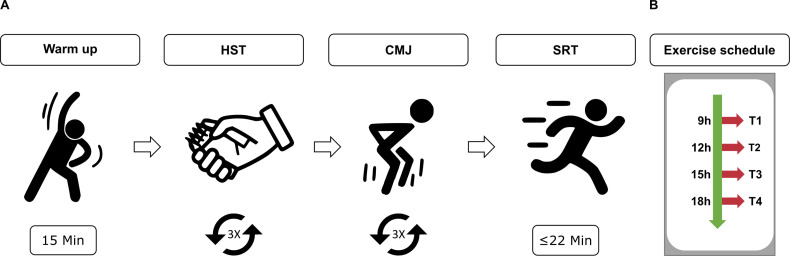
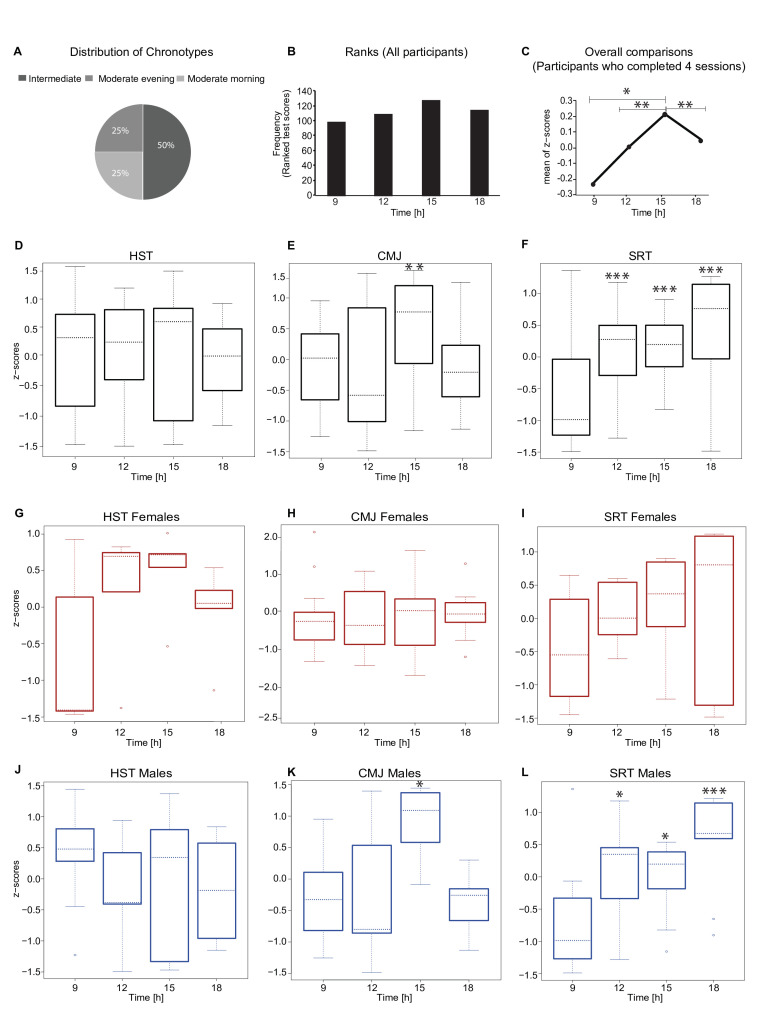
21 healthy participants (13 men and 8 women) took part in three test series: for the molecular analysis, 15 participants provided hair, blood or saliva time-course sampling for the rhythmicity analysis of core-clock gene expression via RT-PCR. For the exercise tests, 16 participants conducted strength and endurance exercises at different times of the day (9h, 12h, 15h and 18h). Myotonometry was carried out using a digital palpation device (MyotonPRO), five muscles were measured in 11 participants. A computational analysis was performed to relate core-clock gene expression, resting muscle tone and exercise performance.
Core-clock genes show daily fluctuations in expression in all biological samples tested for all participants. Exercise performance peaks in the late afternoon (15-18 hours for both men and women) and shows variations in performance, depending on the type of exercise (eg, strength vs endurance). Muscle tone varies across the day and higher muscle tone correlates with better performance. Molecular daily profiles correlate with daily variation in exercise performance.
Training programmes can profit from these findings to increase efficiency and fine-tune timing of training sessions based on the individual molecular data. Our results can benefit both professional athletes, where a fraction of seconds may allow for a gold medal, and rehabilitation in clinical settings to increase therapy efficacy and reduce recovery times.
在本研究中,我们调查了人类外周细胞中分子(基因表达)和生理(生物力学肌肉特性)特征的每日波动情况及其与运动表现的相关性。
21名健康参与者(13名男性和8名女性)参加了三个测试系列:对于分子分析,15名参与者提供头发、血液或唾液的时间进程样本,通过逆转录聚合酶链反应(RT-PCR)对核心生物钟基因表达的节律性进行分析。对于运动测试,16名参与者在一天中的不同时间(9时、12时、15时和18时)进行力量和耐力运动。使用数字触诊设备(MyotonPRO)进行肌张力测量,对11名参与者的五块肌肉进行测量。进行了一项计算分析,以关联核心生物钟基因表达、静息肌张力和运动表现。
在所有参与者测试的所有生物样本中,核心生物钟基因的表达均呈现每日波动。运动表现在下午晚些时候达到峰值(男性和女性均为15至18时),并且根据运动类型(例如,力量运动与耐力运动)表现有所不同。肌张力在一天中有所变化,较高的肌张力与更好的表现相关。分子每日图谱与运动表现的每日变化相关。
训练计划可以从这些发现中受益,以提高效率并根据个体分子数据微调训练课程的时间安排。我们的结果对职业运动员(在那里几分之一秒可能决定能否获得金牌)以及临床环境中的康复治疗都有益,可提高治疗效果并缩短恢复时间。