Cui Xueyang, Lv Zhi, Ding Hanxi, Xing Chengzhong, Yuan Yuan
Tumor Etiology and Screening Department of Cancer Institute and General Surgery, The First Hospital of China Medical University, Shenyang, China.
Key Laboratory of Cancer Etiology and Prevention in Liaoning Education Department, The First Hospital of China Medical University, Shenyang, China.
Front Oncol. 2021 Feb 18;10:531244. doi: 10.3389/fonc.2020.531244. eCollection 2020.
We investigated microRNA (miR) 1539 as a potential biomarker for predicting the risk and pathobiological behavior of colorectal cancer (CRC).
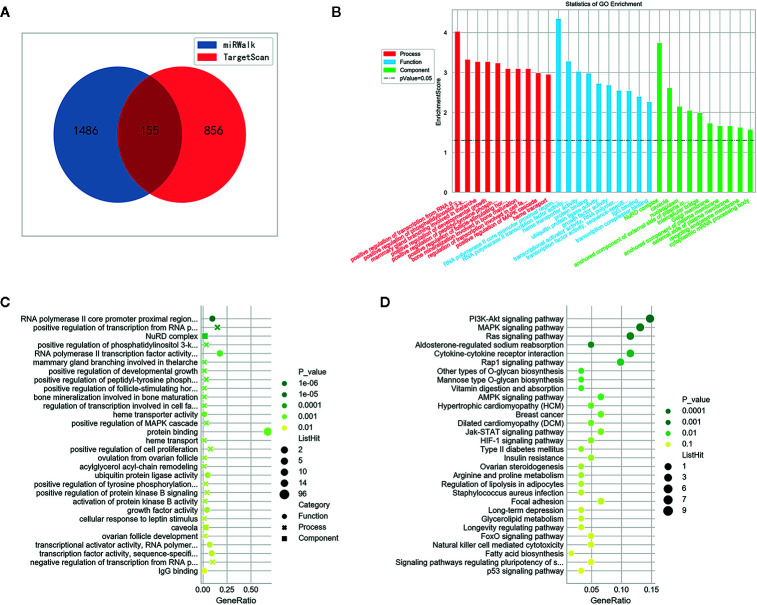
Our strategy consisted of analyzing 100 serum samples from 51 CRC patients, 49 healthy controls (HCs), and another 56 CRC tissue and matched normal adjacent to tumor (NAT) samples. The relative expression levels of miR-1539 in exosomes, serum and tissues were detected and compared in the different groups, using reverse transcription-polymerase chain reaction (RT-qPCR). The diagnostic value and potential function of miR-1539 were investigated using clinicopathological data combined with bioinformatics analysis.
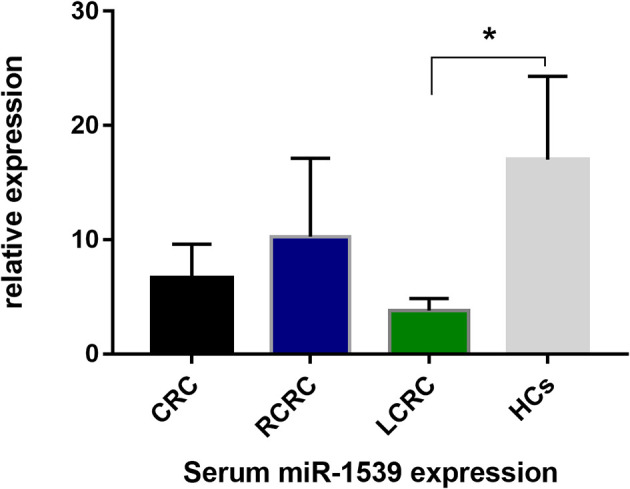
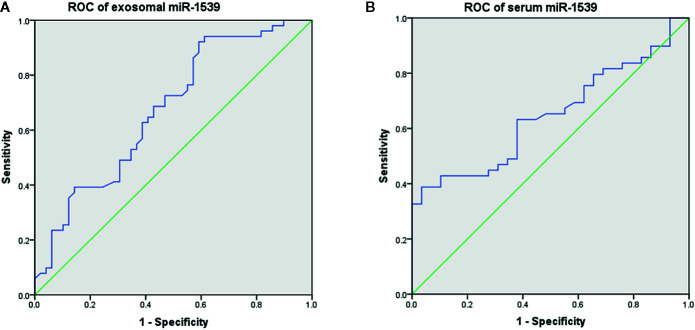
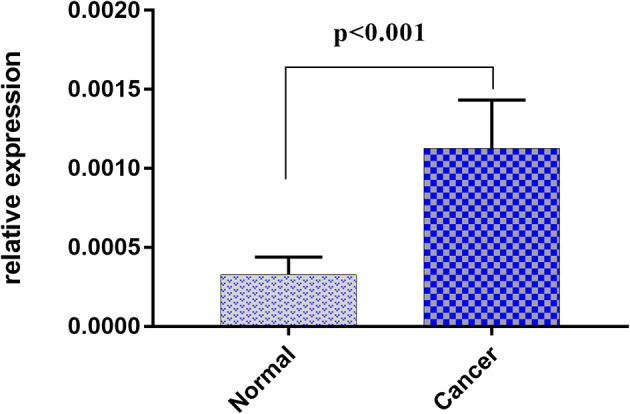
MiR-1539 expression was significantly up-regulated in exosomes ( = 0.003) and cancer tissue ( < 0.001) from CRC patients. MiR-1539 expression levels in serum varied according to different tumor sites (right-sided vs. left-sided, = 0.047; left-side CRC vs. HCs, = 0.031). In terms of diagnostic efficacy, miR-1539 expression in exosomes may help distinguish CRC cases from HCs with a sensitivity of 92.2%, and miR-1539 expression in serum may improve the specificity to 96.6% for left-sided CRC diagnosis. When combined with clinicopathological data, serum miR-1539 levels were positively associated with vascular endothelial growth factor (VEGF) expression ( = 0.028), whilst levels in CRC tissue were positively associated with increased Ki-67 levels ( = 0.035). Poorer pathologic differentiation was potentially related to an increased tendency of miR-1539 expression in CRC tissue ( = 0.071). Based on our bioinformatics analysis, miR-1539 may have a significant mechanistic influence on CRC genesis and progression.
Circulating or tissue based miR-1539 may be used as a novel potential biomarker for CRC screening, and a predictor of poor clinicopathological behavior in tumors.
我们研究了微小RNA(miR)1539作为预测结直肠癌(CRC)风险和病理生物学行为的潜在生物标志物。
我们的策略包括分析来自51例CRC患者的100份血清样本、49例健康对照(HCs)以及另外56份CRC组织和配对的肿瘤旁正常(NAT)样本。使用逆转录聚合酶链反应(RT-qPCR)检测并比较不同组中外泌体、血清和组织中miR-1539的相对表达水平。结合临床病理数据和生物信息学分析,研究miR-1539的诊断价值和潜在功能。
CRC患者的外泌体(P = 0.003)和癌组织(P < 0.001)中miR-1539表达显著上调。血清中miR-1539表达水平因不同肿瘤部位而异(右侧与左侧,P = 0.047;左侧CRC与HCs,P = 0.031)。在诊断效能方面,外泌体中miR-1539表达可能有助于将CRC病例与HCs区分开来,敏感性为92.2%,血清中miR-1539表达可将左侧CRC诊断的特异性提高到96.6%。当与临床病理数据相结合时,血清miR-1539水平与血管内皮生长因子(VEGF)表达呈正相关(P = 0.028),而CRC组织中的水平与Ki-67水平升高呈正相关(P = 0.035)。较差的病理分化可能与CRC组织中miR-1539表达增加的趋势有关(P = 0.071)。基于我们的生物信息学分析,miR-1539可能对CRC的发生和进展具有重大的机制影响。
循环或基于组织的miR-1539可作为CRC筛查的新型潜在生物标志物,以及肿瘤不良临床病理行为的预测指标。