Ruppenstein Aylin, Limberg Maren M, Loser Karin, Kremer Andreas E, Homey Bernhard, Raap Ulrike
Division of Experimental Allergy and Immunodermatology, Faculty of Medicine and Health Sciences, University of Oldenburg, Oldenburg, Germany.
Division of Immunology, Faculty of Medicine and Health Sciences, University of Oldenburg, Oldenburg, Germany.
Front Med (Lausanne). 2021 Feb 18;8:627985. doi: 10.3389/fmed.2021.627985. eCollection 2021.
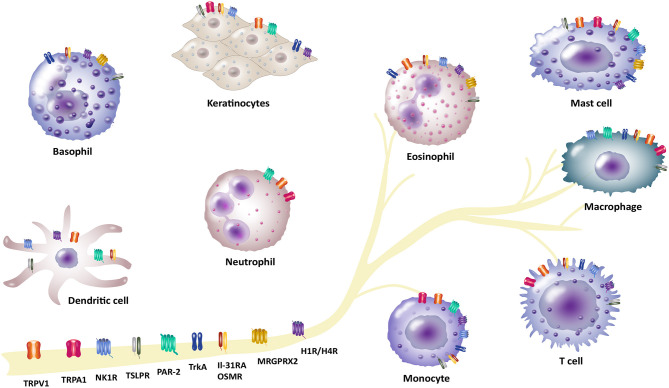
Pruritus is a common, but very challenging symptom with a wide diversity of underlying causes like dermatological, systemic, neurological and psychiatric diseases. In dermatology, pruritus is the most frequent symptom both in its acute and chronic form (over 6 weeks in duration). Treatment of chronic pruritus often remains challenging. Affected patients who suffer from moderate to severe pruritus have a significantly reduced quality of life. The underlying physiology of pruritus is very complex, involving a diverse network of components in the skin including resident cells such as keratinocytes and sensory neurons as well as transiently infiltrating cells such as certain immune cells. Previous research has established that there is a significant crosstalk among the stratum corneum, nerve fibers and various immune cells, such as keratinocytes, T cells, basophils, eosinophils and mast cells. In this regard, interactions between receptors on cutaneous and spinal neurons or on different immune cells play an important role in the processing of signals which are important for the transmission of pruritus. In this review, we discuss the role of various receptors involved in pruritus and inflammation, such as TRPV1 and TRPA1, IL-31RA and OSMR, TSLPR, PAR-2, NK1R, H1R and H4R, MRGPRs as well as TrkA, with a focus on interaction between nerve fibers and different immune cells. Emerging evidence shows that neuro-immune interactions play a pivotal role in mediating pruritus-associated inflammatory skin diseases such as atopic dermatitis, psoriasis or chronic spontaneous urticaria. Targeting these bidirectional neuro-immune interactions and the involved pruritus-specific receptors is likely to contribute to novel insights into the underlying pathogenesis and targeted treatment options of pruritus.
瘙痒是一种常见但极具挑战性的症状,其潜在病因多种多样,包括皮肤病、全身性疾病、神经疾病和精神疾病。在皮肤科,瘙痒是急性和慢性(持续时间超过6周)最常见的症状。慢性瘙痒的治疗通常仍然具有挑战性。患有中度至重度瘙痒的患者生活质量显著下降。瘙痒的潜在生理机制非常复杂,涉及皮肤中的多种成分网络,包括角质形成细胞和感觉神经元等驻留细胞,以及某些免疫细胞等短暂浸润细胞。先前的研究已经证实,角质层、神经纤维和各种免疫细胞(如角质形成细胞、T细胞、嗜碱性粒细胞、嗜酸性粒细胞和肥大细胞)之间存在显著的相互作用。在这方面,皮肤和脊髓神经元或不同免疫细胞上的受体之间的相互作用在信号处理中起重要作用,这些信号对于瘙痒的传递至关重要。在本综述中,我们讨论了参与瘙痒和炎症的各种受体的作用,如TRPV1和TRPA1、IL-31RA和OSMR、TSLPR、PAR-2、NK1R、H1R和H4R、MRGPRs以及TrkA,重点是神经纤维与不同免疫细胞之间的相互作用。新出现的证据表明,神经免疫相互作用在介导与瘙痒相关的炎症性皮肤病(如特应性皮炎、银屑病或慢性自发性荨麻疹)中起关键作用。针对这些双向神经免疫相互作用以及所涉及的瘙痒特异性受体,可能有助于深入了解瘙痒的潜在发病机制和靶向治疗方案。