Li Bo, Sun Xuezhao, Huo Qin, Zhang Guiguo, Wu Tingting, You Peihua, He Yuhua, Tian Wannian, Li Rongquan, Li Changsheng, Li Jianping, Wang Chunqing, Song Baijun
The Innovation Centre of Ruminant Precision Nutrition and Smart and Ecological Farming, Jilin Agricultural Science and Technology University, Jilin City, China.
Jilin Inter-Regional Cooperation Centre for the Scientific and Technological Innovation of Ruminant Precision Nutrition and Smart and Ecological Farming, Jilin City, China.
Front Vet Sci. 2021 Feb 12;8:629016. doi: 10.3389/fvets.2021.629016. eCollection 2021.
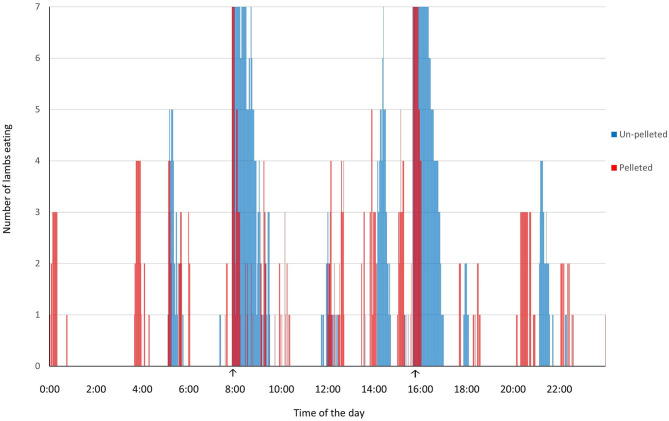
Feeding pelleted total mixed rations (TMR) instead of traditional loose concentrate plus forage to fattening lambs is an emerging practice. This study aimed to determine the effects of feeding pelleted TMR to fattening lambs on feed intake behaviour, growth performance, feed digestion, rumen fermentation characteristics, rumen microbial community, serum parameters, slaughter performance, meat quality, and the economic outcome. Two physical forms (pelleted vs. un-pelleted) of TMR composed of the same ingredients with the same particle sizes were compared in three animal experiments. Feed intake and average daily gain were higher when the TMR was pelleted, but apparent total tract digestibility of nutrients (organic matter, crude protein, neutral detergent fibre, acid detergent fibre, and ether extract) and serum parameters were not affected and apparent total tract dry matter digestibility was slightly lower. Feeding pelleted TMR increased total short-chain fatty acid concentration and decreased rumen pH. Rumen microbial community was not affected by the physical form of the TMR at phylum level but changed slightly at genus level. Liveweight at slaughter and hot carcass weight were higher for lambs fed the pelleted compared to the un-pelleted TMR, while dressing percentage and meat quality were not affected. In conclusion, feeding pelleted TMR improves growth performance of fattening lambs mainly due to an increase in feed intake. Feeding pelleted TMR is a feasible strategy for intensive lamb fattening operations.
给育肥羔羊饲喂颗粒全混合日粮(TMR)而非传统的松散精料加饲草是一种新兴做法。本研究旨在确定给育肥羔羊饲喂颗粒TMR对采食量行为、生长性能、饲料消化、瘤胃发酵特性、瘤胃微生物群落、血清参数、屠宰性能、肉品质以及经济效益的影响。在三项动物实验中比较了由相同成分且粒径相同的两种物理形态(颗粒状与非颗粒状)的TMR。TMR制成颗粒时,采食量和平均日增重更高,但营养物质(有机物、粗蛋白、中性洗涤纤维、酸性洗涤纤维和乙醚提取物)的表观全消化道消化率和血清参数未受影响,表观全消化道干物质消化率略低。饲喂颗粒TMR会增加总短链脂肪酸浓度并降低瘤胃pH值。瘤胃微生物群落在门水平上不受TMR物理形态的影响,但在属水平上略有变化。与饲喂非颗粒TMR的羔羊相比,饲喂颗粒TMR的羔羊屠宰时的体重和热胴体重更高,而屠宰率和肉品质不受影响。总之,饲喂颗粒TMR主要通过增加采食量来提高育肥羔羊的生长性能。饲喂颗粒TMR是集约化羔羊育肥作业的一种可行策略。