
通过在超级电容器电极中原位剥离准一维石墨烯纳米带实现显著的电容增强
Significant Capacitance Enhancement via In Situ Exfoliation of Quasi-One-Dimensional Graphene Nanostripes in Supercapacitor Electrodes.
作者信息
Bagley Jacob D, Danielsen Dorte R, Yeh Nai-Chang
机构信息
Division of Chemistry and Chemical Engineering, California Institute of Technology, Pasadena, California 91125, United States.
Department of Physics, California Institute of Technology, Pasadena, California 91125, United States.
出版信息
ACS Omega. 2021 Feb 18;6(8):5679-5688. doi: 10.1021/acsomega.0c06048. eCollection 2021 Mar 2.
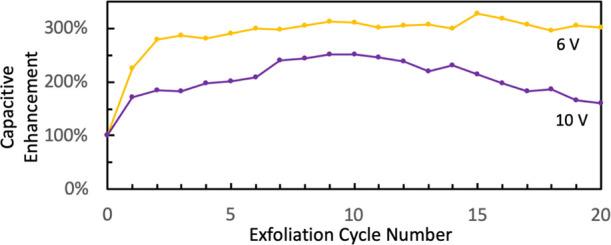
Graphene has received much attention as a supercapacitor electrode material due to its chemical inertness in preventing reaction with electrolytes and the large surface area due to its two-dimensional nature. However, when graphene sheets are processed into electrodes, they tend to stack together and form a turbostratic graphite material with a much reduced surface area relative to the total surface area of individual graphene sheets. Separately, electrochemical exfoliation of graphite is one method of producing single-layer graphene, which is often used to produce graphene for supercapacitor electrodes, although such exfoliated graphene still leads to reduced surface areas due to stacking during electrode fabrication. To utilize the large surface area of graphene, graphene must be exfoliated in situ within a supercapacitor device after the device fabrication. However, graphitic electrodes are typically destroyed upon exfoliation, which is largely due to the loss of electrical connectivity among small exfoliated graphene flakes. Here, we report successful in situ exfoliation of graphene nanostripes, a type of quasi-one-dimensional graphene nanomaterial with large length-to-width aspect ratios, as the anode material in supercapacitors. We find that the in situ exfoliation leads to over 400% enhancement in capacitance as the result of retaining the electrical connectivity among exfoliated quasi-one-dimensional graphene nanostripes in addition to increasing the total surface area, paving ways to fully realizing the benefit of graphene electrodes in supercapacitor applications.
石墨烯作为一种超级电容器电极材料受到了广泛关注,这是由于其化学惰性可防止与电解质发生反应,且因其二维性质具有较大的表面积。然而,当将石墨烯片加工成电极时,它们往往会堆叠在一起,形成一种乱层石墨材料,其表面积相对于单个石墨烯片的总表面积大幅减小。另外,石墨的电化学剥离是生产单层石墨烯的一种方法,该方法常用于生产超级电容器电极用的石墨烯,不过这种剥离后的石墨烯在电极制造过程中由于堆叠仍会导致表面积减小。为了利用石墨烯的大表面积,必须在超级电容器器件制造完成后在器件内部原位剥离石墨烯。然而,石墨电极通常在剥离时会被破坏,这主要是由于小的剥离石墨烯薄片之间失去了电连接。在此,我们报告了在超级电容器中成功地将石墨烯纳米带(一种具有大长宽比的准一维石墨烯纳米材料)原位剥离作为阳极材料。我们发现,原位剥离除了增加总表面积外,还通过保持剥离后的准一维石墨烯纳米带之间的电连接,使电容提高了400%以上,为在超级电容器应用中充分实现石墨烯电极的优势铺平了道路。



 Zotero 插件