Programa de Pós-Graduação em Ciências do Movimento Humano and Programa de Pós-Graduação em Fisioterapia, Centro de Ciências da Saúde e do Esporte, Universidade do Estado de Santa Catarina, .
Laboratório de Vibrações Mecânicas, Policlínica Piquet Carneiro, Departamento de biofísica e biometria, Instituto de Biologia Roberto Alcantara Gomes, Universidade do Estado do Rio de Janeiro, RJ, Brazil .
Acta Biomed. 2020 Nov 10;92(1):e2021027. doi: 10.23750/abm.v92i1.10803.
The goal of this study was to investigate the practice and habits of physical exercise impact due to COVID-19 social isolation before and during the outbreak in Brazil and its mains macro-regions, which have social and economic disparities.
This is an observational cross-sectional study through an online questionnaire survey. A self-administered survey (PEF-COVID19) was applied in the Brazilian general population, age ≥ 18 years. T-test for independent samples and Chi-square tests were used to compare Brazil and different macro-regions, p˂0.05.
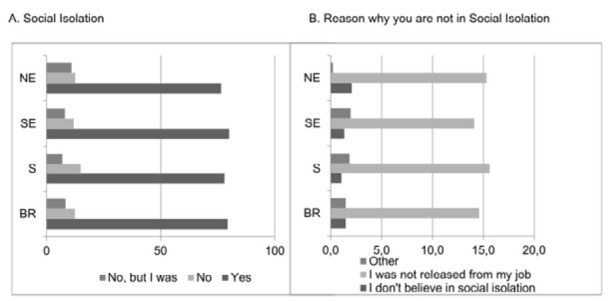
1,977 participants filled the survey and 1,845 were included; 80% of the included ones were in social isolation. In general, the self-related physical exercise practice before and during the COVID-19 pandemic and exercise characteristics were highly affected by the pandemic (p˂0.05). Sedentary behavior increased significantly (14.9 vs. 29.8%) and between the active ones, the frequency of PEx per week and duration of the PEx practice decreased significantly. The motivation to exercise also changed considering performance and health before and during the pandemic, respectively (10 vs. 5.6% and 72.4 vs. 79.1%). Also, the sample started to exercise less in the night and more in the afternoon, respectively (33.7 vs. 25.3% and 19.1 vs. 31.5%).
The COVID-19 pandemic highly influenced the physical exercise practice and habits (frequency, duration, motivation, period to exercise) in Brazil and its main macro-regions. These results can be used to create measures, as home-based exercise programs, to avoid the harm of sedentary behaviors and mental health impact during and after the pandemic.
本研究旨在调查 COVID-19 社交隔离期间巴西及其主要大区(社会经济差异较大)在疫情爆发前后,体育锻炼对个人的影响。
这是一项通过在线问卷调查进行的观察性横断面研究。在巴西普通人群(年龄≥18 岁)中应用了一份自我管理的调查问卷(PEF-COVID19)。采用独立样本 t 检验和卡方检验比较巴西和不同大区之间的差异,p<0.05。
共有 1977 名参与者填写了调查问卷,其中 1845 名被纳入研究;80%的参与者处于社交隔离状态。总体而言,在 COVID-19 大流行前后,自我相关的体育锻炼实践和运动特征受到了疫情的强烈影响(p<0.05)。久坐行为显著增加(14.9%对 29.8%),在积极运动者中,每周锻炼次数和锻炼时间明显减少。锻炼动机也发生了变化,考虑到大流行前后的表现和健康状况,分别为(10%对 5.6%和 72.4%对 79.1%)。此外,样本开始在晚上运动减少,下午运动增加(33.7%对 25.3%和 19.1%对 31.5%)。
COVID-19 大流行极大地影响了巴西及其主要大区的体育锻炼实践和习惯(频率、时长、动机、锻炼时间)。这些结果可用于制定措施,如家庭锻炼计划,以避免在疫情期间和之后久坐行为和心理健康影响造成的危害。