Romer Adrienne L, Hariri Ahmad R, Strauman Timothy J
Center for Depression, Anxiety and Stress Research, McLean Hospital/Harvard Medical School, Belmont, MA, USA.
Laboratory of NeuroGenetics, Duke University, Durham, NC, USA; Department of Psychology & Neuroscience, Duke University, Durham, NC, USA.
J Psychiatr Res. 2021 May;137:178-185. doi: 10.1016/j.jpsychires.2021.02.051. Epub 2021 Feb 27.
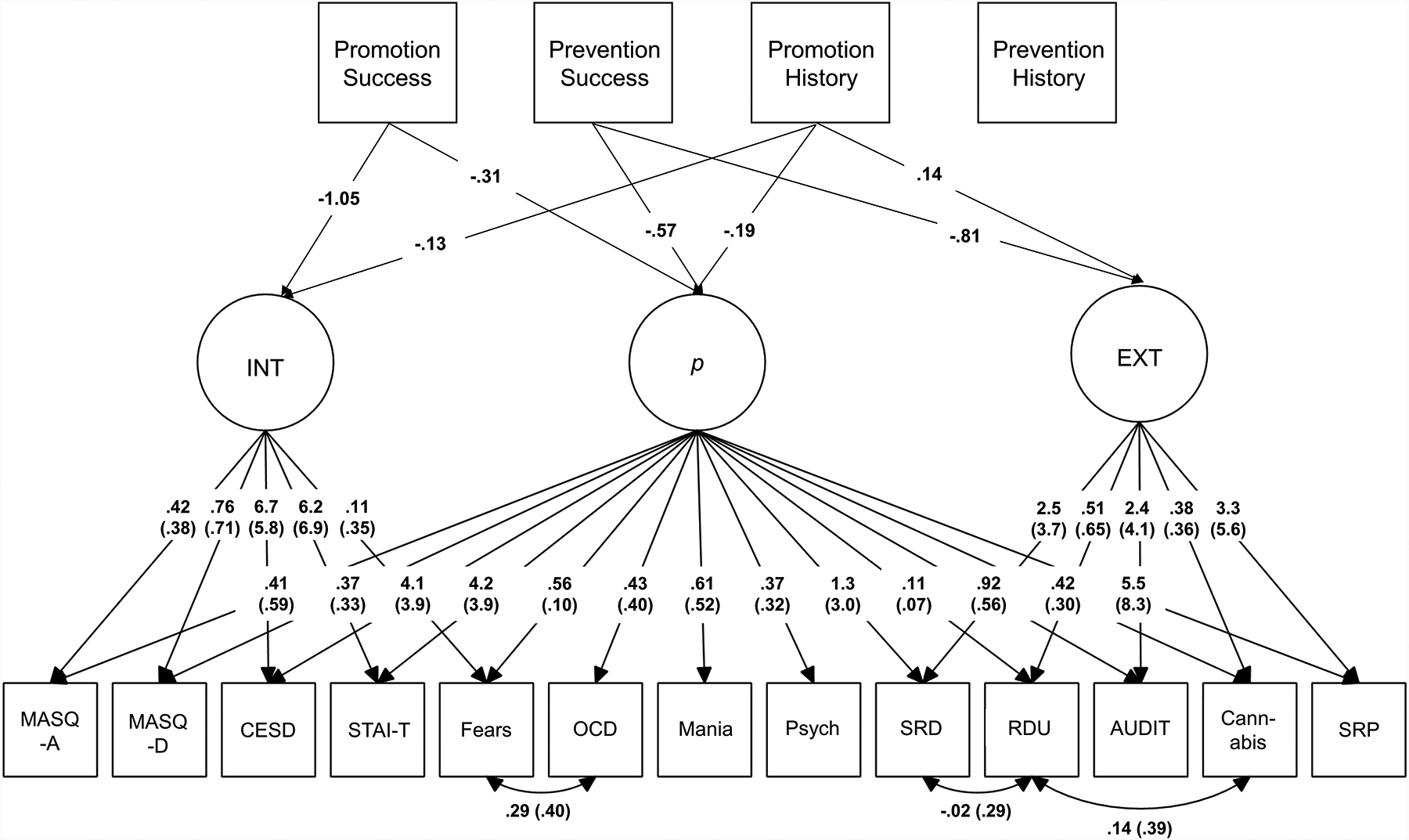
A general psychopathology ('p') factor captures transdiagnostic features of mental illness; however, the meaning of the p factor remains unclear. Regulatory focus theory postulates that individuals regulate goal pursuit either by maximizing gains (promotion) or minimizing losses (prevention). As maladaptive goal pursuit has been associated with multiple categorical disorders, we examined whether individual differences in promotion and prevention goal pursuit are associated with p as well as internalizing- and externalizing-specific factors using structural equation modeling of data from 1330 volunteers aged 18-22. Unsuccessful attainment of promotion and prevention goals was related to increased levels of p. Over and above relations with the p factor, unsuccessful attainment of promotion goals was associated with higher internalizing-specific psychopathology, whereas unsuccessful attainment of prevention goals was related to higher externalizing-specific psychopathology. These associations also were separable from related personality traits. After controlling for sex differences in the composition of the psychopathology factors, there were no sex differences in the relations between promotion and prevention goal pursuit and p and specific internalizing and externalizing factors. These findings suggest higher general psychopathology reflects poorer overall self-regulation of goal pursuit and that maladaptive promotion and prevention orientations also are associated with internalizing- and externalizing-specific psychopathology, respectively.
一个一般精神病理学(“p”)因素捕捉精神疾病的跨诊断特征;然而,p因素的含义仍不明确。调节焦点理论假定,个体通过最大化收益(促进)或最小化损失(预防)来调节目标追求。由于适应不良的目标追求与多种分类障碍有关,我们使用来自1330名18 - 22岁志愿者的数据进行结构方程建模,研究了促进和预防目标追求中的个体差异是否与p因素以及内化和外化特定因素相关。促进和预防目标的未成功实现与p水平的升高有关。除了与p因素的关系外,促进目标的未成功实现与更高的内化特定精神病理学相关,而预防目标的未成功实现与更高的外化特定精神病理学相关。这些关联也与相关人格特质可分离。在控制了精神病理学因素构成中的性别差异后,促进和预防目标追求与p以及特定内化和外化因素之间的关系不存在性别差异。这些发现表明,更高的一般精神病理学反映了目标追求的整体自我调节较差,并且适应不良的促进和预防取向也分别与内化和外化特定精神病理学相关。