Dale Elizabeth, Lee K S Kylie, Conigrave Katherine M, Conigrave James H, Ivers Rowena, Clapham Kathleen, Kelly Peter J
Illawarra Health and Medical Research Institute, School of Psychology, University of Wollongong, Wollongong, Australia.
Faculty of Medicine and Health, Discipline of Addiction Medicine, NHMRC Centre of Research Excellence in Indigenous Health and Alcohol, The University of Sydney, Sydney, Australia.
Drug Alcohol Rev. 2021 Sep;40(6):1013-1027. doi: 10.1111/dar.13264. Epub 2021 Mar 8.
SMART Recovery is a popular mutual support group program. Little is known about its suitability or perceived helpfulness for Indigenous peoples. This study explored the cultural utility of SMART Recovery in an Australian Aboriginal context.
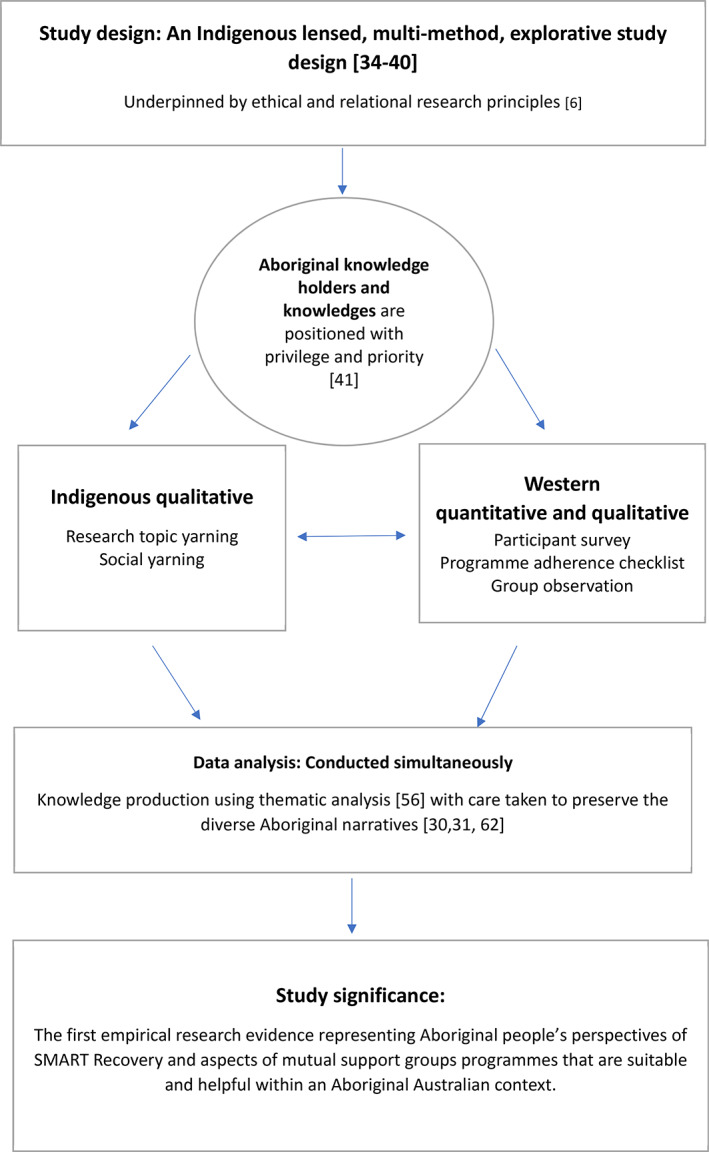
An Indigenous-lensed, multi-methods, exploratory study design was used to develop initial evidence of: (i) attributes of Aboriginal SMART Recovery facilitators and group members; (ii) characteristics of Aboriginal-led SMART Recovery groups; (iii) perceived acceptability and helpfulness of SMART Recovery; and (iv) areas for potential improvement. Data were collected by synthesising Indigenous qualitative methods (research topic and social yarning) with western qualitative and quantitative methods (participant surveys, program adherence rating scale, group observations and field notes). Data were analysed using thematic analysis.
Participants were a culturally diverse sample of male and female Aboriginal facilitators (n = 10) and group members (n = 11), aged 22-65 years. Aboriginal-led SMART Recovery groups were culturally customised to suit local contexts. Program tools 'goal setting' and 'problem solving' were viewed as the most helpful. Suggested ways SMART Recovery could enhance its cultural utility included: integration of Aboriginal perspectives into facilitator training; creation of Aboriginal-specific program and marketing materials; and greater community engagement and networking. Participants proposed an Aboriginal-specific SMART Recovery program.
This study offers insights into Aboriginal peoples' experiences of SMART Recovery. Culturally-informed modifications to the program were identified that could enhance cultural utility. Future research is needed to obtain diverse community perspectives and measure health outcomes associated with group attendance.
SMART Recovery是一个广受欢迎的互助小组项目。对于其对原住民的适用性或感知到的帮助程度,人们了解甚少。本研究探讨了SMART Recovery在澳大利亚原住民背景下的文化效用。
采用以原住民视角为导向的多方法探索性研究设计,以获取以下方面的初步证据:(i)原住民SMART Recovery促进者和小组成员的特征;(ii)由原住民主导的SMART Recovery小组的特点;(iii)对SMART Recovery的感知可接受性和帮助程度;(iv)潜在改进领域。通过将原住民定性方法(研究主题和社会交流)与西方定性和定量方法(参与者调查、项目依从性评定量表、小组观察和实地记录)相结合来收集数据。使用主题分析法对数据进行分析。
参与者包括文化背景多样的原住民促进者(n = 10)和小组成员(n = 11),年龄在22至65岁之间,有男性也有女性。由原住民主导的SMART Recovery小组在文化上进行了定制,以适应当地情况。项目工具“目标设定”和“解决问题”被认为最有帮助。提高SMART Recovery文化效用的建议方法包括:将原住民观点纳入促进者培训;制作针对原住民的项目和营销材料;以及加强社区参与和网络建设。参与者提出了一个针对原住民的SMART Recovery项目。
本研究提供了对原住民参与SMART Recovery经历的见解。确定了对该项目进行文化适应性修改的方法,这些方法可以提高文化效用。未来需要开展研究,以获取不同社区的观点,并衡量与参加小组相关的健康结果。